
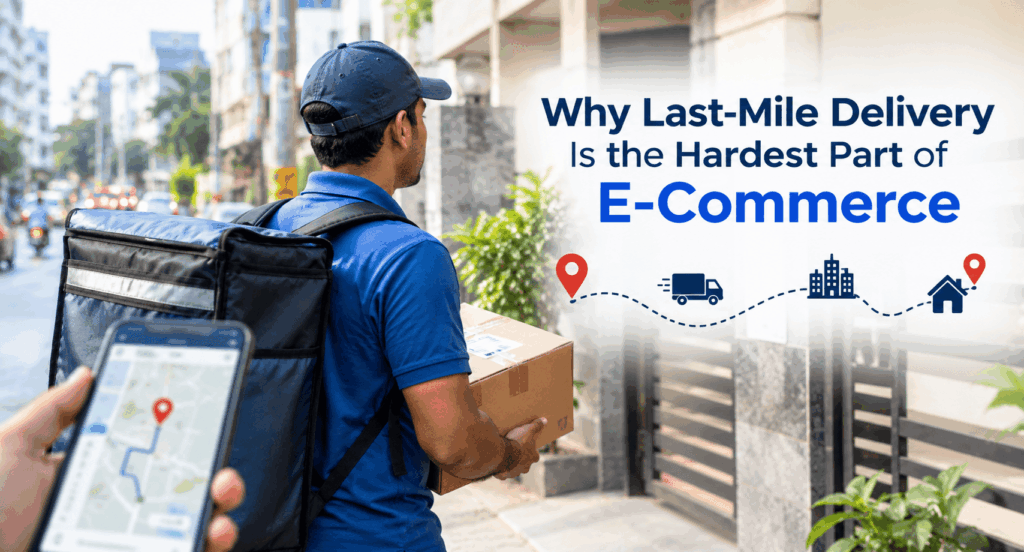
For an e-commerce business, getting a customer to place an order is only the beginning. The real challenge starts after the product leaves the warehouse or store.
A package may have been picked, packed, labelled and dispatched correctly, but it still needs to travel through busy roads, reach the correct building, find the right apartment or office, and finally reach the customer at a convenient time.
This final stage is called last-mile delivery, and it is often one of the most difficult parts of the entire e-commerce process.
For businesses serving customers in Chennai, the challenge can be even more noticeable. Traffic congestion, busy commercial areas, residential streets, apartment communities, changing weather and customers’ availability can all affect the final delivery.
Let’s look at why last-mile delivery is so difficult and what Chennai businesses can do about it.
What Is Last-Mile Delivery?
Last-mile delivery refers to the final stage of transporting an order from a local fulfilment point, warehouse, store or distribution centre to the customer’s doorstep.
For example, imagine a customer in Velachery orders a product from a local business.
The order may go through this process:
Customer places order → Business processes order → Product is packed → Parcel is dispatched → Local delivery executive collects it → Parcel travels through Chennai → Customer receives the order
The final journey from the local delivery point to the customer’s address is the last mile.
Interestingly, the “last mile” does not necessarily mean one literal mile. It simply describes the final portion of the delivery journey.
Why Is the Last Mile So Difficult?
1. Chennai Traffic Can Change the Delivery Time
One of the biggest challenges for local deliveries is road congestion.
A route that takes 20 minutes during a quieter period may take considerably longer during peak traffic.
Areas around T. Nagar, Guindy, Anna Nagar, Velachery, OMR and other busy parts of Chennai can experience very different traffic conditions depending on the time of day.
This creates a problem for businesses trying to provide accurate delivery estimates.
A business may know where the customer is, but predicting exactly how long the journey will take can still be difficult.
2. Every Customer Has a Different Address
A warehouse has a relatively predictable environment. A customer’s doorstep does not.
One delivery could be to an independent house. Another could be to a large apartment complex. Another might be an office building, shop or gated community.
The delivery executive may need to find:
- The correct street
- The correct building
- The correct entrance
- The security gate
- The apartment block
- The customer’s floor
- The customer’s exact location
Even when the address is technically correct, unclear delivery instructions can create delays.
3. Customers May Not Be Available
Imagine ordering something online and receiving a message saying:
“Your delivery executive is arriving soon.”
But you’re not at home.
The delivery executive arrives, calls the customer and waits. If the customer cannot receive the package, the delivery may need to be attempted again.
This creates additional travel, time and operational costs.
For businesses, a successful first delivery is much more efficient than repeatedly sending a parcel to the same address.
4. Small Delays Can Become Expensive
A five-minute delay might not sound significant.
But consider a delivery executive handling 15 or 20 orders in a day.
If several deliveries experience small delays because of:
- Difficult addresses
- Customer unavailability
- Traffic
- Waiting at security gates
- Incorrect phone numbers
- Payment issues
those minutes can add up quickly.
The result can be fewer deliveries completed per executive and higher delivery costs for the business.
5. Delivery Expectations Are Getting Higher
Customers have become accustomed to seeing delivery estimates while shopping online.
They may expect:
- Same-day delivery
- Next-day delivery
- Scheduled delivery
- Live tracking
- Delivery notifications
- Easy communication with the delivery executive
This creates pressure on e-commerce businesses.
Customers generally don’t see the operational problems happening behind the scenes. They simply know that their order is expected at a particular time.
That makes the last mile a critical part of the customer experience.
6. Chennai’s Weather Can Affect Deliveries
Weather is another factor businesses need to consider.
During heavy rainfall, roads can become difficult to navigate and traffic conditions can change quickly. Delivery executives may also need additional protection for packages.
For businesses delivering electronics, documents, clothing, food products and other sensitive items, proper packaging becomes especially important.
A fast delivery isn’t useful if the product arrives damaged or wet.
7. Returns Make the Last Mile Even More Complicated
Last-mile logistics isn’t only about delivering products.
Sometimes the customer wants to return them.
Now the delivery network needs to handle the reverse movement:
Customer → Delivery executive → Local collection point → Business or warehouse
This is known as reverse logistics.
For e-commerce businesses, efficient return collection can be just as important as the original delivery.
Why Last-Mile Delivery Matters to Chennai Businesses
For a small or medium-sized Chennai business, delivery can directly influence repeat purchases.
Suppose two businesses sell similar products at similar prices.
One provides:
- Clear delivery updates
- Reliable delivery times
- Professional delivery handling
- Easy communication
The other frequently has delayed deliveries and poor communication.
The product may be similar, but the customer experience is very different.
This is why local delivery should not be treated as an afterthought.
Delivery is part of the product experience.
How Businesses Can Improve Last-Mile Delivery
Plan Delivery Zones
Instead of treating every order separately, businesses can organize customers into geographic zones.
For example:
Zone 1: T. Nagar, Saidapet, Guindy
Zone 2: Adyar, Besant Nagar, Thiruvanmiyur
Zone 3: Anna Nagar, Kilpauk, Mogappair
The actual zones should depend on where the business operates and where its customers are located.
Zone-based planning can make it easier to organize deliveries efficiently.
Use Appropriate Delivery Vehicles
A small parcel doesn’t necessarily need a large vehicle.
Two-wheelers can be practical for many local deliveries because they can navigate urban roads more easily, while larger vehicles may be more suitable for bulk or oversized shipments.
Choosing the right vehicle for each delivery can help businesses manage time and operating costs.
Improve Address Collection
Businesses should encourage customers to provide complete delivery information.
A useful address form can include:
- Door number
- Street
- Area
- City
- PIN code
- Landmark
- Apartment or building name
- Contact number
- Additional delivery instructions
These small details can save valuable time at the doorstep.
Give Customers Delivery Updates
Communication can reduce uncertainty.
Customers should ideally know when their order has been:
Confirmed → Packed → Dispatched → Out for delivery → Delivered
For local businesses, even a simple SMS or WhatsApp update can make the delivery experience more transparent.
Work With a Local Delivery Partner
Maintaining an entire delivery operation internally isn’t always practical for a growing business.
A business may need to manage drivers, vehicles, fuel, maintenance, route planning, delivery tracking and customer communication.
Working with a local delivery service can allow the business to concentrate more on selling and serving customers while getting support with the last-mile operation.
For Chennai businesses looking to organize local deliveries, Kourierly.com can be part of that solution, particularly for businesses that need a more structured way to handle local delivery requirements.
The Future of Last-Mile Delivery
Last-mile delivery is becoming increasingly connected to technology.
Businesses can now use digital tools for:
- Order management
- Route planning
- Delivery tracking
- Driver coordination
- Customer notifications
- Delivery confirmation
- Performance monitoring
Over time, better use of data can help businesses understand which areas generate the most orders, which delivery periods create delays and where additional delivery capacity may be required.
The goal isn’t simply to make every delivery extremely fast.
The goal is to make deliveries predictable, efficient and convenient.