
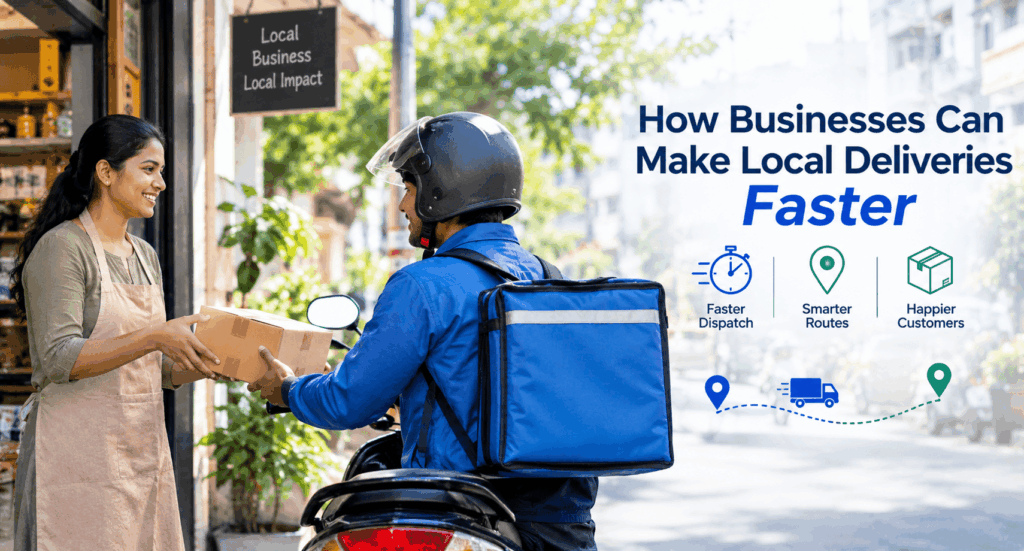
For businesses in Chennai, delivery speed has become an important part of customer experience. Whether you run a bakery in Anna Nagar, a boutique in T. Nagar, a pharmacy in Adyar, an electronics store in Velachery, or an online business serving customers across the city, customers increasingly expect their orders to reach them quickly and safely.
But making local deliveries faster is not simply about asking delivery executives to drive faster. Chennai’s traffic, peak-hour congestion, weather conditions, narrow streets, and long distances between some commercial and residential areas can all affect delivery times. The real solution is to improve the entire delivery process, from receiving an order to handing it over to the customer.
Recent logistics discussions around Chennai highlight the importance of improving urban last-mile delivery, particularly for small and medium-sized businesses.
Here are practical ways Chennai businesses can make local deliveries faster.
1. Keep Your Delivery Area Clearly Defined
One of the simplest ways to improve delivery speed is to understand exactly where you can deliver efficiently.
Instead of accepting every order without considering distance, divide Chennai into practical delivery zones.
For example, a business could organize deliveries around areas such as:
- T. Nagar
- Mylapore
- Adyar
- Velachery
- Anna Nagar
- Guindy
- Porur
- Tambaram
- Ambattur
- OMR
The exact zones will depend on your business location.
A smaller delivery radius can often make same-day and scheduled delivery easier because drivers spend less time travelling between distant areas.
2. Choose the Right Delivery Vehicle
Not every delivery requires a large vehicle.
For small parcels, documents, food products, medicines, clothing and other lightweight items, two-wheelers can be practical for navigating busy urban roads.
Larger vehicles may be appropriate for bulk shipments, fragile equipment or multiple packages going to the same destination.
Chennai’s urban environment makes vehicle selection particularly important. Research on Chennai’s last-mile logistics has pointed to the difficulties created by congestion and dense urban streets, especially for MSMEs.
The objective should not simply be choosing the fastest vehicle. It should be choosing the most suitable vehicle for the delivery.
3. Plan Routes Before the Driver Leaves
A common mistake is assigning deliveries one by one without considering the complete route.
Suppose you have five orders in different parts of Chennai. Sending the driver from one side of the city to another and then back again can waste valuable time.
Instead, group deliveries geographically.
For example:
Morning: Anna Nagar → Kilpauk → Egmore
Afternoon: Guindy → Saidapet → T. Nagar
Evening: Adyar → Besant Nagar → Velachery
The actual route should always depend on current traffic and delivery addresses, but the basic principle remains the same: reduce unnecessary travel.
Route planning and real-time dispatch are increasingly important components of modern hyperlocal delivery systems.
4. Set a Clear Order Cut-Off Time
Customers need to know when an order qualifies for same-day delivery.
For example, a business might establish:
- Orders before 11 AM: same-day delivery
- Orders after 11 AM: next available delivery slot
- Urgent orders: priority delivery where available
There is no universal cut-off time that works for every Chennai business. It depends on your location, staff, inventory, packaging process and delivery capacity.
What matters is having a realistic system.
A clear cut-off gives your team enough time to confirm inventory, pack the order, assign a delivery executive and complete dispatch. Order processing and dispatch time can have a significant impact on the final delivery window.
5. Keep Products Ready for Dispatch
Sometimes the delivery driver is ready, but the package isn’t.
This happens when employees are still:
- Searching for products
- Preparing invoices
- Packing orders
- Printing labels
- Confirming addresses
- Waiting for payment confirmation
If you want faster deliveries, your internal order-processing system also needs to be fast.
For frequently ordered products, businesses can prepare packaging materials in advance and organize inventory so employees can find products quickly.
Fast delivery starts inside the business, not on the road.
6. Use Accurate Customer Addresses
An incomplete address can turn a 20-minute delivery into a much longer trip.
In Chennai, customers may provide an address with an apartment name, street name, landmark or local reference that is more useful than a basic postal address.
Encourage customers to provide:
- Full address
- Building or apartment name
- Door number
- Area
- PIN code
- Nearby landmark
- Contact number
- Delivery instructions
For apartment complexes and commercial buildings, asking for the exact entrance or floor can also reduce delays.
7. Communicate With Customers
A delivery executive should not have to repeatedly call a customer simply to find the location.
Send customers a message when:
- The order is confirmed.
- The package is dispatched.
- The delivery executive is on the way.
- The package has been delivered.
Real-time tracking can make this process even easier. Modern hyperlocal delivery platforms increasingly use GPS tracking and digital dispatch systems to improve visibility for businesses and customers.
Good communication also reduces missed deliveries.
8. Prepare for Chennai’s Peak Traffic and Weather
Chennai businesses know that delivery conditions can change significantly during peak traffic hours or heavy rain.
A delivery plan that works perfectly at 10 AM may not work the same way during evening peak hours.
Businesses should therefore avoid promising extremely narrow delivery windows unless they have enough operational control to meet them.
During heavy rain, packaging also becomes important. Waterproof outer packaging and proper protection for electronics, documents, clothing and food products can prevent delivery problems.
9. Consider a Local Delivery Partner
Building an in-house delivery team can be expensive for smaller businesses.
You may need to manage:
- Delivery executives
- Vehicles
- Fuel
- Maintenance
- Route planning
- Tracking
- Customer calls
- Replacement staff
- Peak-hour capacity
A local delivery partner can allow businesses to focus on their core operations while outsourcing the last-mile component.
For businesses handling frequent local orders, platforms such as Kourierly.com can be considered as part of a broader local delivery strategy, helping businesses think about delivery as an organized operational process rather than simply sending a driver whenever an order arrives.
10. Measure Delivery Performance
If you want deliveries to become faster, measure them.
Track metrics such as:
| Metric | What It Tells You |
|---|---|
| Order processing time | How quickly an order becomes ready |
| Dispatch time | How long it takes to assign and send an order |
| Delivery time | How long the actual trip takes |
| First-attempt delivery rate | How often deliveries succeed without another attempt |
| Delayed deliveries | Where your process is breaking down |
| Customer complaints | What customers experience |
After a few weeks, patterns usually become easier to identify.
Perhaps deliveries to one area are consistently delayed. Maybe orders received after a certain time are difficult to complete the same day. Or perhaps packing takes longer than transportation.
Once you identify the bottleneck, you can work on the specific problem instead of simply telling drivers to deliver faster.
Faster Local Delivery Is About Better Planning
For Chennai businesses, faster delivery doesn’t necessarily mean driving faster.
It means planning better.
A business that combines accurate inventory, organized packing, sensible delivery zones, appropriate vehicles, route planning, clear customer communication and reliable delivery support can significantly improve the customer experience.
Hyperlocal delivery is becoming increasingly important in India’s urban commerce ecosystem, with businesses using local fulfilment points, delivery networks and routing technology to shorten the distance between sellers and customers.
For a small business owner in Chennai, the goal should be simple: get the right product to the right customer at the right time, without unnecessary delays.
That is where a structured local delivery solution such as Kourierly.com can fit into a business’s delivery strategy. Instead of treating every delivery as a separate task, businesses can build a repeatable process designed around speed, visibility and customer convenience.
In a competitive Chennai market, that difference can matter. Customers may remember the product they purchased, but they also remember whether the delivery experience was smooth, predictable and convenient.