
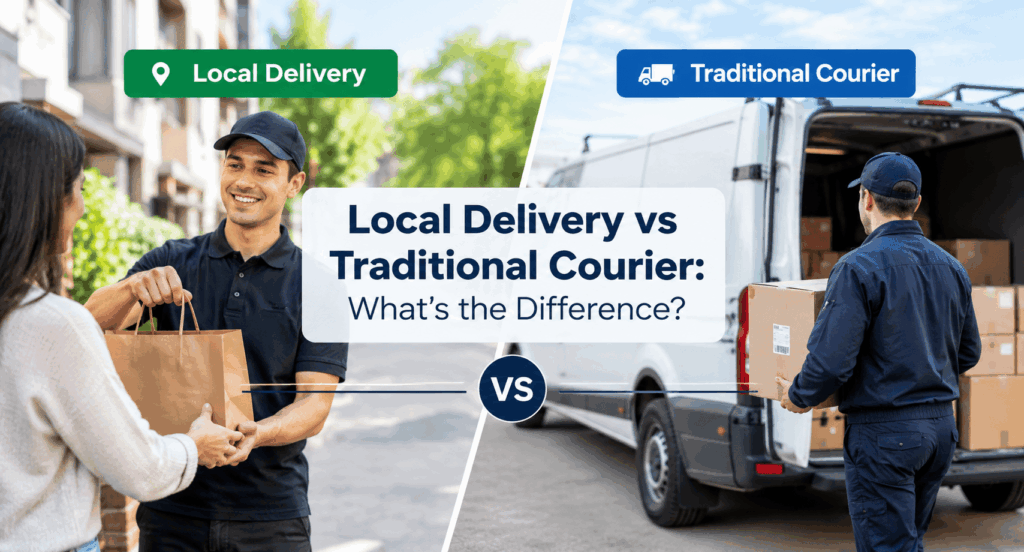
For a small business in Chennai, getting a product from the shop to the customer can be just as important as making the sale.
A customer may find a product on Instagram, place an order through WhatsApp, or call a neighbourhood shop directly. Once the order is confirmed, the next question is simple: How will the product reach the customer?
This is where businesses often consider two different options: local delivery and traditional courier services.
Although both involve moving packages from one location to another, they are designed for different delivery needs.
Understanding the difference can help Chennai businesses choose the right option for their customers and day-to-day operations.
What Is Local Delivery?
Local delivery is designed to move products within a limited geographical area, typically within the same city or nearby neighbourhoods.
For a Chennai business, a local delivery could involve moving an order from:
- T. Nagar to Adyar
- Anna Nagar to Kilpauk
- Velachery to Perungudi
- Mylapore to Besant Nagar
- Tambaram to nearby areas
The focus is usually on short-distance, last-mile delivery.
A local business can receive an order, prepare the package, and arrange for a delivery partner to collect it and take it directly to the customer.
This model is particularly useful when the customer wants the product relatively soon.
What Is a Traditional Courier Service?
Traditional courier services are generally designed for sending parcels and documents between different locations, including different cities, states, and sometimes countries.
For example, a Chennai business may use a courier service to send a package to:
- Bengaluru
- Hyderabad
- Mumbai
- Delhi
- Coimbatore
- Madurai
Traditional courier networks typically operate through collection points, sorting facilities, transportation networks, and delivery centres.
This makes them useful for businesses that need to ship products over longer distances.
The Main Difference: Distance and Delivery Purpose
The simplest way to understand the difference is to look at the delivery requirement.
Local delivery focuses on nearby customers and last-mile convenience.
Traditional courier services focus more broadly on parcel transportation across locations.
Neither option is universally suitable for every order.
A Chennai boutique sending a dress to a customer in Nungambakkam may have a very different delivery requirement from the same boutique sending a package to a customer in Mumbai.
The first is a local delivery situation.
The second is a traditional courier shipment.
Local Delivery Can Be More Suitable for Same-City Orders
Suppose a customer orders a product from a shop in Chennai and lives only a few kilometres away.
The customer may not want to wait several days for the product to move through a conventional courier network.
Local delivery can provide a more direct approach.
The shop prepares the order, a delivery partner collects it, and the package is taken to the customer’s address within the local delivery area.
For time-sensitive local orders, this can make the shopping experience more convenient.
Traditional Courier Services Are Useful for Long-Distance Shipping
Traditional couriers continue to play an important role for businesses.
If a Chennai business regularly ships products to customers throughout Tamil Nadu, across India, or internationally, a conventional courier network can provide the infrastructure required for those longer journeys.
For example, an online seller in Chennai may receive an order from Pune.
A local delivery service is not designed for that journey.
A traditional courier service may be the appropriate solution because the package needs to travel between cities.
Local Delivery Can Offer More Flexibility
Small businesses often receive orders that do not fit into a fixed shipping schedule.
A customer might call in the morning and ask:
“Can you deliver this to my office today?”
For a local business, being able to arrange a nearby delivery can provide useful flexibility.
This is especially relevant for businesses such as:
- Bakeries
- Flower shops
- Boutiques
- Grocery stores
- Pharmacies
- Gift shops
- Electronics stores
- Home-based businesses
The business can handle the order based on the customer’s location and delivery requirement.
Traditional Courier Services Follow a Different Process
A traditional courier shipment usually follows a more structured network.
The package may be collected, processed at a facility, transported to another location, sorted again, and eventually delivered.
That network is what makes nationwide and international shipping possible.
However, for a short-distance delivery within Chennai, a multi-stage network may not always be necessary.
When the customer and business are in the same city, direct local delivery can be a more natural fit.
Communication Can Be Different
Local delivery can also provide a more direct communication experience.
A small business may communicate with its customer through WhatsApp or phone and provide information about the delivery.
For example:
“Your order has been picked up and is on the way.”
This type of communication can feel particularly useful for local customers who have arranged a same-day or scheduled delivery.
Traditional courier services also provide tracking and shipment updates, but the overall process is generally designed around a larger delivery network.
Which Businesses Can Benefit From Local Delivery?
Local delivery is particularly useful for businesses that serve customers within their own city.
Neighbourhood Retailers
Local shops can accept orders remotely and deliver products to nearby customers.
Restaurants and Food Businesses
Businesses handling prepared food or other time-sensitive products often require delivery within a defined local area.
Bakeries
Cakes and other fresh products can benefit from planned local delivery.
Boutiques
Customers can order clothing and accessories through social media or messaging platforms and arrange delivery.
Florists
Flowers are often purchased for specific occasions, making timing an important consideration.
Home Businesses
Home bakers, handmade-product sellers, and small Instagram businesses can use local delivery without maintaining a dedicated delivery team.
When Should a Business Use Traditional Courier Services?
Traditional courier services can be useful when:
- The customer is outside the local delivery area
- The shipment needs to travel to another city
- The business ships across India
- International delivery is required
- The package needs to enter a larger logistics network
For example, a Chennai business shipping an order to Coimbatore or Delhi may choose a courier service designed for intercity transportation.
The important point is that businesses don’t necessarily have to choose one method for every order.
They can use different delivery options depending on where the customer is located.
Local Delivery and E-Commerce
The growth of social commerce and small online businesses has made local delivery increasingly relevant.
A business doesn’t need to operate a large e-commerce website to receive online orders.
Many Chennai sellers now use Instagram, WhatsApp, Facebook, or simple websites to showcase products.
A customer sees the product, sends an enquiry, confirms the order, and asks for delivery.
If that customer is located nearby, local delivery can complete the transaction.
This creates a simple connection between digital discovery and physical delivery.
Cost Is Another Consideration
Delivery cost depends on several factors, including distance, package size, service level, timing, and the delivery provider.
For short-distance orders, businesses may want a delivery option designed specifically for local movement rather than paying for a broader shipping network.
At the same time, businesses should compare actual service terms rather than assuming that one method will always be cheaper.
The right choice depends on the type of order, customer expectations, and delivery distance.
Local Delivery Can Strengthen the Customer Relationship
For a small Chennai business, delivery is not just a logistics task.
It can become part of the customer experience.
A customer who orders from a familiar local shop may appreciate being able to receive the product without travelling to the store.
The business can maintain its personal relationship with the customer while adding the convenience of doorstep service.
This can be particularly valuable for neighbourhood businesses competing in an increasingly digital marketplace.
How Kourierly Fits Into Local Delivery
For businesses that regularly serve customers within Chennai, having access to dependable local delivery support can simplify operations.
Kourierly.com is focused on helping businesses with local delivery needs, making it easier to connect orders from businesses with customers who need products delivered locally.
Instead of requiring business owners or employees to spend their working hours travelling around the city, businesses can use delivery support to handle the last-mile part of the order.
For Chennai retailers, restaurants, home businesses, boutiques, and online sellers, this can provide another way to offer customers a convenient doorstep experience.
Local Delivery vs Traditional Courier: A Simple Comparison
| Feature | Local Delivery | Traditional Courier |
|---|---|---|
| Main purpose | Same-city or nearby delivery | Intercity, nationwide, or international shipping |
| Delivery area | Local | Broad |
| Typical use | Last-mile orders | Parcel transportation |
| Best suited for | Local businesses and nearby customers | Businesses shipping to distant locations |
| Delivery model | Often more direct | Usually network-based |
| Common examples | Shop to nearby customer | Chennai to Mumbai |
| Customer interaction | Often direct and local | Usually managed through courier systems |
Can a Business Use Both?
Absolutely.
A growing business may use local delivery for Chennai customers and traditional courier services for customers elsewhere.
For example, imagine a boutique based in Chennai.
A customer in Adyar places an order. The boutique can arrange local delivery.
Another customer in Bengaluru places an order. The boutique can use a traditional courier service.
The business doesn’t need to force every order into the same delivery model.
Instead, it can choose the method that matches the customer’s location and the nature of the order.