
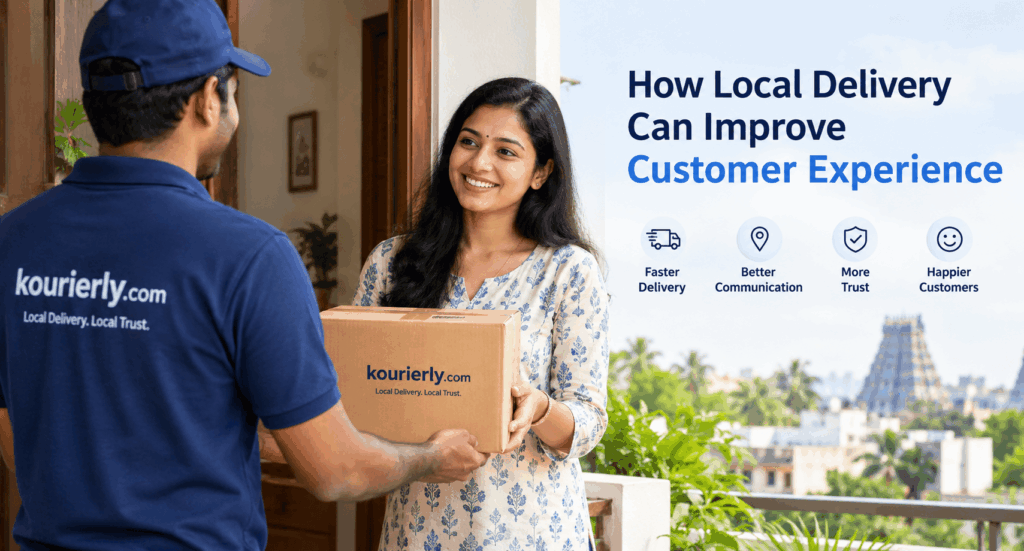
For businesses in Chennai, customer experience does not end when a customer places an order. It continues until the product reaches their doorstep safely, on time, and with clear communication.
Whether it is a saree shop in T. Nagar, a bakery in Anna Nagar, a pharmacy in Velachery, a boutique in Adyar, or an online business serving customers across Chennai, local delivery can become an important part of the customer experience.
Today, customers are becoming increasingly comfortable with fast and convenient delivery. Major e-commerce and quick-commerce services have also raised expectations around delivery speed in Chennai and other Indian cities.
For local businesses, this creates an opportunity: instead of treating delivery as simply a transportation expense, businesses can use it as a way to build trust, convenience, and long-term customer relationships.
What Is Local Delivery?
Local delivery refers to delivering products, documents, food, gifts, medicines, or other items within a specific nearby area or city.
For a Chennai business, this could mean delivering an order from:
- T. Nagar to Adyar
- Anna Nagar to Kilpauk
- Velachery to Medavakkam
- Tambaram to Pallavaram
- Porur to Vadapalani
- OMR to Sholinganallur
- Ambattur to Avadi
The main advantage is proximity. Instead of sending every order through a long-distance courier network, businesses can use local delivery options for customers who are nearby.
Depending on the business and delivery model, local delivery may include same-day, scheduled, or on-demand delivery.
Why Delivery Has Become Part of Customer Experience
Imagine a customer purchases a product from your business.
The product may be excellent.
The price may be reasonable.
Your website may look professional.
But if the customer has to wait several days without knowing where the order is, their overall impression can still become negative.
On the other hand, a smooth delivery experience can make the customer feel that the business is reliable and professional.
Research and industry reporting in India increasingly point toward speed, convenience, communication, and reliability becoming important parts of the online shopping experience. YouGov’s 2025 research, for example, examined delivery speed and tracking expectations among urban Indian online shoppers.
So, delivery is not just the final step of an order. It is part of the customer’s relationship with your brand.
1. Faster Delivery Creates Greater Convenience
One of the biggest benefits of local delivery is speed.
When the customer and business are located within the same city, the delivery journey can be much shorter than an interstate shipment.
For example, a customer in Chennai may order a product from a local boutique in the morning and want it for an event that evening.
Traditional shipping may not be suitable for such situations.
A local delivery service can help businesses offer options such as:
- Same-day delivery
- Scheduled delivery
- Express delivery
- On-demand delivery
- Local document delivery
- Business-to-business delivery
This is particularly useful for urgent purchases, gifts, documents, replacement products, and time-sensitive orders.
Industry research also shows that Indian commerce is moving toward faster delivery models, with rapid commerce increasingly focusing on delivery within a few hours rather than traditional multi-day fulfilment.
2. Customers Get Better Delivery Visibility
Speed is important, but customers also want to know what is happening with their order.
Think about the difference between:
“Your order has been shipped.”
and:
“Your order has been picked up and is expected to arrive today.”
The second message gives the customer more confidence.
Good local delivery operations can provide better communication through:
- Pickup notifications
- Delivery status updates
- Estimated delivery times
- WhatsApp or SMS notifications
- Delivery confirmation
- Proof of delivery
This reduces the uncertainty customers often experience after placing an order.
For Chennai businesses, where traffic conditions can vary considerably throughout the day, communication becomes especially useful. If a delivery is delayed, informing the customer is usually better than leaving them wondering when the parcel will arrive.
3. Local Delivery Can Build Trust
Trust is one of the most valuable assets for a local business.
A customer who receives an order safely and on time is more likely to feel confident about purchasing again.
This is especially important for small and medium-sized businesses.
For example, consider a Chennai customer buying from a small Instagram-based clothing business for the first time.
They may not know the company personally.
A professional delivery experience can reinforce the impression that the business is genuine, organised, and customer-focused.
Over time, consistent delivery performance can contribute to:
Order → Good delivery → Customer satisfaction → Repeat purchase → Recommendation
That cycle can be extremely valuable for local businesses.
4. Same-Day Delivery Can Help Local Businesses Compete
Large e-commerce companies have changed customer expectations around delivery.
Customers can increasingly find products with same-day or faster delivery options. Amazon reported that more than 55 crore products were delivered same or next day to Prime members in India during 2025, illustrating the scale of fast fulfilment expectations in the market.
A small Chennai business does not necessarily need to compete with a massive e-commerce company on every aspect.
Instead, it can use its local advantage.
A local store already has something large national businesses may not have: proximity to its customers.
For example:
Local store:
Customer orders at 10 AM → product dispatched locally → delivery later that day.
Traditional long-distance model:
Customer orders → parcel enters a larger logistics network → sorting → transportation → last-mile delivery.
For suitable products and service areas, local fulfilment can provide a more convenient experience.
5. It Can Make Urgent Deliveries Easier
Not every delivery can wait until tomorrow.
Chennai businesses frequently deal with time-sensitive requirements.
For example:
- A company needs an important document delivered to another office.
- A customer forgets an item and needs it sent across the city.
- A boutique needs to send an outfit before an event.
- A business needs a spare part quickly.
- A gift needs to reach someone on the same day.
- A local seller needs to deliver an online order to a nearby customer.
In these situations, customers are not necessarily looking for the cheapest shipping option.
They are looking for reliability and convenience.
A local delivery partner can help businesses serve these requirements more effectively.
6. Better Delivery Can Improve Repeat Purchases
Customer retention is not only about the product.
It is about the complete experience.
Consider two customers who purchase the same product from two different businesses.
Business A
- Order confirmation is quick
- Delivery is completed on time
- Customer receives updates
- Package arrives safely
Business B
- Order confirmation is delayed
- Customer receives little information
- Delivery date keeps changing
- Customer has to contact support
Even if both businesses sell similar products, the first experience can feel considerably smoother.
A positive delivery experience can therefore support customer satisfaction and encourage customers to return.
7. Local Delivery Can Strengthen Chennai-Based E-commerce
Many traditional Chennai businesses are now exploring online sales through:
- Websites
- Marketplaces
- Google Business Profiles
But selling online is only one part of the process.
The business also needs to fulfil the order.
This is where local delivery becomes important.
A saree shop in T. Nagar, for example, can sell products through Instagram and deliver them to customers within Chennai.
A bakery can accept online orders and arrange local doorstep delivery.
A boutique can accept WhatsApp orders and deliver to nearby customers.
A home business can expand beyond its immediate neighbourhood without immediately building a large logistics operation.
This makes local delivery particularly useful for Chennai’s growing small-business and D2C ecosystem.
8. Local Delivery Can Support Better Customer Service
Delivery and customer service are closely connected.
When a customer contacts a business asking:
“Where is my order?”
the business needs accurate delivery information to respond.
A structured local delivery process can make it easier to answer questions such as:
- Has the parcel been picked up?
- Where is it currently?
- When will it arrive?
- Has the customer received it?
- Was delivery attempted?
- Was there any issue at the destination?
This reduces unnecessary communication between the customer, seller, and delivery team.
Good logistics can therefore make the entire customer service process smoother.
9. Chennai Businesses Need Reliable Local Delivery
Chennai is a large and busy city with customers spread across different neighbourhoods and business zones.
Delivery routes can involve:
- Heavy traffic
- Peak-hour congestion
- Long distances between suburbs
- Apartment access
- Office delivery restrictions
- Customer availability issues
- Weather-related delays
Because of these factors, simply promising “fast delivery” is not enough.
Businesses need a delivery process that balances speed, reliability, communication, and customer convenience.
A successful local delivery experience should not only ask:
“How quickly can we deliver?”
It should also ask:
“Can we deliver when we promised?”
That difference matters.
10. How Kourierly Can Help Businesses Focus on Their Customers
For businesses looking to improve their local delivery experience, Kourierly can be part of a local-first delivery strategy.
Instead of businesses spending their valuable time coordinating every local delivery themselves, a dedicated delivery solution can help simplify the process.
For a Chennai business, the goal should be straightforward:
Sell the product → Prepare the order → Arrange delivery → Keep the customer informed → Complete the delivery smoothly.
The easier this process becomes, the more time the business can spend on products, marketing, sales, and customer relationships.
How Businesses Can Improve Their Local Delivery Experience
Simply offering local delivery is not enough. Businesses should also pay attention to the quality of the service.
1. Give realistic delivery times
Do not promise 30 minutes if the business cannot consistently achieve it.
A realistic delivery window is better than an unrealistic promise.
2. Keep customers informed
Send updates when the order is:
- Confirmed
- Ready
- Picked up
- Out for delivery
- Delivered
3. Make delivery charges clear
Customers should know the delivery fee before completing their order.
4. Confirm the delivery address
A small address mistake can result in major delays.
Confirm important details such as:
- Door number
- Street
- Area
- Pincode
- Landmark
- Contact number
5. Provide proof of delivery
For business documents and higher-value products, delivery confirmation can provide additional confidence.
6. Handle failed deliveries professionally
If the customer is unavailable, the business should have a clear process for contacting the customer and arranging another attempt when appropriate.
Local Delivery Is More Than Moving a Parcel
For many businesses, delivery is still considered an operational activity.
But customers experience it differently.
They see the delivery as part of their interaction with the brand.
If the delivery is:
Fast + Reliable + Transparent + Convenient
the customer may remember the business positively.
If the delivery is:
Late + Unclear + Difficult + Poorly communicated
the customer may associate that experience with the brand itself.
That is why businesses should think of delivery as a customer experience channel, not simply a logistics function.
The Future of Local Delivery in Chennai
The growth of e-commerce, social commerce, D2C brands, and quick commerce is changing what customers expect from businesses.
Chennai has already seen expansion of rapid-delivery services, including Flipkart Minutes, which launched across multiple areas of the city with micro-fulfilment centres designed to support hyperlocal delivery.
This does not mean every business needs to offer 10-minute delivery.
Instead, businesses should identify what their customers actually need.
For one business, it may be same-day delivery.
For another, it may be scheduled delivery.
For a B2B company, it may be reliable document or parcel delivery.
For a boutique, it may be evening delivery.
The right delivery model depends on the product, customer, location, and business model.