
For a manufacturing company, electricity is more than a utility bill. It is part of the cost of producing every product that leaves the factory.
For factories in Chennai and the surrounding industrial belt, including Sriperumbudur, Oragadam, Ambattur, Maraimalai Nagar, Poonamallee, Gummidipoondi and other manufacturing clusters, electricity costs can become a significant operating expense.
This is why many factory owners are looking beyond traditional grid power and rooftop solar. One model that has received considerable attention is group captive renewable power.
The concept can sound complicated when explained through electricity regulations, open-access terminology and ownership structures. But the basic idea is actually quite straightforward.
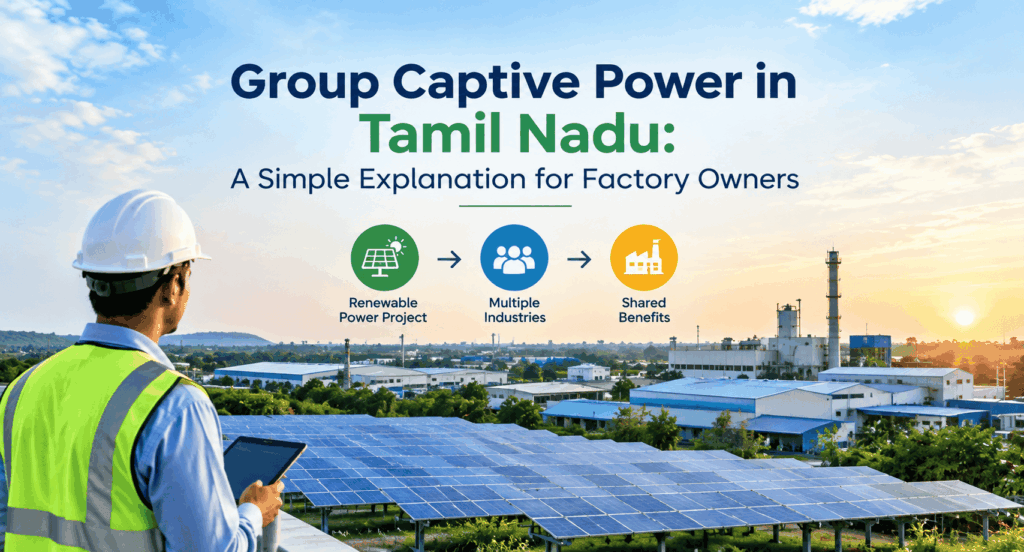
Several electricity-consuming businesses participate in the ownership of a renewable power project, usually a large solar project. The project generates electricity, and the participating businesses consume the electricity through the applicable open-access framework.
In simple terms, instead of every factory building its own large solar plant, several businesses can participate together in a larger renewable-energy project.
However, group captive power is not simply a way to buy cheaper solar electricity. There are ownership requirements, consumption requirements, open-access charges, scheduling considerations, contracts and compliance responsibilities.
For a factory owner, understanding these details before making a long-term commitment is extremely important.
What Is Group Captive Power?
Let’s start with the simplest explanation.
Imagine five manufacturing companies in Tamil Nadu.
Each factory needs a large amount of electricity, but not every factory has enough suitable rooftop space to install a solar plant that can meet a meaningful share of its consumption.
Instead of building five separate plants, the companies participate in a larger renewable-energy project.
The participating companies become captive users of the project under the applicable rules. They hold the required ownership interest and consume the required amount of electricity generated by the plant.
The electricity can then be supplied to their factories through the applicable open-access mechanism.
That structure is broadly known as group captive power.
For renewable projects, the model is particularly relevant to industrial consumers that have substantial electricity consumption but may not have enough rooftop or land availability at their own premises.
Why Are Chennai Factory Owners Looking at Group Captive Power?
The basic reason is energy economics.
A manufacturing company normally buys electricity from the distribution system according to its applicable tariff and charges.
If the factory can source a portion of its electricity from a renewable project at a lower effective landed cost, there may be an opportunity to reduce its long-term power expenditure.
But the important phrase is effective landed cost.
A factory owner should never compare only:
Grid tariff vs solar tariff
The real comparison needs to consider the complete cost of renewable electricity reaching the factory.
That can include:
- Energy cost
- Open-access charges
- Transmission-related charges
- Wheeling-related charges
- Banking charges, where applicable
- Scheduling and forecasting costs
- Other applicable regulatory charges
- Project-related costs
- Taxes and duties where applicable
The exact treatment depends on the project structure, consumer category, applicable regulations and the prevailing regulatory framework.
So a group captive proposal should always be evaluated using the factory’s actual electricity bills and expected renewable-energy consumption.
The Two Numbers Every Factory Owner Should Know: 26% and 51%
If you hear about group captive power in India, you will almost certainly hear two numbers:
26%
and
51%
These are fundamental to the captive-generation framework.
Under the Electricity (Amendment) Rules, 2026, a captive generating plant generally qualifies when at least 26% of the ownership is held by the captive user(s) and at least 51% of the aggregate electricity generated during the financial year is consumed for captive use, subject to the detailed rules and structure.
These numbers are important because group captive status is not created simply by signing an agreement to buy renewable electricity.
There has to be an appropriate ownership relationship and sufficient captive consumption.
What Does the 26% Mean?
One common misunderstanding is that a factory must pay 26% of the entire cost of a solar project.
That is not what the rule says.
The requirement relates to the qualifying ownership interest in the captive generating plant.
The commercial investment structure can be more complicated than simply saying, “I need to pay 26% of the project cost.”
The project’s legal structure, equity arrangement, financing, shareholder agreement and power allocation all matter.
This is one reason factory owners should examine the actual project documents rather than relying on a sales presentation.
What Does the 51% Mean?
The project also has to satisfy the captive-consumption requirement.
At least 51% of the aggregate electricity generated by the captive plant during the financial year must be consumed for captive use under the applicable rules.
This means group captive is not simply about owning shares.
The participating consumers must also have enough electricity demand to consume the required amount of renewable generation.
This is why your factory’s historical electricity consumption is one of the most important pieces of information in a group captive evaluation.
An Important Change in the 2026 Captive Power Rules
Factory owners considering a group captive project in 2026 should be aware that the rules have changed.
The Ministry of Power notified the Electricity (Amendment) Rules, 2026 on March 13, 2026, replacing Rule 3 of the Electricity Rules, 2005 with a new framework for captive generating plants.
The headline 26% ownership and 51% consumption thresholds remain.
But the way captive users, ownership and consumption are treated has been revised.
For example, the amended rules recognise certain relationships involving a company, its subsidiaries, holding company and other subsidiaries of that holding company when determining captive-user treatment. They also expressly recognise consumption through an energy-storage system when the stored electricity comes from the captive generating plant
The rules also introduce specific treatment for association-of-person structures, including how individual users’ proportionate consumption is considered.
This matters because group captive projects are long-term arrangements. A factory should not rely on an old explanation of the captive rules when evaluating a project today.
The legal and commercial structure should be checked against the rules applicable to the project during the relevant financial year.
How Does Group Captive Solar Work for a Factory?
Let’s take a simple example.
Suppose a manufacturing company near Sriperumbudur consumes several million units of electricity every year.
The company has limited rooftop space.
Instead of installing a solar system entirely at its factory, it evaluates participation in a larger off-site solar project.
The project is structured as a captive generating plant.
Several industrial consumers participate in the ownership.
The participating consumers collectively satisfy the applicable captive requirements.
Solar electricity is generated at the project.
Power is scheduled and transmitted through the applicable electricity network under the open-access framework.
The factory receives the renewable electricity allocation according to the agreed commercial and regulatory structure.
The factory continues to use grid infrastructure for delivery and may continue to draw other electricity as required.
The key point is that the solar panels do not need to be physically located next to the factory for the group captive model to work.
That is one of the reasons the structure can be relevant to large industrial consumers.
Group Captive vs Rooftop Solar
This is one of the first comparisons factory owners should make.
Rooftop Solar
With rooftop solar, the panels are installed at the factory itself.
The factory directly uses the solar electricity generated on-site, subject to the applicable grid and metering arrangement.
This can be attractive when the factory has:
- Large suitable roof space
- Strong daytime electricity consumption
- A structurally suitable roof
- Relatively straightforward electrical integration
Tamil Nadu’s solar portal confirms that grid-connected rooftop systems can serve captive loads and interact with the grid under the applicable arrangement.
Group Captive Solar
With group captive, the renewable project can be located away from the factory.
The factory participates in the project’s ownership structure and receives renewable electricity through the applicable open-access framework.
This can be useful when the factory:
- Has limited rooftop space
- Has a large electricity requirement
- Wants access to a larger renewable project
- Has multiple industrial locations
- Wants to evaluate off-site renewable procurement
Neither model automatically suits every factory.
The right structure depends on consumption, site conditions, capital availability, regulatory treatment and the company’s long-term energy strategy.
Why Factory Electricity Consumption Data Is So Important
Before discussing a group captive project, collect your electricity data.
At a minimum, look at 12 months of electricity bills.
Ideally, the analysis should go further.
You should understand:
Annual electricity consumption
How many units does the factory consume every year?
Monthly consumption
Does consumption remain stable or change significantly by season?
Maximum demand
What is the factory’s maximum demand pattern?
Operating hours
Does the plant run during the day, night, or multiple shifts?
Weekend consumption
Does the factory operate on Saturdays and Sundays?
Load profile
Which equipment consumes the most electricity?
Future expansion
Will production increase over the next three to five years?
This information helps determine how much renewable power the factory can realistically use.
A group captive proposal should be designed around actual consumption rather than simply offering a standard MW allocation.
Why Daytime Consumption Still Matters
Solar generation naturally follows daylight hours.
For a factory operating mainly during the daytime, renewable solar power can align well with its energy demand.
But many manufacturing facilities operate in multiple shifts.
That does not automatically make solar unsuitable.
It simply means the commercial and technical model needs to account for the factory’s complete load profile, scheduling, open-access framework and applicable banking arrangements.
For example, a factory operating 24 hours a day may have a strong overall electricity demand and therefore be able to absorb a significant amount of renewable generation.
The actual calculation should be based on measured consumption rather than assumptions.
What Is Open Access?
The term open access can sound complicated, but the basic concept is simple.
The electricity generated at a renewable project may be delivered to an eligible consumer using the electricity network rather than requiring the power plant and factory to be physically connected by a dedicated private line.
The network remains important because the electricity has to be transmitted and wheeled to the consumer.
That is why group captive power involves more than the solar project itself.
There are grid procedures, technical requirements, scheduling, metering, charges and regulatory compliance.
For a factory owner, this means the question should not simply be:
“What is the solar generation cost?”
The better question is:
“What will be my final landed renewable electricity cost at the factory?”
What Are the Main Costs in Group Captive Power?
A proper financial model should identify all applicable costs.
Depending on the project and applicable rules, these may include:
- Renewable energy generation cost
- Open-access charges
- Transmission charges
- Wheeling charges
- Banking charges
- Scheduling and forecasting costs
- Applicable losses
- Other regulatory charges
- Operation and maintenance costs
- Financing costs
- Taxes and statutory charges where applicable
The exact numbers can change over time.
Therefore, a group captive proposal should be evaluated using current applicable charges rather than a generic savings percentage.
This is particularly important because a project that looks attractive based on generation cost alone may have a different result after all applicable delivery costs are included.
What About Banking?
Banking is another term that factory owners should understand.
In simple terms, banking can allow eligible renewable energy to be accounted for and used at another time subject to the applicable regulatory framework, settlement period and charges.
The treatment is not something a factory should assume will remain unchanged indefinitely.
Tamil Nadu’s renewable open-access framework and applicable regulatory orders determine the treatment of banking and related charges.
Therefore, when evaluating a group captive project, ask the developer to clearly explain:
How much energy can be banked?
For how long?
What charges apply?
How is unused energy treated?
What happens at the end of the settlement period?
These details can materially affect the financial outcome.
Group Captive Requires Long-Term Thinking
A group captive project is generally not something a factory should approach like a short-term electricity purchase.
There can be long-term ownership, power-supply and commercial commitments.
Before joining, management should understand:
The project company
Ownership percentage
Shareholder agreement
Power purchase arrangement
Exit provisions
Minimum commitment
Project life
O&M responsibilities
Performance expectations
Regulatory compliance
Transfer or sale of ownership
Treatment of additional factory consumption
Treatment of lower-than-expected consumption
This is especially important for companies that expect significant changes in production.
What Happens If a Factory’s Consumption Changes?
Manufacturing businesses are rarely static.
A factory may increase production.
Another factory may shut down a production line.
A company may add a new plant.
A major customer may increase or reduce orders.
These changes can affect electricity consumption.
Since captive status is linked to ownership and consumption conditions, consumption planning matters.
The 2026 rules also introduced specific provisions around individual captive users in association-of-person structures, including limits related to proportionate consumption and collective treatment.
This is why a factory should understand the project’s compliance mechanism rather than assuming that another participant will always cover any shortfall.
What Happens If the Captive Conditions Are Not Met?
This is one of the most important questions to ask before investing.
A group captive project must maintain the conditions required to qualify as captive.
If the project fails to satisfy the applicable requirements, the electricity may not receive the treatment available to qualifying captive consumption.
That can materially change the economics.
Depending on the circumstances, applicable surcharges and other charges can become relevant.
Therefore, a factory owner should ask the project developer:
Who monitors captive compliance?
Who calculates the ownership and consumption position?
How often is compliance reviewed?
What happens if another participating consumer changes its ownership?
What happens if another participant reduces consumption?
Who carries the financial risk of non-compliance?
These questions are more important than simply asking for the lowest renewable tariff.
A Simple Example for a Chennai Factory
Consider a hypothetical manufacturing company in Chennai that consumes 10 million units of electricity every year.
The company is considering renewable energy.
It has three options to investigate:
Option 1: Rooftop Solar
Install solar at the factory and use the electricity directly.
Option 2: Group Captive Solar
Participate in an off-site renewable project and consume the electricity through the applicable open-access framework.
Option 3: Third-Party Open Access
Purchase renewable electricity from a developer without taking the same ownership position associated with a captive structure.
The company should compare these options based on:
Current grid electricity cost
Expected renewable landed cost
Capital investment
Financing cost
Open-access charges
Banking treatment
Expected renewable consumption
Contract duration
Compliance requirements
Operational risk
Exit flexibility
Long-term savings
The answer will be different for different factories.
A factory with a large, structurally suitable roof may find rooftop solar worth evaluating.
A factory with limited roof space but high annual electricity consumption may investigate group captive or another open-access structure.
The important thing is to compare the complete economics, not just the advertised solar tariff.
Group Captive Is Not the Same as Buying Solar Panels
This distinction is worth making very clearly.
When a factory installs rooftop solar, it is buying and operating a physical power-generation asset at its premises.
In group captive, the factory participates in a larger power-generation project through the applicable ownership structure.
The project may be located hundreds of kilometres away.
Therefore, the decision involves financial, legal and regulatory considerations in addition to engineering.
A good group captive proposal should explain the entire chain:
Generation → Ownership → Open Access → Transmission → Delivery → Consumption → Settlement
If a proposal explains only the generation tariff and monthly savings, ask for more information.
What Should Factory Owners Check Before Joining?
Before signing a group captive agreement, request complete documentation.
The project developer should be able to explain the project structure clearly.
Important documents and information can include:
Project company details
Ownership structure
Proposed shareholding
Project capacity
Technology details
Project location
Expected generation
Power allocation methodology
Open-access arrangement
Grid connectivity
Transmission arrangement
Applicable charges
Banking mechanism
O&M arrangement
Forecasting and scheduling responsibility
Insurance
Performance expectations
Compliance monitoring
Exit mechanism
Transfer restrictions
Contract duration
Payment obligations
This information should be reviewed by the company’s legal, finance and technical teams before signing a long-term commitment.
What About Project Location?
The solar plant may be located outside Chennai.
That is not necessarily a problem.
In fact, off-site generation is one of the reasons group captive can be useful.
But project location affects the delivery arrangement.
A factory should understand the relevant transmission and wheeling path, losses, charges, connectivity and open-access requirements.
The developer should also provide sufficient information about the actual project.
Do not evaluate a group captive project only from a brochure.
Ask:
Where is the plant?
Is the land secured?
Is grid connectivity available?
What is the project capacity?
Is the plant already operational?
If it is under development, what is the expected commissioning schedule?
Who owns the project?
Who operates it?
What happens if commissioning is delayed?
These questions can reveal important differences between projects.
Group Captive and Sustainability Goals
Cost savings are usually the first reason a factory considers renewable energy.
But renewable electricity can also become part of a company’s broader sustainability strategy.
Large manufacturers increasingly need to understand their energy sources because sustainability requirements can extend through supply chains.
For companies supplying automotive, electronics, engineering and multinational customers, renewable electricity may form part of a broader effort to reduce the emissions associated with electricity consumption.
However, sustainability claims should be based on the applicable accounting and reporting methodology rather than simply saying that a factory “uses solar.”
The energy arrangement, ownership structure and applicable renewable-energy accounting treatment should be properly documented.
Is Group Captive Suitable for Every Factory?
No.
A factory should first determine whether the model fits its electricity consumption and business situation.
Group captive may be worth evaluating when a company has:
High electricity consumption
Long-term operating requirements
Limited rooftop potential
Interest in renewable electricity
Ability to make the required investment
Suitable open-access eligibility
A stable consumption profile
Willingness to enter a long-term arrangement
But it may be less suitable where electricity consumption is very small, production is highly uncertain, capital availability is limited, or the company needs maximum short-term flexibility.
That is why a proper feasibility study is more useful than a generic claim such as “group captive can save 30%.”
The actual savings depend on the factory.
Group Captive vs Rooftop Solar vs TPOA
For a Chennai industrial consumer, these three models are worth comparing.
| Factor | Rooftop Solar | Group Captive | Third-Party Open Access |
|---|---|---|---|
| Solar plant location | Factory premises | Off-site | Off-site |
| Ownership | Factory | Captive users/project structure | Developer |
| Large land/roof requirement | Yes, at factory | Not necessarily | Not necessarily |
| Upfront investment | Usually required | Usually required | Potentially lower |
| Open access | Depends on configuration | Typically central to model | Central to model |
| Long-term commitment | Moderate to high | Usually high | Usually high |
| Compliance complexity | Lower relative complexity | Higher | Higher |
| Best evaluated using | Site + load data | Load + ownership + open access | Load + contract + open access |
This table is only a starting point. The actual commercial structure should be evaluated against the current regulations and the factory’s specific connection and consumption profile.
How Kinetiq Energy Can Help
For a factory owner, understanding renewable power options can be difficult because the decision sits between engineering, finance and electricity regulations.
At Kinetiq Energy, the objective is to help industrial businesses approach energy decisions from the factory’s actual requirements rather than from a one-size-fits-all solar package.
For a Chennai or Tamil Nadu manufacturing business, the process can begin by understanding:
Your electricity consumption
Your existing tariff structure
Factory operating hours
Maximum demand
Future expansion plans
Rooftop and land availability
Renewable-energy requirement
Capital availability
Preferred investment structure
From there, different renewable-energy options can be compared, including rooftop solar and suitable open-access structures such as group captive, where applicable.
The important part is to calculate the landed cost of electricity and understand the long-term commercial implications before making a commitment.
You can learn more about Kinetiq Energy and its energy solutions at kinetiqenergy.com.
Questions to Ask Kinetiq Energy or Any Group Captive Provider
Before making a decision, factory management should ask practical questions.
What is my expected landed cost per unit?
Do not stop at the generation tariff.
What are all the open-access charges?
Ask for the complete calculation.
What ownership structure am I entering?
Understand exactly what you are purchasing.
How much electricity am I expected to consume?
Check the requirement against your actual historical load.
What happens if my consumption falls?
This is particularly important for cyclical manufacturing businesses.
What happens if another captive user exits?
Understand how changes in the group affect the project.
Who is responsible for compliance?
There should be a clear answer.
What is my exit mechanism?
Do not ignore this question simply because the project looks attractive today.
What happens after the agreement ends?
Understand the treatment of shares, assets and contracts.
How is renewable generation measured?
Ask how generation and consumption are verified.
These questions can help a factory move from a sales discussion to a proper investment evaluation.
Don’t Compare Renewable Power Only on Price
This is perhaps the most important lesson for factory owners.
Suppose one renewable project offers electricity at ₹3.50 per unit and another offers ₹3.70.
It may be tempting to choose the first one.
But that comparison may be incomplete.
If the first project has higher transmission costs, more complex banking, greater compliance risk or less favourable contractual terms, the final economics could be different.
Instead, compare:
Generation cost + applicable delivery costs + other charges = landed renewable electricity cost
Then compare that figure with your current effective electricity cost.
Only after that should you calculate expected savings.
The Future of Industrial Renewable Power in Tamil Nadu
Tamil Nadu has a large industrial base and substantial renewable-energy potential.
For factories, the renewable-energy discussion is moving beyond simply installing panels on a roof.
Companies can evaluate a combination of:
Energy efficiency
Rooftop solar
Open-access renewable power
Group captive projects
Power purchase agreements
Energy storage
Demand management
Energy monitoring
The appropriate combination depends on the factory.
A large automotive supplier in Sriperumbudur may have a very different energy strategy from a small engineering factory in Ambattur.
That is why the energy plan should start with the factory’s actual consumption.