
For years, rooftop solar has been one of the most practical ways for businesses in Chennai to reduce electricity costs.
A factory installs solar panels on its roof. An office puts panels on the building. A warehouse uses its unused roof space to generate electricity. The business consumes the solar power during the day and purchases the remaining electricity it needs from the grid.
The concept is straightforward.
But in 2026, a growing number of larger businesses in Chennai are asking a different question:
“What if our roof is not enough?”
That question is changing the way commercial and industrial companies think about renewable energy.
Chennai has a large concentration of factories, warehouses, IT facilities, commercial buildings, engineering companies, automobile suppliers, hospitals, educational institutions and other high-electricity consumers. Many of these businesses have already considered rooftop solar, and some have installed as much capacity as their site can practically accommodate.
The next step is therefore not always another rooftop panel.
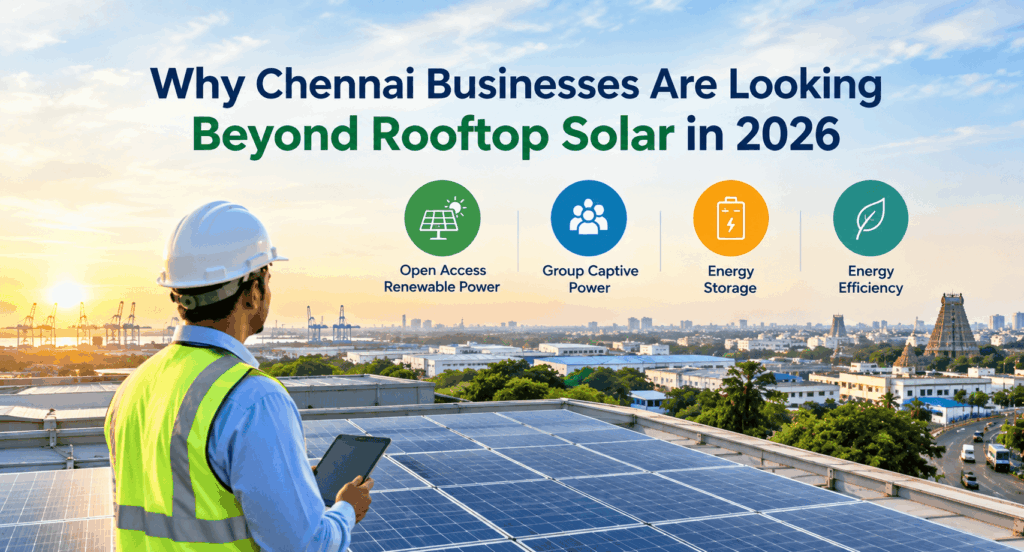
Businesses are increasingly evaluating solar open access, group captive power, long-term renewable power agreements, energy storage, energy efficiency and hybrid energy strategies.
This does not mean rooftop solar has become irrelevant.
Instead, rooftop solar is becoming one part of a larger energy strategy.
For Chennai businesses, that shift is important.
Rooftop Solar Is Still Valuable
Before discussing why businesses are looking beyond rooftop solar, it is important to understand that rooftop solar remains useful.
A rooftop system has one major advantage: the electricity is generated at or close to the point where it is consumed.
Tamil Nadu’s official rooftop-solar information explains that grid-connected rooftop systems can generate electricity for captive loads during the day, with excess electricity flowing to the grid according to the applicable arrangement
For a business with a suitable roof and substantial daytime electricity consumption, this can be an attractive starting point.
There is also no need to acquire additional land for the solar plant.
For example, a manufacturing facility in Ambattur may have a large factory roof that receives good sunlight. A warehouse near Sriperumbudur may have several thousand square metres of unused roof space. A commercial building in Chennai may have sufficient rooftop area for a meaningful solar installation.
In such cases, rooftop solar can directly reduce grid electricity consumption.
The challenge comes when the business needs much more renewable electricity than the roof can provide.
The Roof Has a Physical Limit
Every building has a finite amount of usable roof space.
A roof may look huge from the ground, but the entire area cannot necessarily be covered with solar modules.
Some space may be occupied by:
HVAC equipment
Water tanks
Ventilation systems
Skylights
Access pathways
Fire-safety areas
Electrical equipment
Maintenance zones
Other rooftop structures
Shading can also reduce the practical solar area.
Structural strength is another consideration.
A factory may have an old roof that requires reinforcement or replacement before additional solar equipment can be installed.
This creates a natural limit.
Imagine a factory consumes 10 million units of electricity every year but its roof can accommodate a solar system that produces only a fraction of that requirement.
Installing rooftop solar is still useful.
But the factory may need another source of renewable electricity to address the remaining demand.
That is where off-site renewable power becomes relevant.
Chennai’s Industrial Energy Requirements Are Getting Larger
Chennai’s industrial ecosystem is not limited to small factories.
The wider Chennai region includes major manufacturing clusters around areas such as Sriperumbudur, Oragadam, Maraimalai Nagar, Ambattur, Poonamallee and Gummidipoondi.
Many facilities operate production lines, compressors, motors, chillers, pumps, CNC equipment, automation systems and other high-consumption machinery.
Some operate multiple shifts.
Some operate around the clock.
For these businesses, the question is often not whether solar can generate electricity.
The question is:
“How much of our total electricity requirement can renewable energy realistically cover?”
That requires looking beyond the roof.
What Does Looking Beyond Rooftop Solar Actually Mean?
It does not necessarily mean abandoning rooftop solar.
It means considering additional renewable-energy procurement options.
A Chennai business could potentially combine:
Rooftop solar
Solar panels installed at the business premises.
Solar open access
Renewable electricity generated at an off-site project and supplied through the electricity network under the applicable open-access framework.
Group captive power
The business participates in the ownership structure of a renewable generating project and consumes electricity under the applicable captive-power rules.
Power purchase agreements
A long-term contractual arrangement for purchasing renewable electricity from a project.
Battery energy storage
Energy storage that can help manage when electricity is generated and when it is consumed.
Energy efficiency
Reducing electricity consumption through better equipment, controls and operating practices.
The right combination depends on the business.
Solar Open Access Is Becoming More Important
One of the biggest developments for larger commercial and industrial consumers is the growing relevance of green-energy open access.
Tamil Nadu’s Green Energy Open Access Regulations, 2025 establish a framework for procuring renewable and other non-fossil electricity through the state’s transmission and distribution network. The regulations cover areas including open-access procedures, energy accounting, banking, scheduling, metering and related processes.
This creates another pathway for businesses that cannot generate all the renewable electricity they need at their own premises.
Instead of asking:
“How many solar panels can I fit on my roof?”
a larger consumer can ask:
“How much renewable electricity does my business need, and what is the most practical way to procure it?”
That is a much broader energy question.
Why Open Access Can Matter to a Large Factory
Consider a hypothetical manufacturing company near Sriperumbudur.
The factory has a large electricity requirement, but the available roof can support only a limited solar installation.
The company could install rooftop solar to cover part of its daytime requirement.
It could then evaluate an off-site renewable project for additional electricity.
The off-site project may be much larger than the rooftop system because it is not restricted by the factory’s roof.
This is one of the key differences between rooftop solar and open-access renewable power.
Rooftop solar is limited by the physical characteristics of the consumer’s property.
Open access can potentially allow a large consumer to participate in renewable generation beyond the physical boundaries of its factory.
Of course, open access also introduces additional charges, technical requirements, scheduling considerations and regulatory conditions.
So it should be evaluated using the complete landed electricity cost.
Group Captive Power Is Another Option
Some Chennai manufacturers are also looking at group captive renewable power.
The basic idea is relatively simple.
Several eligible electricity consumers participate in the ownership of a renewable generating project and consume electricity from that project under the applicable captive framework.
This can be particularly relevant to businesses that have high electricity consumption but insufficient rooftop or land availability.
However, group captive is more complicated than simply buying solar electricity.
Ownership requirements, consumption requirements, contracts, compliance and open-access arrangements all need to be considered.
The 2026 Electricity Rules continue to use the important captive framework involving ownership and captive consumption requirements, including the 26% ownership and 51% consumption thresholds, subject to the detailed rules. Therefore, a group captive proposal needs to be assessed as an ownership-and-consumption structure, not simply as a discounted electricity contract.
For a factory owner, this means the question is not just:
“What is the price per unit?”
It is also:
“What am I investing in, what are my obligations, and how will captive compliance be maintained?”
The Economics Are More Important Than the Solar Panel Count
When businesses first consider solar, the conversation often starts with system capacity.
“How many kilowatts can we install?”
“How many panels will fit?”
“What will the project cost?”
Those questions are useful, but they are not enough for a large energy consumer.
The more important question is:
“What will renewable electricity actually cost us after all applicable charges?”
For an open-access project, the final cost may include several components beyond the generation cost.
These can include:
Generation cost
Transmission charges
Wheeling charges
Open-access charges
Banking-related charges
Scheduling and forecasting costs
Applicable losses
Taxes or statutory charges
Other project-specific costs
This is why comparing a rooftop solar quote with an open-access quote using only the rupees-per-unit generation price can produce a misleading result.
The comparison should be based on the effective landed cost.
2026 Is Also Bringing More Attention to Energy Storage
Solar generation has an obvious limitation.
It depends on sunlight.
A factory may need electricity after sunset.
An office may have its highest cooling requirement at a different time from peak solar generation.
A commercial facility may have demand patterns that do not perfectly match solar production.
This is where battery energy storage becomes relevant.
Battery storage can allow electricity generated during one period to be used during another period, subject to system design, economics and applicable regulations.
In 2026, energy storage is receiving increasing attention from commercial and industrial consumers alongside open-access renewable procurement. Industry analysis has identified battery energy storage as an emerging option for C&I consumers in Tamil Nadu seeking alternatives and complements to conventional grid supply and rooftop solar
But batteries are not automatically economical for every business.
A proper calculation should consider:
Battery capacity
Power rating
Cycle frequency
Round-trip efficiency
Battery degradation
Capital cost
Replacement requirements
Electricity tariff structure
Peak-demand pattern
Expected savings
The right question is not “Should every factory install a battery?”
It is:
“Does storage solve a specific energy problem at an acceptable cost for this facility?”
Rooftop Solar + Open Access Can Be a Stronger Strategy
Businesses sometimes treat rooftop solar and open access as competing choices.
They do not necessarily have to be.
A large Chennai factory could potentially use both.
For example:
Step 1: Install rooftop solar on available factory roofs.
Step 2: Use that generation directly against on-site consumption.
Step 3: Measure the remaining annual electricity requirement.
Step 4: Evaluate off-site renewable procurement for the remaining requirement.
Step 5: Study battery storage if the consumption pattern makes it financially relevant.
This creates a layered energy strategy.
The roof does what the roof can do.
Off-site renewable power addresses additional demand.
Storage can potentially address timing differences.
Energy efficiency reduces the amount of electricity the entire system needs.
That is more sophisticated than simply trying to maximise rooftop capacity.
Energy Efficiency Should Come Before Bigger Solar
There is another important point that businesses sometimes overlook.
The cheapest unit of electricity is often the unit that the factory does not need to consume.
Suppose a factory has inefficient compressed-air systems.
Or old motors.
Or oversized pumps.
Or poor power-factor performance.
Or inefficient chillers.
Or lighting that operates when nobody needs it.
Or equipment that runs during idle periods.
Installing solar will reduce the electricity purchased from the grid, but it does not correct those inefficiencies.
An energy audit can identify where electricity is actually being consumed and where operational improvements may be possible.
The result can be a combination of:
Reduce consumption + generate renewable electricity + optimise procurement
That is often a more complete strategy than solar alone.
Chennai Businesses Should Look at Their Load Profile
Two businesses can have identical annual electricity consumption and still need completely different energy strategies.
Consider two factories.
Factory A consumes most of its electricity between 8 AM and 6 PM.
Factory B operates three shifts and consumes electricity almost continuously.
Both may consume 5 million units annually.
But the value of rooftop solar, open-access solar, storage and grid electricity can differ between them.
This is why annual electricity consumption is only one part of the analysis.
A business should also understand:
When electricity is consumed
How much is consumed
Maximum demand
Daytime demand
Night-time demand
Weekend demand
Seasonal variations
Production schedules
Future expansion
Once the load profile is understood, renewable energy can be designed around the actual business.
What About Rising Open-Access Charges?
Businesses considering open access should also recognise that the economics are not fixed forever.
Charges and regulatory arrangements can change.
For example, in September 2026, TNPDCL proposed an additional surcharge of ₹0.63 per unit for certain high-voltage consumers using open-access electricity for the period October 1, 2026 to March 31, 2027. The proposal was submitted to TNERC and therefore should be treated as a regulatory proposal rather than an automatically applicable final charge.
This is a good illustration of why a renewable-energy financial model should not rely on one assumed charge for the entire life of a project.
Businesses should stress-test their calculations.
What happens if open-access charges increase?
What happens if banking charges change?
What happens if the factory’s electricity consumption decreases?
What happens if production expands?
A robust energy strategy should remain understandable under different scenarios.
Rooftop Solar Has Its Own Constraints
Rooftop solar also has limitations.
A business should evaluate:
Roof condition
Structural capacity
Available area
Shading
Orientation
Electrical infrastructure
Fire safety
Maintenance access
Future building expansion
Equipment placement
Roof replacement plans
For example, if a factory knows that its roof will be replaced within three years, installing a large solar system today may require additional planning.
The same applies to leased buildings.
A tenant should consider what happens to the solar asset if the lease ends before the expected project life.
These practical questions are often more important than the panel specification.
The Financing Question Is Changing Too
A business does not always need to think about solar as a simple CAPEX purchase.
Depending on the project and eligibility, companies can evaluate different financing and ownership structures.
Tamil Nadu Industrial Investment Corporation, for example, has a solar power project financing scheme covering eligible solar photovoltaic projects for captive consumption and certain other solar projects, subject to its stated eligibility and lending conditions.
Businesses can therefore evaluate:
Direct CAPEX
Bank financing
Third-party ownership
Long-term renewable procurement
Captive investment
Hybrid approaches
The best structure depends on the company’s financial position and long-term strategy.
Chennai’s Large Businesses Need a Different Solar Conversation
A small commercial building can sometimes make its solar decision simply.
Look at the roof.
Calculate the capacity.
Install the system.
Monitor generation.
A large manufacturing company needs a broader process.
The energy discussion may involve:
Finance
Operations
Electrical engineering
Procurement
Legal
Sustainability
Facility management
Senior management
That is because electricity is not just a facility expense for a large industrial company.
It can affect the cost of production.
This is why industrial energy planning should be based on data rather than a standard solar package.
What Should a Chennai Business Do Before Choosing Its Next Solar Project?
Start with the electricity bill.
But do not stop there.
Collect at least 12 months of electricity consumption data.
Understand your maximum demand.
Review your factory or building’s operating hours.
Assess the available rooftop area.
Check roof condition and structural suitability.
Identify major electricity-consuming equipment.
Estimate future expansion.
Then compare multiple strategies.
For example:
Option 1: Rooftop solar only.
Option 2: Rooftop solar + grid.
Option 3: Rooftop solar + open access.
Option 4: Group captive renewable power.
Option 5: Renewable power + battery storage.
Option 6: Energy efficiency + rooftop solar + renewable procurement.
The comparison should use actual business data.
How Kinetiq Energy Can Help Chennai Businesses
At Kinetiq Energy, the focus should not simply be on putting more panels on a roof.
For businesses in Chennai and across Tamil Nadu, the bigger opportunity is to understand how electricity is being consumed and then identify the right combination of energy solutions.
That can begin with an assessment of:
Electricity consumption
Load profile
Maximum demand
Operating schedule
Roof availability
Energy-efficiency opportunities
Renewable-energy requirements
Future business expansion
Investment preferences
From there, a business can evaluate whether rooftop solar is enough or whether it should investigate additional options such as open-access renewable power, group captive arrangements, storage or a combination of solutions.
The objective is simple:
Generate where it makes sense. Procure where it makes sense. Store where it makes sense. Reduce consumption where possible.
This approach can help a business build an energy strategy around its actual operations rather than around a single technology.
You can explore Kinetiq Energy’s solutions at kinetiqenergy.com.
The Future Is Not Rooftop Solar vs Open Access
It is easy to frame the discussion as:
Rooftop solar or open access?
For many Chennai businesses, the better question is:
“How should we combine different energy solutions to meet our electricity requirements?”
A manufacturing facility might use rooftop solar for part of its daytime load.
It could evaluate off-site renewable power for additional consumption.
A battery might be considered if the load profile supports the economics.
Energy efficiency could reduce the total requirement.
The grid would continue to provide the remaining flexibility and reliability required by the operation.
That is a more realistic picture of commercial and industrial energy in 2026