
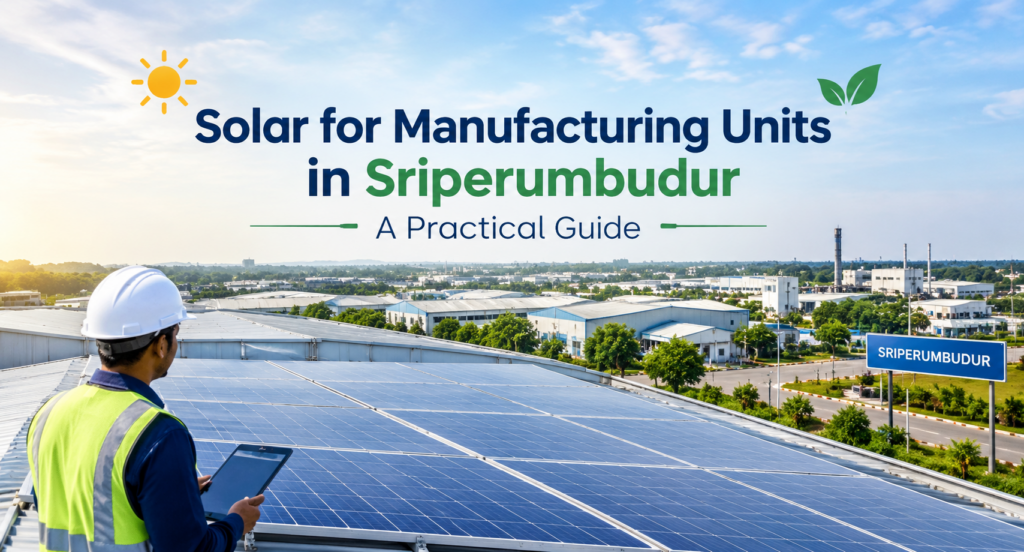
Sriperumbudur has become one of the important manufacturing and industrial corridors around Chennai. With automobile and auto-component companies, electronics manufacturers, engineering companies, warehouses, assembly plants, and other industrial businesses operating across the region, electricity is not simply another operating expense. It is a major part of keeping production running.
For many manufacturing units, electricity costs can have a direct impact on production costs, operating margins, and long-term competitiveness. This is one reason industrial solar power is attracting increasing attention from businesses in Sriperumbudur, Oragadam, Pillaipakkam, Sunguvarchatram, Irungattukottai, and the wider Chennai industrial belt.
However, installing solar for a factory is very different from installing a small rooftop system for a home. A manufacturing plant needs a proper assessment of its electricity consumption, roof structure, operating schedule, electrical infrastructure, transformer capacity, safety requirements, and financial objectives before a solar system is designed.
This practical guide explains what manufacturing units in Sriperumbudur should consider before investing in solar power.
Why Manufacturing Units in Sriperumbudur Are Looking at Solar
Manufacturing facilities typically consume electricity throughout the working day. Motors, compressors, pumps, HVAC systems, CNC machines, welding equipment, conveyors, lighting, refrigeration, automation systems, and other production equipment can create substantial electricity demand.
The good news is that many factories also operate during the same daytime hours when a rooftop solar system is generating electricity.
This creates a natural opportunity.
Instead of purchasing all of the daytime electricity required by the factory from the grid, a properly designed solar plant can generate a portion of that electricity on-site.
For a manufacturing unit, the objective should not simply be to install as many panels as possible. The objective is to design a system that matches the factory’s actual energy consumption and delivers useful savings over its operating life.
This distinction is important.
A factory with a large roof does not automatically need a large solar plant. Likewise, a factory with a high sanctioned load does not necessarily benefit from installing solar equal to that entire load.
The right system begins with the energy profile of the facility.
Why Sriperumbudur Is a Practical Location for Industrial Solar
Sriperumbudur and the surrounding industrial belt have a strong concentration of manufacturing activity. The area includes established industrial parks and manufacturing facilities serving automotive, electronics, engineering, logistics, and other sectors.
Solar can work particularly well for facilities where electricity consumption is concentrated during daylight hours.
A typical manufacturing facility may begin production in the morning and continue through the afternoon. Solar generation follows a similar pattern, generally increasing through the morning and reaching its strongest production around the middle of the day before reducing toward evening.
This makes daytime manufacturing operations particularly suitable for rooftop solar.
For factories operating multiple shifts, solar can still reduce the amount of electricity purchased from the grid during daylight hours. Battery storage may also be considered in specific applications, although the economics should be evaluated separately rather than assuming that batteries are necessary for every industrial project.
The First Step: Study Your Factory’s Electricity Consumption
Before asking a solar company for a quotation, a manufacturing unit should understand how much electricity it actually consumes.
Looking at only one electricity bill is usually not enough.
A proper assessment should ideally examine several months of electricity bills and, where available, interval or load data.
Important information includes:
- Monthly electricity consumption
- Maximum demand
- Contracted or sanctioned demand
- Daytime versus nighttime consumption
- Production operating hours
- Major electrical loads
- Seasonal variations
- Existing power factor
- Transformer capacity
- Available roof area
- Existing electrical distribution arrangement
- This information helps determine whether rooftop solar is technically and financially suitable.
For example, imagine two factories with the same roof area.
Factory A operates mainly from 8 AM to 6 PM.
Factory B operates continuously across three shifts.
Both may be able to install a similar number of solar panels, but their energy consumption patterns are different. Their solar utilisation and financial calculations should therefore be evaluated differently.
How Much Solar Capacity Does a Factory Need?
There is no universal answer.
A solar EPC company should calculate the appropriate capacity after studying the facility’s electricity consumption, available roof area, structural conditions, electrical system, and applicable grid requirements.
As a simple planning concept, a factory might evaluate options such as:
5 MW roof potential does not automatically mean a 5 MW solar installation.
Instead, the business may compare different capacities based on actual daytime consumption and financial objectives.
For example, a company might compare a 500 kW, 1 MW, and larger system to determine how each option affects annual generation, self-consumption, export, investment, and payback.
The final capacity should come from engineering and financial analysis rather than from roof size alone.
Rooftop Solar vs Ground-Mounted Solar
Manufacturing businesses in the Sriperumbudur region can consider different solar configurations.
Rooftop Solar
Factory rooftops are often attractive because they use existing space.
A well-designed rooftop project can convert unused roof space into an energy-generating asset without requiring additional land.
However, the roof must be checked carefully.
The engineering assessment should consider:
- Roof age
- Structural strength
- Waterproofing
- Roof material
- Existing equipment
- Shading
- Access pathways
- Wind loading
- Maintenance access
- Fire and electrical safety
The cheapest installation is not necessarily the best installation if it creates roof-maintenance problems later.
Ground-Mounted Solar
If suitable land is available near the manufacturing facility, ground-mounted solar can also be considered.
This can provide easier access for maintenance and may allow a larger plant depending on the available land and grid infrastructure.
However, land availability, land cost, evacuation infrastructure, permissions, and project development requirements must be considered.
Hybrid Approach
Some large industrial facilities may evaluate a combination of rooftop and ground-mounted solar.
The appropriate model depends on the company’s site, electricity demand, available space, and commercial objectives.
Understand Your Factory’s Roof Before Installing Panels
One area that deserves more attention in industrial solar projects is the roof itself.
A manufacturing plant may have a large metal or concrete roof, but that does not automatically mean the entire area is suitable for solar installation.
Some portions may be shaded by HVAC equipment, tanks, exhaust systems, skylights, or other structures.
Some areas may need to remain clear for maintenance.
Older roofs may require repairs before solar installation.
A professional solar assessment should therefore include a roof survey and structural evaluation.
This is especially important because a solar plant is expected to operate for many years. The mounting system, waterproofing, drainage, cable routing, and maintenance access should be considered from the beginning.
Solar Generation and Factory Load Should Be Matched
This is one of the most important concepts for industrial solar.
Solar generation changes throughout the day.
Factory consumption also changes throughout the day.
The best project is not necessarily the one that produces the largest amount of electricity. It is the one that creates useful value against the factory’s actual electricity consumption and applicable commercial arrangement.
For example, if a factory consumes a large amount of electricity between 9 AM and 5 PM, a rooftop solar system can potentially offset a significant portion of that daytime consumption.
If the factory has very low daytime consumption and high nighttime consumption, the financial calculation can be different.
This is why an energy audit and load analysis should come before the final solar design.
What About Excess Solar Power?
A manufacturing unit should understand what happens when the solar system generates more electricity than the facility is consuming.
The answer depends on the applicable Tamil Nadu regulatory framework, consumer category, connection characteristics, system capacity, and the approved commercial arrangement.
Tamil Nadu has provisions covering mechanisms such as net metering, net billing/net feed-in and gross metering, with eligibility and technical conditions varying by consumer category and system configuration. The 2021 TNERC framework, for example, provides provisions for non-domestic consumer categories under net billing/net feed-in subject to applicable limits and conditions.
For this reason, a factory should not calculate its solar savings simply by multiplying total solar generation by the electricity tariff.
The actual financial model should consider how much generation is self-consumed, how excess generation is treated, applicable charges, demand-related costs, and the specific connection arrangement.
The latest applicable requirements should always be confirmed during project development.
TANGEDCO and Technical Feasibility
Grid-connected industrial solar projects require more than simply installing panels and switching on an inverter.
The electrical connection needs to comply with applicable technical requirements and grid-interconnection procedures.
Depending on the project, the process can involve technical feasibility assessment, electrical drawings, protection systems, metering arrangements, approvals, inspections, and grid synchronisation.
Tamil Nadu’s rooftop solar framework also includes technical requirements relating to interconnection and grid safety. Earlier TANGEDCO working instructions, for example, specify isolation arrangements and automatic shutdown during grid outages so that the solar plant does not continue feeding power into a disconnected distribution network.
For an industrial facility, these requirements should be incorporated into the engineering design from the beginning.
This is why choosing an EPC partner purely because it offers the lowest panel price can create problems later.
Don’t Select Solar Panels Based Only on Price
Panels are one component of an industrial solar plant.
The complete system can include:
Solar modules
Inverters
Mounting structures
DC cables
AC cables
Combiner boxes
Protection equipment
Transformers where required
Monitoring systems
Earthing and lightning protection
Meters
Switchgear
Control and safety equipment
The quality and compatibility of these components can influence long-term plant performance.
A factory should therefore evaluate the complete engineering solution rather than comparing quotations based only on the rupees-per-watt figure.
Inverter Selection Matters for Manufacturing Plants
The inverter converts the DC electricity generated by the solar panels into usable AC electricity.
Industrial projects may require different inverter configurations depending on plant size, electrical architecture, roof layout, shading, voltage requirements, and redundancy considerations.
A good design should also consider what happens if an inverter fails.
If a large portion of the plant depends on one inverter, an outage can affect a significant amount of generation.
Distributed inverter architecture can sometimes provide operational advantages, although the right approach depends on the individual project.
Solar Should Not Compromise Manufacturing Operations
For a manufacturing company, production comes first.
Solar installation work must therefore be planned around factory operations.
Installation teams may need to work at height, move materials across the site, access electrical rooms, work around production areas, and coordinate with the factory’s safety team.
Industrial solar projects should have appropriate safety procedures covering:
Work at height
Electrical isolation
Material handling
Roof access
Fire safety
PPE
Cable routing
Lifting operations
Emergency access
Plant shutdown coordination
A solar project that saves electricity but creates unnecessary operational disruption is not a well-managed project.
Energy Audit Before Solar: Why It Matters
Solar reduces electricity purchased from the grid, but it does not automatically solve inefficient energy consumption.
A factory may have inefficient motors, compressed-air leaks, poor power factor, outdated lighting, oversized pumps, inefficient chillers, or equipment that operates unnecessarily.
An energy audit can identify these opportunities.
For example, suppose a manufacturing unit spends ₹1 crore per year on electricity.
Installing solar might reduce the electricity purchased from the grid.
But if the company can simultaneously reduce avoidable energy consumption through efficiency improvements, the overall energy strategy can become more effective.
This is why solar should ideally be considered as part of a broader industrial energy-management plan.
Calculate Solar ROI Carefully
A solar quotation should not stop at system price.
A manufacturing business should understand:
Initial investment
Expected annual generation
Expected self-consumption
Expected electricity-cost reduction
Export or settlement treatment
Operations and maintenance cost
System degradation
Financing cost, if applicable
Insurance
Expected project life
Estimated payback period
Long-term savings
The calculation should also use realistic generation assumptions rather than an optimistic production figure.
Solar output can vary because of weather, dust, temperature, shading, equipment performance, downtime, and maintenance conditions.
For an industrial decision-maker, the goal is to understand the project’s expected economics under realistic operating conditions.
CAPEX or Solar Financing?
Manufacturing companies have several ways to approach solar investment.
Under a traditional CAPEX model, the company purchases and owns the solar plant.
The business carries the initial investment but also owns the asset and receives the resulting energy savings.
Another approach is to evaluate financing or third-party ownership models, depending on eligibility and commercial structure.
The right option depends on the company’s cash position, financing cost, investment strategy, tax considerations, and preference for owning infrastructure.
The important point is to compare models based on total long-term economics rather than simply focusing on the initial monthly payment.
What Manufacturing Companies Should Ask a Solar EPC Company
Before signing a solar contract, factory management should ask practical questions.
How was the proposed solar capacity calculated?
What percentage of solar generation is expected to be self-consumed?
What assumptions were used for annual generation?
Has the roof structure been evaluated?
What equipment brands and specifications are proposed?
What warranties are provided?
Who will handle approvals and grid-related documentation?
What monitoring system will be provided?
What is included in operations and maintenance?
How will the system be cleaned?
How will performance be measured?
What happens if generation is lower than expected?
How will safety be managed during installation?
These questions can help a company distinguish between a basic equipment quotation and a properly engineered industrial solar project.
Solar Maintenance in Sriperumbudur’s Industrial Environment
Solar panels do not require the same maintenance as conventional electrical equipment, but they still need regular attention.
Dust, industrial pollution, bird droppings, and other environmental factors can reduce panel performance if the modules are not maintained properly.
A suitable maintenance program may include:
Panel cleaning
Visual inspection
Inverter inspection
Thermal scanning
Electrical testing
Cable inspection
Earthing checks
Monitoring-system review
Preventive maintenance
Fault detection
The maintenance frequency should be determined based on site conditions.
For a factory located in an active industrial environment, monitoring performance is especially useful because a small drop in generation across thousands of panels can become a significant annual energy loss.
Why Monitoring Is Important
A modern industrial solar plant should not be treated as an installation that can simply be forgotten after commissioning.
Digital monitoring allows the business to track generation and identify abnormal performance.
Plant managers can potentially monitor:
Daily generation
Monthly generation
Inverter performance
String-level performance where available
Fault alerts
Historical production
Performance trends
This information helps identify problems before they become larger production losses.
For large manufacturing facilities, solar monitoring should be integrated into the overall energy-management approach wherever practical.
Solar Can Also Support Sustainability Goals
Energy savings are usually the primary reason companies consider industrial solar.
But there is another benefit.
Manufacturers supplying multinational companies increasingly face sustainability expectations from customers, investors, and supply chains.
Using renewable electricity can support a company’s broader environmental objectives and reporting efforts, depending on how the renewable electricity is structured and accounted for.
Tamil Nadu itself has established financing support through institutions such as the Tamil Nadu Industrial Investment Corporation for eligible solar power projects, including rooftop and ground-based projects for captive consumption, subject to applicable conditions.
Companies should verify current eligibility, financing terms, regulatory requirements, and applicable incentives before including them in a project financial model.
A Practical Solar Roadmap for a Sriperumbudur Factory
For a manufacturing company considering solar, the process can be kept straightforward.
Start with electricity bills and consumption data.
Next, conduct an energy assessment.
Then inspect the available roof or land.
After that, evaluate the electrical infrastructure and grid connection.
The solar EPC team can then prepare different system-capacity options.
Compare expected generation, self-consumption, investment, operating costs, and long-term savings.
Once the business selects the preferred approach, detailed engineering and approvals can begin.
Installation should then be carried out with proper factory safety coordination.
Finally, commissioning, monitoring, preventive maintenance, and performance tracking should continue throughout the life of the plant.
How Kinetiq Energy Can Help Manufacturing Units
For a manufacturing business in Sriperumbudur, solar should be approached as an energy investment rather than simply a panel installation.
At Kinetiq Energy, the focus is on helping businesses understand their energy requirements and evaluate solar solutions around their actual operations.
The process can begin with understanding your electricity consumption, factory operating pattern, available roof space, electrical infrastructure, and energy objectives.
From there, a suitable solar configuration can be evaluated based on technical feasibility and financial considerations.
For businesses in Chennai and the surrounding industrial areas, including Sriperumbudur and other major manufacturing clusters, having a local understanding of industrial operating conditions is important.
A properly planned project should balance energy savings, engineering quality, safety, reliability, maintenance, and long-term performance.
You can explore solar and energy solutions through kinetiqenergy.com and discuss the requirements of your manufacturing facility with the Kinetiq Energy team.