
Delivery has changed a lot in Chennai.
A few years ago, customers were often happy if a parcel simply arrived on the promised day. Today, expectations are much higher. Whether someone is ordering groceries from a neighbourhood shop in Anna Nagar, sending an important document from T. Nagar to OMR, getting spare parts delivered to a workshop, or ordering food and household products, the delivery experience has become part of the overall customer experience.
People do not only ask, “Will my order reach me?”
They also want to know: When will it arrive? Where is it now? Who is delivering it? How much will I pay? What happens if I am not available? Can I contact someone if there is a problem?
This shift is especially visible in cities like Chennai, where customers are becoming accustomed to faster digital services while businesses are trying to serve customers across busy roads, residential areas, IT corridors, industrial zones and rapidly growing suburbs.
Recent Indian consumer research reflects this change. Studies and industry reports increasingly point toward speed, delivery visibility, flexibility, communication and reliability as important parts of the modern shopping experience. The growth of rapid commerce has also raised expectations around how quickly local products can reach customers.
For customers, this does not necessarily mean every parcel needs to arrive in 10 minutes. It means the delivery service should be predictable, convenient and transparent.
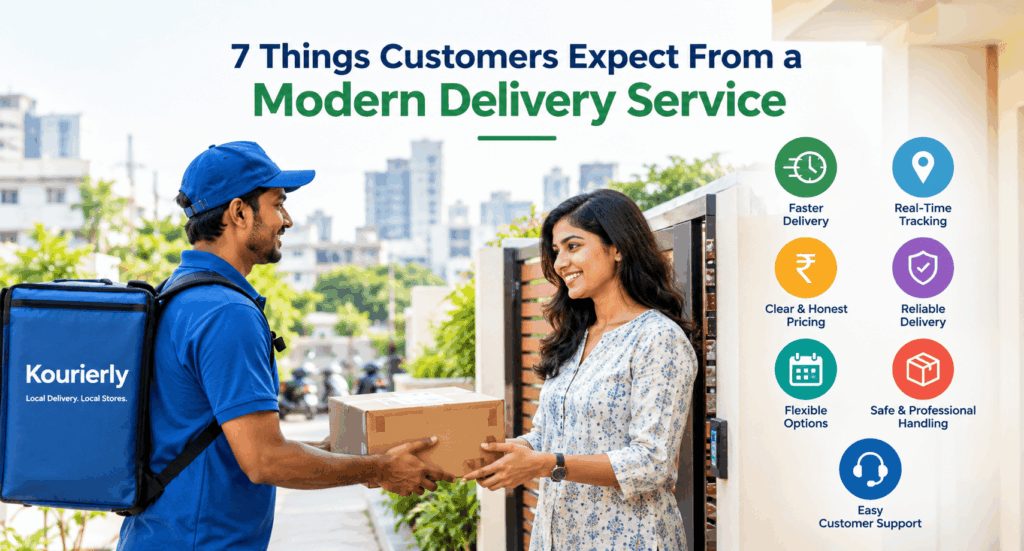
Here are seven things customers increasingly expect from a modern delivery service.
1. Customers Expect Faster Delivery
Speed is probably the most obvious change in delivery expectations.
When someone buys something online, they generally do not want to wait unnecessarily. If a product is available at a shop only a few kilometres away, customers naturally wonder why it should take an entire day to reach them.
This is particularly important for local and hyperlocal purchases.
Imagine a customer in Velachery who needs an electronic accessory urgently. The product may already be available at a nearby store. Or consider a restaurant, pharmacy, bakery or small retailer receiving an order from a customer just a few kilometres away. The customer expects the business to have a practical way of getting that product from the shop to the doorstep.
But faster does not mean promising unrealistic delivery times.
A good delivery service should balance speed with actual road conditions, distance, vehicle availability, order volume and customer location.
Chennai is a large and busy city. A delivery from Adyar to Guindy during one part of the day can be very different from the same route during peak traffic. A trip along OMR can behave differently from a short trip within a dense residential neighbourhood.
That is why modern delivery is not simply about having more riders. It is about better dispatching, better routing and better communication.
Customers appreciate speed, but they appreciate a realistic promise even more.
A delivery service that says “arriving shortly” and actually arrives when expected can create more trust than one that promises an extremely fast delivery and repeatedly misses the target.
2. Customers Want Real-Time Tracking
One of the biggest improvements in modern delivery is visibility.
Customers no longer want to place an order and then wonder what happened to it.
They want to see whether the order has been accepted, whether the item has been picked up, where the delivery is and whether it is approaching their location.
This is particularly useful in Chennai because customers may be at home, at work, in an apartment complex, inside a shop or somewhere else when the delivery arrives.
Real-time tracking makes the process easier for everyone.
Instead of repeatedly calling the store and asking, “Anna, delivery enga irukku?” customers can check the delivery status themselves.
For businesses, tracking also reduces unnecessary customer calls. When customers can see the status of an order, they have more confidence in the process.
For example, imagine a customer ordering a product from a local shop in Mylapore and sending it to an office in Guindy. If the customer can follow the delivery journey, they can plan when to receive it.
This small feature can make the entire experience feel more professional.
Kourierly is designed around this kind of local delivery experience, including delivery updates and tracking that allow customers to follow an active delivery journey.
3. Customers Expect Clear and Honest Pricing
Nobody likes surprises at checkout.
A customer may accept a reasonable delivery charge. What creates frustration is discovering unexpected fees after placing an order.
Modern customers want to understand what they are paying for.
A transparent delivery service should make important pricing information clear before the customer confirms the booking. Depending on the service, factors such as distance, vehicle type, delivery requirements and location may affect the final price.
This is especially important for Chennai businesses.
A small retailer may want to deliver products to customers in nearby areas. A customer may want to send a parcel across the city. A business may need a three-wheeler for larger goods instead of a two-wheeler.
The delivery cost should make sense for the service being provided.
Transparency also helps businesses plan better.
For a local retailer, knowing the expected delivery cost makes it easier to decide whether to offer free delivery, charge customers separately or include delivery within the product pricing.
Modern delivery is therefore not simply about being cheap.
It is about making the price understandable.
A customer who knows what they are paying before confirming an order is more likely to feel comfortable using the service again.
4. Customers Want Reliable Delivery, Not Just Fast Delivery
Fast delivery gets attention.
Reliable delivery builds trust.
These are not the same thing.
A delivery service can promise extremely fast delivery, but if orders frequently arrive late, get cancelled or require repeated phone calls, customers will eventually lose confidence.
Reliability means the delivery service performs consistently.
If an order is scheduled for a particular time window, customers want the service to make a genuine effort to meet that commitment.
Of course, unexpected situations happen. Chennai traffic can change quickly. Heavy rain can slow roads. A customer may provide incomplete directions. A store may take longer than expected to prepare an order.
The important thing is how the delivery service handles these situations.
A reliable service should identify problems early and communicate them instead of leaving the customer guessing.
For example, if a delivery is delayed because of heavy traffic, informing the customer can make a significant difference.
Silence creates uncertainty.
Communication creates understanding.
This is why reliability should be measured not only by successful deliveries, but also by how professionally exceptions are handled.
5. Customers Expect Flexible Delivery Options
Not every customer has the same schedule.
One person may work from home. Another may be at an office from morning until evening. A shop owner may need deliveries during business hours. A family may only be available to receive an order after work.
Modern delivery services need to recognise this reality.
Flexibility can include different delivery windows, suitable vehicle options, alternative drop-off arrangements or the ability to coordinate with the receiver.
This becomes particularly important for local businesses.
Consider a clothing store in Chennai that receives several orders from customers in different parts of the city. Or a hardware store receiving requests for heavier products. Or a home-based food business that needs to send multiple orders around a particular time.
One delivery method may not work for every situation.
A modern delivery platform should therefore support different types of deliveries rather than treating every package exactly the same way.
Kourierly, for example, is positioned around different local delivery requirements and supports vehicle choices that can vary according to the type of delivery, distance and availability.
The goal is simple: delivery should adapt to the requirement rather than forcing every customer into the same process.
6. Customers Expect Safe and Professional Handling
Speed and tracking are important, but customers ultimately want their products to arrive safely.
A document should not be damaged.
A food order should be handled properly.
An electronic product should not be treated like an ordinary lightweight parcel.
A fragile item needs appropriate care.
This is where the quality of the delivery operation becomes important.
Customers want confidence that the person collecting their package will handle it responsibly and deliver it to the correct recipient.
For businesses, this is even more important because the delivery person becomes part of the customer’s interaction with the brand.
Think about a small Chennai business that has spent years building a good reputation. The product may be excellent, the store may provide great service and the packaging may be carefully prepared.
If the final delivery experience is careless, the customer may still remember the entire experience negatively.
The delivery person may not technically be the business owner, but from the customer’s point of view, they are part of the service.
That is why professionalism, verification, communication and safe handover matter.
A modern delivery ecosystem needs to focus on the complete journey from pickup to drop-off.
7. Customers Expect Easy Customer Support
Even with good technology, something can occasionally go wrong.
The address may be difficult to locate.
The receiver may not answer the phone.
The shop may need additional preparation time.
A vehicle issue may cause a delay.
The customer may need help changing delivery details.
When something goes wrong, customers want a straightforward way to get help.
This does not mean every issue needs a large call centre.
It means customers should know where to go and what to expect.
Good customer support should be accessible, responsive and connected to the actual delivery information.
For example, if a customer contacts support about a delayed delivery, they should not have to explain the entire situation repeatedly if the delivery status is already available in the system.
Technology should make support easier, not create another layer of frustration.
This is particularly important for small businesses using delivery services. A shop owner does not want to spend the entire day coordinating between customers, riders and delivery teams.
A well-designed delivery platform can reduce that operational burden.
What These Expectations Mean for Chennai Businesses
The seven expectations above are not only relevant to customers.
They are becoming important for businesses too.
Chennai has a large ecosystem of local retailers, restaurants, pharmacies, workshops, manufacturers, home businesses, speciality stores and service providers.
Many of these businesses already have something valuable: a physical location and an existing customer base.
The challenge is reaching customers digitally without losing the advantages of local business.
A customer may know that a favourite shop is only two kilometres away, but if they cannot easily discover the shop, place an order or arrange delivery, they may choose a larger online platform instead.
This is where hyperlocal delivery can create an interesting opportunity.
Instead of moving every product through a large warehouse network, a customer can potentially order from a nearby business and have the product delivered locally.
That creates a different model of convenience.
The local store keeps its identity.
The customer gets digital convenience.
The delivery network connects the two.
This is the approach Kourierly is building around: connecting nearby businesses and customers while providing local delivery infrastructure.
Delivery Is Becoming Part of the Brand Experience
There was a time when businesses could treat delivery as something that happened after the sale.
That is becoming harder.
Today, delivery is part of the customer experience.
If an order is easy to place, clearly priced, professionally handled and delivered when expected, the customer remembers the business positively.
If the delivery is confusing, delayed and difficult to track, that experience can affect how the customer thinks about the business itself.
This is why companies should not ask only:
“How much does delivery cost?”
They should also ask:
“How does delivery affect our customer experience?”
“How many customers contact us because they cannot track orders?”
“How often do deliveries fail because of communication problems?”
“How quickly can we respond when something changes?”
“Can our customers conveniently order from us again?”
These questions can reveal opportunities to improve the entire customer journey.
The Future of Delivery in Chennai Will Be More Local and More Connected
The growth of rapid commerce in India has changed what people consider convenient. Industry research has highlighted the expansion of faster delivery models, while consumer research shows growing expectations around delivery options, tracking and communication.
But the future of delivery does not necessarily mean that every product needs to arrive within minutes.
For many customers, the real value is convenience and certainty.
If a nearby shop has the product they need, they want an easy way to discover it, order it and receive it without unnecessary travel.
This could be particularly valuable in a city like Chennai.
A customer in Anna Nagar may want products from a local store.
Someone in Adyar may need an item from a nearby pharmacy.
A business in Guindy may need a parcel collected from T. Nagar.
A workshop in Ambattur may need spare parts moved quickly.
A family in Velachery may want groceries from a neighbourhood supermarket.
These are not always traditional e-commerce problems.
They are local logistics problems.
And solving them well requires a combination of technology, local businesses and reliable delivery infrastructure.
Why Kourierly Fits Into This Changing Delivery Landscape
Kourierly is built around the idea of making local delivery and local shopping more convenient.
The platform connects customers with nearby businesses and provides delivery services for eligible orders. It also supports people who simply need to move a parcel from one location to another.
For local businesses, this can create an additional way to reach nearby customers without having to build and manage their own delivery fleet.
For customers, the idea is straightforward: discover local products, place an order or arrange a delivery, and follow the delivery journey.
That combination is increasingly relevant as Chennai customers become more comfortable with digital ordering while continuing to depend heavily on neighbourhood businesses.
The opportunity is not about replacing every local shop with a large online marketplace.
It is about helping local shops become easier to discover and more convenient to buy from.