
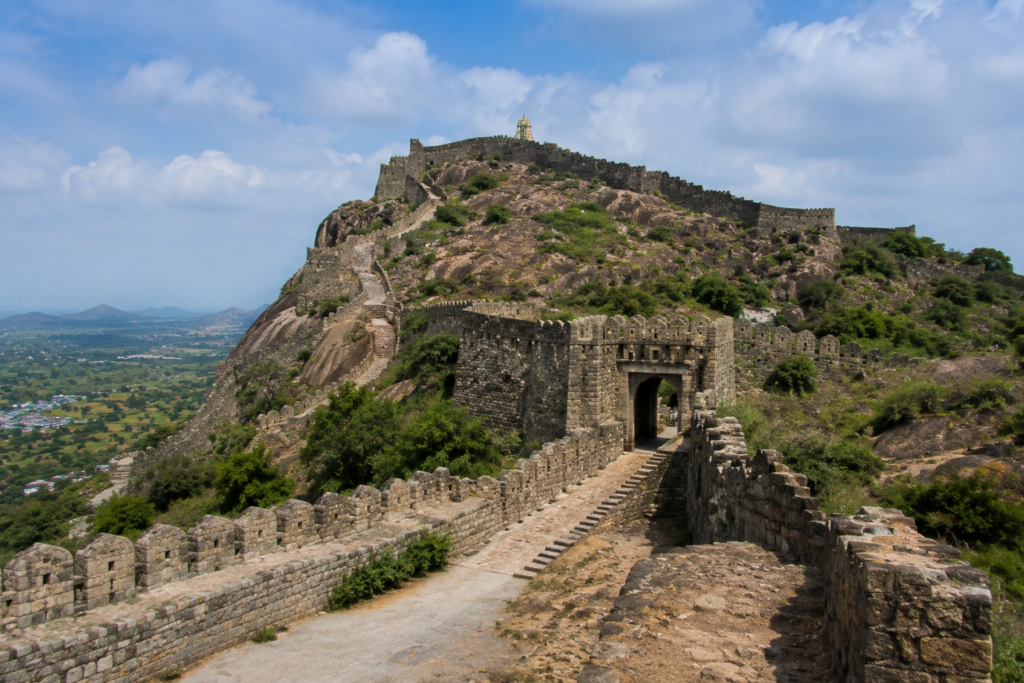
Rising majestically atop a rocky hill in the Salem district of Tamil Nadu, Sankagiri Fort is one of South India’s most fascinating yet lesser-known historical monuments. Overlooking the town of Sankagiri, this magnificent hill fort has witnessed the rise and fall of powerful kingdoms, fierce military campaigns, and significant political transformations for more than 800 years.
Unlike many famous forts in India that attract large crowds, Sankagiri Fort remains a hidden treasure for history enthusiasts, architecture lovers, trekkers, photographers, and students of Indian history. Its massive stone walls, winding pathways, ancient gateways, temples, watchtowers, and panoramic hilltop views reflect the military brilliance of medieval South Indian rulers.
The fort served as an important military outpost under the Vijayanagara Empire, Madurai Nayaks, Mysore rulers, Hyder Ali, Tipu Sultan, and later the British East India Company. Because of its strategic location on ancient trade routes connecting Tamil Nadu, Karnataka, and Kerala, Sankagiri Fort became one of the strongest defensive fortresses in the region.
Today, the fort is protected by the Archaeological Survey of India (ASI) and continues to attract visitors interested in exploring Tamil Nadu’s rich historical heritage. Whether you are preparing for competitive examinations, planning a heritage trip, or simply curious about India’s medieval history, Sankagiri Fort offers a fascinating glimpse into the past.
Where Is Sankagiri Fort Located?
Sankagiri Fort is situated in Sankagiri town, Salem district, Tamil Nadu.
Approximate distances:
Salem – 40 km
Erode – 38 km
Namakkal – 45 km
Coimbatore – 125 km
Chennai – 360 km
Its location on an elevated rocky hill provided excellent visibility over the surrounding plains, making it an ideal military stronghold.
Origin of Sankagiri Fort
The exact date of the fort’s construction is not fully established, but historians believe the earliest fortifications were built during the **13th century**.
The region later became part of the Vijayanagara Empire, which expanded and strengthened the fort to protect important trade routes and administrative territories.
Its hilltop location naturally enhanced its defensive capabilities.
Expansion During the Vijayanagara Empire
The Vijayanagara rulers transformed Sankagiri into a formidable military base.
They added:
Massive granite walls
Strong defensive gates
Watchtowers
Storage facilities
Barracks
Water reservoirs
Temples
The fort became one of the major military centers in western Tamil Nadu.
Rule of the Madurai Nayaks
After the decline of the Vijayanagara Empire following the Battle of Talikota in 1565, the Madurai Nayaks assumed control of Sankagiri Fort.
The Nayaks further strengthened the fort by constructing:
Additional fortification walls
Bastions
Defensive passages
Administrative buildings
Many of the surviving structures visible today date to this period.
Sankagiri Under the Mysore Kingdom
During the 18th century, Sankagiri Fort became part of the expanding Mysore Kingdom.
Under **Hyder Ali** and later **Tipu Sultan**, the fort served as a strategic military center for defending Mysore’s southern territories.
Its location allowed rapid movement of troops between Karnataka and Tamil Nadu.
British East India Company
Following the Anglo-Mysore Wars, the British East India Company captured Sankagiri Fort.
The British used it as:
Military headquarters
Administrative center
Prison
Arms storage facility
Gradually, as military technology advanced, the fort’s strategic value declined.
Strategic Importance
Several factors made Sankagiri Fort extremely valuable:
Elevated hill position
Natural rocky defenses
Excellent visibility
Control of trade routes
Strong defensive architecture
Reliable water storage
The fort allowed rulers to monitor troop movements and protect important commercial routes.
Architecture of Sankagiri Fort
Sankagiri Fort is an outstanding example of medieval military engineering.
Hilltop Design
The fort occupies a steep rocky hill approximately 1,500 feet above sea level.
Its natural elevation provided a strong defensive advantage.
Multiple Defensive Walls
Unlike ordinary forts, Sankagiri contains multiple concentric fortification walls.
Each defensive layer increased protection against invading armies.
Nine Defensive Gates
One of the fort’s most remarkable features is its **nine successive gateways** leading toward the summit.
Each gate was carefully positioned to slow enemy advances.
Many gateways still display impressive stone masonry.
Bastions
Circular bastions project outward from the fort walls.
These allowed soldiers to:
Observe approaching enemies
Fire arrows and later firearms
Protect vulnerable sections of the walls
Watchtowers
Watchtowers positioned along the hill provided extensive views of the surrounding countryside.
Enemy movements could be detected well in advance.
Water Management
Despite its hilltop location, Sankagiri Fort maintained reliable water supplies.
The builders created:
Rainwater harvesting tanks
Stone reservoirs
Wells
Natural water storage systems
These facilities enabled soldiers to survive prolonged sieges.
Temples Inside the Fort
Several ancient temples are located within the fort complex.
These temples served the spiritual needs of soldiers and local residents.
Many contain beautiful stone carvings reflecting traditional Dravidian architecture.
Secret Passages
Like many medieval hill forts, Sankagiri is believed to contain hidden escape routes and secret passages.
Although many are now inaccessible, these passages played an important role during military emergencies.
Daily Life Inside the Fort
Sankagiri Fort functioned as a self-contained settlement.
Within its walls were:
Soldiers’ quarters
Administrative offices
Temples
Granaries
Water tanks
Storehouses
Animal shelters
Large numbers of people could live inside the fort during wartime.
Military Engineering
The builders carefully combined natural geography with man-made defenses.
Important defensive features include:* Steep rocky slopes
Narrow access paths
Thick granite walls
Multiple gateways
Elevated watchpoints
Bastions
Water storage
Together, these made the fort difficult to capture.
Role in Trade
Sankagiri lay along important commercial routes linking:
Tamil Nadu
Karnataka
Kerala
Merchants transporting spices, textiles, grains, and other goods frequently passed through the region.
Protecting these trade routes increased the fort’s economic importance.
Sankagiri Fort Today
Today, Sankagiri Fort is protected by the Archaeological Survey of India.
Visitors can explore:
Ancient gateways
Fort walls
Temples
Water tanks
Stone pathways
Watchtowers
Panoramic viewpoints
The hill trek itself is an enjoyable experience for adventure enthusiasts.
Best Time to Visit
The ideal months are:
October
November
December
January
February
The weather during these months is pleasant for climbing the hill.
Morning visits are recommended to avoid afternoon heat.
Travel Tips
Before visiting Sankagiri Fort:
Wear comfortable trekking shoes.
Carry sufficient drinking water.
Wear a cap or hat.
Bring a camera for scenic photography.
Start early in the morning.
Follow ASI regulations.
Avoid littering.
Importance for Competitive Exams
Sankagiri Fort is relevant for UPSC, TNPSC, SSC, Railways, and state-level examinations.
Important facts include:
Located in Salem district.
Built on a rocky hill.
Expanded by the Vijayanagara rulers.
Strengthened by the Madurai Nayaks.
Used by Hyder Ali and Tipu Sultan.
Captured by the British East India Company.
Protected by the Archaeological Survey of India.
Famous for its nine defensive gateways.
Lesser-Known Facts
Sankagiri Fort covers a large hill area with multiple levels of fortification.
The fort’s granite construction has helped it survive for centuries.
Some sections still preserve original defensive walls from medieval times.
The panoramic view from the summit extends across much of the surrounding plains.
Historians believe the fort once housed hundreds of soldiers and administrators.
Why Sankagiri Fort Matters Today
Although it is less famous than Vellore or Gingee Fort, Sankagiri Fort is an important reminder of Tamil Nadu’s military heritage. It illustrates how medieval engineers used natural landscapes to create nearly impregnable fortifications and highlights the region’s role in trade, governance, and warfare.
For students, it offers valuable insights into South Indian political history. For researchers, it preserves architectural and archaeological evidence from multiple dynasties. For travelers, it combines history, adventure, and breathtaking scenery in one destination.