
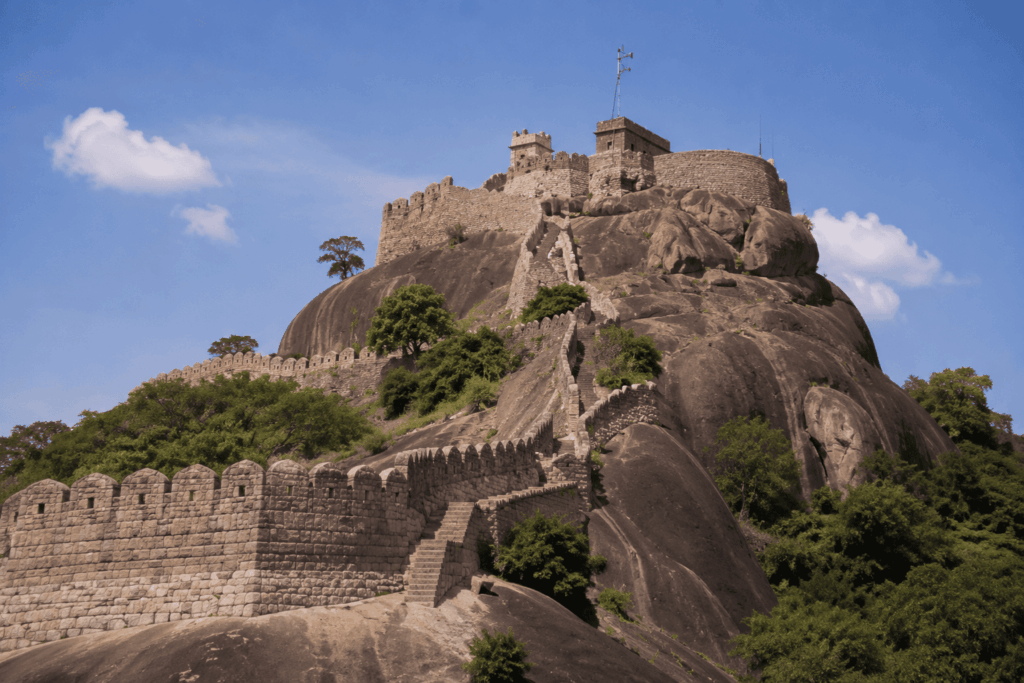
Rising majestically from a massive monolithic rock in the heart of **Namakkal , Tamil Nadu, **Namakkal Fort** is one of South India’s finest examples of medieval military architecture. Built atop a gigantic granite hill that dominates the surrounding landscape, this historic fort has witnessed centuries of political change, military campaigns, and cultural evolution.
Unlike many hill forts that are hidden deep within forests or mountains, Namakkal Fort stands prominently in the middle of the town, making it one of the most recognizable landmarks in western Tamil Nadu. The fort is closely associated with the powerful **Vijayanagara Empire**, the **Madurai Nayaks**, the **Kingdom of Mysore**, and later the **British East India Company**. Over the centuries, it served as an important military stronghold, administrative center, and strategic observation point.
Today, Namakkal Fort is protected by the **Archaeological Survey of India (ASI)** and attracts thousands of visitors each year. History lovers, architecture enthusiasts, photographers, trekkers, students, and competitive exam aspirants visit the fort to explore its remarkable engineering, panoramic views, and fascinating past.
This article explores the history, architecture, military importance, nearby attractions, and travel information about Namakkal Fort, offering readers a complete guide to one of Tamil Nadu’s hidden historical treasures.
Where Is Namakkal Fort Located?
Namakkal Fort is situated in Namakkal district Tamil Nadu.
Approximate distances:
Salem – 55 km
Erode – 65 km
Tiruchirappalli – 90 km
Karur – 35 km
Chennai – 380 km
The fort occupies a massive isolated granite hill that rises approximately **75 metres (250 feet)** above the surrounding town.
Its central location made it an ideal military observation post during ancient times.
Origin of Namakkal Fort
The rocky hill itself is believed to be millions of years old, while human settlements around it date back many centuries.
Although earlier dynasties controlled the region, the existing fort was primarily built during the **17th century** by **Ramachandra Nayak**, a ruler of the **Madurai Nayak Kingdom**.
The Nayaks recognized the strategic value of the massive granite hill and transformed it into a powerful defensive fortress.
Rule Under Different Dynasties
Early History
Before the construction of the fort, the region was influenced by:
The Cheras
The Cholas
The Pandyas
These dynasties contributed to the area’s cultural and religious development.
Vijayanagara Influence
Following the rise of the **Vijayanagara Empire**, Namakkal became an important administrative and military region.
The empire encouraged the development of forts across South India to secure trade routes and defend its territories.
Madurai Nayaks
The Madurai Nayaks were responsible for constructing most of the present-day fortifications.
They built:
Granite walls
Watchtowers
Defensive gateways
Water storage systems
Barracks
Secret passages
The fort became one of the strongest military installations in the region.
Mysore Kingdom
During the 18th century, Namakkal Fort came under the control of the **Kingdom of Mysore**.
Both **Hyder Ali** and **Tipu Sultan** recognized its military importance.
The fort served as a defensive base protecting Mysore’s southern territories.
British East India Company
Following the **Anglo-Mysore Wars**, the British East India Company occupied Namakkal Fort.
Although improvements in artillery gradually reduced its military significance, the British continued to use the fort for administrative purposes.
Why Was Namakkal Fort Important?
Namakkal Fort occupied a strategic location connecting western and central Tamil Nadu.
Its advantages included:
Elevated natural rock formation
Wide visibility over surrounding plains
Strong granite foundation
Difficult access for enemies
Control over regional trade routes
These features made it an ideal military fortress.
Architecture of Namakkal Fort
Namakkal Fort is admired for combining natural geography with remarkable engineering.
Massive Granite Rock
The fort is built directly upon a single gigantic granite rock.
Unlike ordinary hill forts, builders made use of the natural rock surface instead of constructing artificial platforms.
This greatly strengthened the fort’s defenses.
Fort Walls
The granite fortification walls follow the contours of the hill.
These thick walls were designed to withstand prolonged attacks and enemy artillery.
Many sections remain remarkably well preserved.
Entrance Gate
Visitors reach the summit through stone staircases leading to the main entrance.
The gateways were designed with narrow passages that slowed enemy movement.
Watch Towers
The elevated watchtowers provided soldiers with panoramic views extending for several kilometres.
Enemy armies could be detected long before they approached the fort.—
Water Management System
One of the greatest engineering achievements of Namakkal Fort is its rainwater harvesting system.
The builders created:
Rock-cut water tanks
Stone reservoirs
Rainwater channels
Wells
These ensured a dependable water supply during prolonged sieges.
Secret Passages
Like many medieval South Indian forts, Namakkal Fort is believed to contain hidden escape routes.
Although many have been sealed or damaged over time, local traditions continue to preserve stories about these secret passages.
Temples Near Namakkal Fort
One of the unique features of Namakkal is the close association between its military and religious heritage.
Narasimha Swamy Rock-Cut Temple
Located at the base of the hill, this ancient temple is carved directly into the rock.
Dedicated to Lord Narasimha, it is believed to date back to the **Pallava period**.
The temple contains:
Beautiful stone carvings
Ancient sculptures
Rock-cut sanctum
Historical inscriptions
It is considered one of the oldest monuments in Namakkal.
Namakkal Anjaneya Temple
Opposite the Narasimha Temple stands the famous **Namakkal Anjaneya Temple**.
The temple is known for its towering Hanuman idol, standing approximately **18 feet (5.5 metres)** tall.
Thousands of devotees visit the shrine every year, making it one of Tamil Nadu’s most revered Hanuman temples.
Military Engineering
The fort demonstrates outstanding military planning.
Important defensive features include:
Steep granite slopes* Thick fortification walls
Elevated watchpoints
Narrow stairways
Strong gateways
Water storage
Natural rocky barriers
These features made direct attacks extremely difficult.
Daily Life Inside the Fort
During its active years, the fort functioned as a self-sufficient military settlement.
It included:
Soldiers’ barracks
Storage rooms
Granaries
Water tanks
Administrative offices
Guard posts
The fort could accommodate a large military force during wartime.
Importance in Trade
Namakkal occupied an important position on trade routes connecting:
Salem
Karur
Tiruchirappalli
Erode
Coimbatore
Protecting these routes strengthened the region’s economy and increased the fort’s strategic value.
Conservation and Tourism
Today, Namakkal Fort is maintained by the Archaeological Survey of India.
Conservation efforts focus on:
Structural repairs
Stone preservation
Visitor safety
Historical documentation
Archaeological research
The fort has become an increasingly popular heritage destination.
Best Time to Visit
The ideal season is between:
October
November
December
January
February
Morning and evening visits offer cooler temperatures and excellent opportunities for photography.
Travel Tips
If you plan to visit Namakkal Fort:
Wear comfortable walking shoes.
Carry drinking water.
Visit early in the morning.
Bring a camera for panoramic views.
Explore the nearby temples.
Follow ASI regulations.
Avoid littering.
Importance for Competitive Exams
Namakkal Fort is relevant for UPSC, TNPSC, SSC, Railways, and state-level examinations.
Important facts include:
Located in Namakkal district.
Built by Ramachandra Nayak.
Constructed during the Madurai Nayak period.
Occupied later by Mysore rulers and the British.
Built atop a monolithic granite hill.
Protected by the Archaeological Survey of India.
Famous for its rock-cut water tanks and nearby Narasimha and Anjaneya temples.
Lesser-Known Facts
The granite hill on which the fort stands is estimated to be over a billion years old from a geological perspective.
The fort offers unobstructed panoramic views of the Namakkal region.
Ancient rainwater harvesting systems within the fort still demonstrate the engineering skills of medieval builders.
The Narasimha Temple at the foot of the hill predates the fort itself.
Namakkal is popularly known as the **”Egg City of India,”** making the fort a historical landmark in a district renowned for its poultry industry.
Why Namakkal Fort Matters Today
Namakkal Fort is more than a historical monument—it is a symbol of Tamil Nadu’s rich military, architectural, and cultural heritage. It showcases the ingenuity of medieval engineers who transformed a natural granite hill into a formidable fortress. The fort also reflects the region’s importance in trade, governance, and defense under successive South Indian dynasties.
For students and competitive exam aspirants, it offers valuable insights into medieval history and architecture. For researchers, it preserves evidence of military planning and regional politics. For travelers, it provides a memorable blend of history, spirituality, and breathtaking views.