
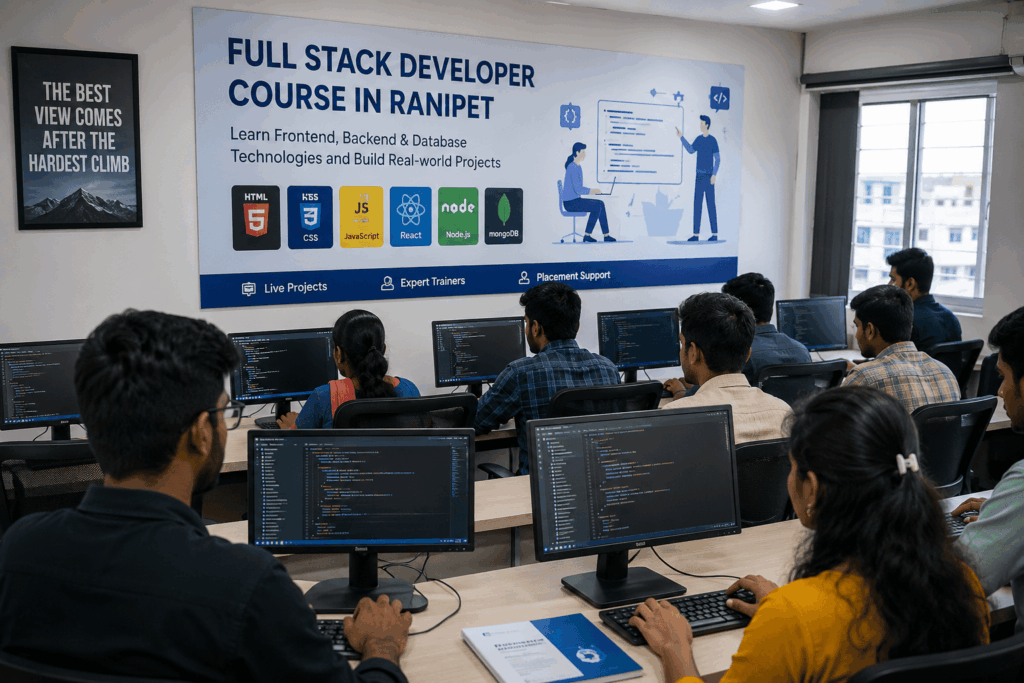
Full Stack Course in Tamil Nadu – Complete Career Guide for Beginners in 2026
Meta Title: Full Stack Course in Tamil Nadu | Best Training with Placement Support
Meta Description: Looking for the best Full Stack Course in Tamil Nadu? Learn about course syllabus, duration, fees, career opportunities, salary, and placement support in this complete guide.
URL Slug: full-stack-course-in-tamil-nadu
Full Stack Course in Tamil Nadu – Everything You Need to Know Before You Join
The IT industry in India is growing faster than ever, and companies are actively looking for professionals who can handle both front-end and back-end development. This is exactly why Full Stack Development has become one of the most popular career choices among students and working professionals.
If you are from Tamil Nadu and looking for a career that offers excellent salary packages, job security, and continuous learning opportunities, joining a Full Stack Course can be one of the smartest decisions you make.
Whether you are a college student, fresher, graduate, diploma holder, or someone planning to switch careers, Full Stack Development opens the door to thousands of job opportunities in software companies, startups, and multinational organizations.
In this guide, we’ll explain everything you need to know about Full Stack Development—from what it is and what you’ll learn to career opportunities, salaries, and how to choose the right training institute in Tamil Nadu.
What is Full Stack Development?
Full Stack Development refers to the ability to develop both the front-end (what users see) and the back-end (server, database, and business logic) of a website or web application.
Instead of working on only one part of a project, a Full Stack Developer can build an application from start to finish.
For example, when you use an online shopping website:
- The product pages, images, and buttons are part of the front-end.
- Login system, payment processing, and order management are handled by the back-end.
- The database stores user details, products, and order history.
A Full Stack Developer understands how all these components work together.
This makes them one of the most valuable professionals in today’s software industry.
Why is Full Stack Development So Popular in Tamil Nadu?
Tamil Nadu has become one of India’s fastest-growing IT destinations. Cities like Chennai, Coimbatore, Madurai, Trichy, Salem, Hosur, Vellore, and Tirunelveli have seen significant growth in software companies, startups, and technology parks.
Companies today prefer hiring Full Stack Developers because they can handle multiple responsibilities, reducing development costs and improving project efficiency.
Some major reasons why students choose Full Stack Development include:
- High demand across industries
- Attractive starting salaries
- Opportunities in startups and MNCs
- Freelancing opportunities
- Remote work options
- Faster career growth
- Excellent overseas opportunities
Even small businesses are now hiring Full Stack Developers to build websites, e-commerce platforms, and internal software applications.
Who Can Join a Full Stack Course?
One of the biggest advantages of Full Stack Development is that almost anyone with basic computer knowledge can start learning.
This course is suitable for:
- Engineering students
- B.Sc. Computer Science students
- BCA students
- MCA students
- Diploma holders
- IT graduates
- Freshers looking for jobs
- Working professionals
- Career switchers
- Freelancers
- Entrepreneurs planning to build their own products
You don’t need years of programming experience before joining the course. A good training institute will start with the fundamentals and gradually move to advanced concepts.
Skills You Will Learn in a Full Stack Course
A professional Full Stack course covers all the technologies required to build modern web applications.
1. HTML
HTML is the foundation of every website. You’ll learn how to create web pages, forms, tables, and website structures.
2. CSS
CSS helps make websites attractive and responsive.
You’ll learn:
- Layout design
- Flexbox
- Grid
- Responsive websites
- Mobile-friendly design
- Animations
3. JavaScript
JavaScript brings websites to life.
You’ll learn:
- Variables
- Functions
- Loops
- Arrays
- DOM Manipulation
- Events
- API Integration
- Modern JavaScript (ES6)
4. React JS
React is one of the most widely used front-end libraries.
Topics include:
- Components
- Props
- State Management
- Hooks
- Routing
- API Integration
- Project Development
5. Node.js
Node.js allows JavaScript to run on the server.
You’ll learn how to:
- Create servers
- Build REST APIs
- Handle authentication
- Manage user requests
6. Express.js
Express simplifies backend development.
Students learn:
- Routing
- Middleware
- Authentication
- API Development
- Error Handling
7. Database (MongoDB/MySQL)
Every application stores information in databases.
You’ll learn:
- CRUD Operations
- Collections
- Tables
- Queries
- Relationships
- Database Design
8. Git & GitHub
Version control is an essential skill for software developers.
You’ll understand:
- Repository creation
- Branching
- Commit history
- Collaboration
- GitHub portfolio management
Live Projects Included in the Course
Learning theory alone isn’t enough.
The best Full Stack courses include practical projects that help students gain real-world experience.
Typical projects include:
- E-commerce Website
- Hospital Management System
- Student Portal
- Employee Management System
- Food Delivery Application
- Online Banking System
- Movie Ticket Booking Website
- CRM Application
- Inventory Management System
- Job Portal
Working on these projects helps students understand how software is developed in real companies.
Benefits of Learning Through Live Projects
Many students complete courses but struggle during interviews because they lack practical experience.
Live projects help you:
- Build confidence
- Improve problem-solving skills
- Understand teamwork
- Create an impressive portfolio
- Answer technical interview questions effectively
- Gain hands-on coding experience
Employers always prefer candidates who can demonstrate practical skills instead of only theoretical knowledge.
Course Duration
The duration of a Full Stack Development course depends on the training format and the student’s learning pace.
Typically, most professional training institutes offer programs ranging from 4 to 6 months, covering both classroom learning and practical project work.
Students who dedicate regular time to coding practice can become job-ready within this period.
Weekend and fast-track batches are also available for working professionals who want to upskill without affecting their current job.
Why Hands-on Practice Matters More Than Theory
Many students make the mistake of focusing only on watching video tutorials or reading notes.
Software development is a practical skill.
The more you code, the better you become.
A good training institute encourages students to write code every day, solve programming challenges, build mini-projects, and participate in coding exercises.
This practical approach improves confidence and prepares students for real workplace challenges.