
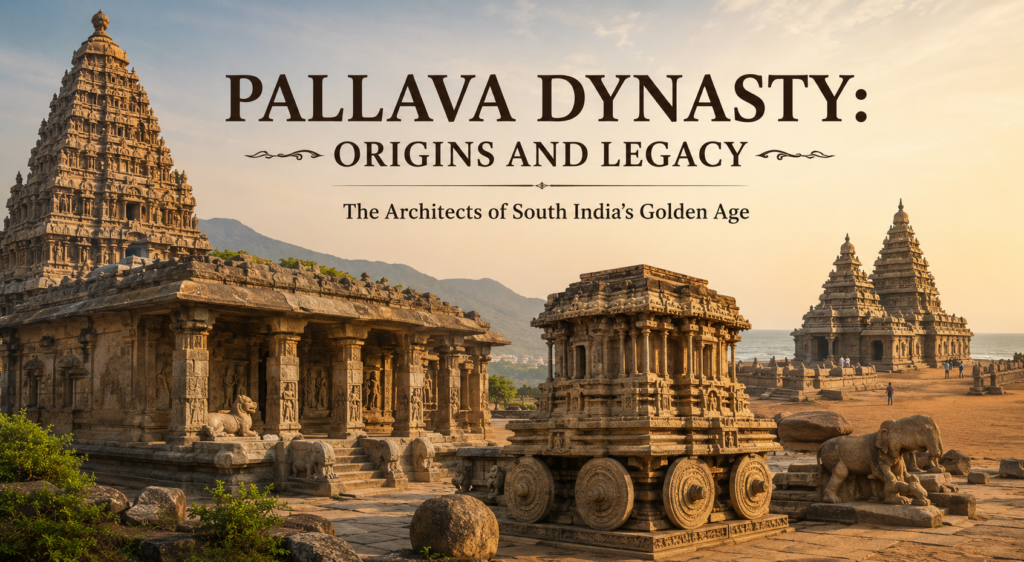
The Pallava Dynasty occupies a special place in the history of South India. Renowned for its remarkable achievements in architecture, administration, literature, and religious patronage, the Pallavas laid the foundation for many cultural traditions that continue to influence India today. Their rule transformed Kanchipuram into one of the most important centres of learning, spirituality, and art, while their magnificent rock-cut temples at Mahabalipuram (Mamallapuram remain among India’s greatest architectural treasures.
The Pallavas ruled large parts of present-day Tamil Nadu and Andhra Pradesh between the3rd and 9th centuries CE. During this period, they successfully defended their kingdom against powerful rivals such as the Chalukyas, Pandyas, and early Cholas. Beyond military achievements, they became pioneers of South Indian temple architecture and played a crucial role in the development of the **Dravidian architectural style which later reached its peak under the Cholas.
The dynasty also promoted education, literature, trade, and religious harmony. Their inscriptions provide valuable historical records, making the Pallavas one of the best-documented dynasties of early medieval India.
This article explores the fascinating origins of the Pallava Dynasty, its rise to power, its greatest rulers, and the enduring legacy that continues to attract historians, tourists, and students from around the world.
Who Were the Pallavas?
The Pallavas were an influential South Indian dynasty that ruled primarily from **Kanchipuram**, one of India’s oldest continuously inhabited cities.
Their kingdom covered:
Northern Tamil Nadu
Southern Andhra Pradesh
Parts of Karnataka during certain periods
Because of their strategic location, the Pallavas controlled important trade routes connecting South India with inland kingdoms and overseas markets.
Kanchipuram became their political capital and one of the greatest centres of religion, philosophy, education, and architecture.
The Origins of the Pallava Dynasty
The origins of the Pallavas remain one of the most debated subjects in Indian history.
Historians have proposed several theories regarding their ancestry.
Theory 1: Indigenous South Indian Origin
Many scholars believe the Pallavas were local rulers who gradually rose to prominence after the decline of the Satavahana Empire.
Theory 2: Andhra Connection
Another theory suggests that the Pallavas originated from regions of present-day Andhra Pradesh before expanding southward into Tamil Nadu.
Theory 3: Mixed Cultural Heritage
Some historians argue that the Pallavas represented a fusion of northern and southern traditions, adopting local Tamil customs while maintaining connections with Sanskrit culture.
Although debates continue, archaeological evidence clearly establishes the Pallavas as one of the earliest major powers of South India.
Rise of the Pallava Kingdom
The Pallavas began as regional chiefs but steadily expanded their influence.
By the 4th century CE, they had emerged as an independent kingdom.
Their strategic advantages included:
Fertile agricultural lands
Strong fortifications
Access to coastal trade
Skilled military leadership
Efficient administration
Over time, they replaced several smaller kingdoms and established themselves as a dominant force in South India.
Why Kanchipuram Became Famous
Kanchipuram was more than just a political capital.
It became renowned for:
Religious scholarship
Sanskrit learning
Tamil literature
Temple construction
Silk weaving
International trade
Pilgrims, scholars, merchants, and foreign travellers frequently visited the city, making it one of India’s greatest cultural centres.
Even today, Kanchipuram is celebrated as the “City of a Thousand Temples.”
Early Pallava Rulers
Several rulers laid the foundation of the Pallava Empire before its golden age.
Among them were:
Simhavarman
One of the early kings who strengthened Pallava authority and expanded the kingdom.
Skandavarman
His inscriptions reveal extensive land grants, administrative organization, and support for religious institutions.
These rulers established political stability that enabled later kings to transform the Pallava state into a major regional power.
Society Under the Pallavas
The Pallava Kingdom enjoyed a well-organized society based on agriculture, trade, and skilled craftsmanship.
Major occupations included:
Farmers
Merchants
Artisans
Sculptors
Soldiers
Priests
Scholars
Village communities played an important role in local administration, while merchants contributed significantly to the economy through inland and overseas trade.
Women participated in religious life, education, and charitable activities, as evidenced by inscriptions recording donations made by queens and noblewomen.
Economy of the Pallava Kingdom
The Pallava economy rested on multiple sources of income.
Agriculture
The fertile plains of northern Tamil Nadu produced:
Rice
Millets
Sugarcane
Cotton
Pulses
Irrigation tanks and canals helped maintain agricultural productivity.
Trade
The Pallavas actively encouraged trade with:
Sri Lanka
Southeast Asia
China
Arab merchants
Exports included:
Cotton textiles
Spices
Precious stones
Ivory
Handicrafts
Trade generated considerable wealth and supported urban development.
Craftsmanship
Pallava artisans became famous for:
Stone sculpture
Bronze work
Jewellery
Temple carving
Silk weaving
These industries provided employment and enhanced the kingdom’s prosperity.
Religion During the Pallava Period
The Pallava rulers primarily supported Hinduism, especially **Shaivism** and **Vaishnavism**.
However, they also patronized:
Jainism
Buddhism
This religious tolerance encouraged intellectual exchange and cultural diversity.
Temples became centres of:
Education
Music
Dance
Literature
Social welfare
Local administration
The Beginning of Pallava Architecture
One of the Pallavas’ greatest contributions to Indian civilization was architecture.
Earlier South Indian temples were mostly constructed using wood and brick.
The Pallavas introduced:
Rock-cut cave temples
Monolithic shrines
Structural stone temples
These innovations revolutionized temple construction across South India.
Their experiments eventually inspired the magnificent temples built by the Cholas and later dynasties.
Mahabalipuram: A Living Heritage
The coastal town of Mahabalipuram (Mamallapuram) became one of the greatest artistic centres under the Pallavas.
Here, master sculptors carved:
Cave temples
Monolithic rathas
Rock reliefs
Shore temples
These monuments display extraordinary engineering skills and artistic excellence.
Today, Mahabalipuram is recognized as a UNESCO World Heritage Site and attracts visitors from across the globe.
Foundation for a Golden Age
By the beginning of the 7th century CE, the Pallavas had become one of the strongest kingdoms in South India.
Their achievements in administration, agriculture, trade, education, and architecture created the ideal conditions for a golden age under legendary rulers such as **Mahendravarman I** and **Narasimhavarman I**.
These kings would elevate the Pallava Empire to unprecedented heights, defeating powerful rivals and creating some of India’s finest architectural masterpieces.