
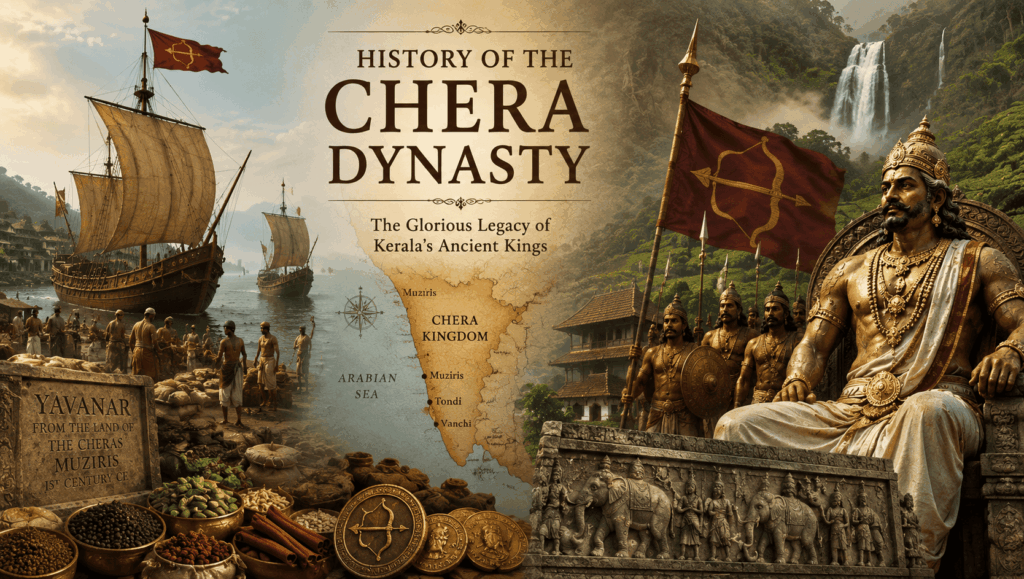
The Chera Dynasty was one of the oldest and most influential royal dynasties in ancient South India. Alongside the Cholas and the Pandyas, the Cheras formed the celebrated Three Crowned Kings of Tamilakam, who shaped the political, economic, and cultural landscape of southern India for centuries.
The Cheras were renowned for their flourishing trade, powerful ports, skilled administration, and strong connections with the Roman Empire and other international civilizations. Their kingdom stretched across present-day Kerala, parts of western Tamil Nadu, and the fertile regions along the Western Ghats. Blessed with abundant rainfall, dense forests, spice plantations, and access to the Arabian Sea, the Chera Kingdom became one of the wealthiest trading powers of the ancient world.
Unlike many kingdoms that relied primarily on military conquest, the Cheras built much of their prosperity through commerce. Their exports of black pepper, cardamom, cinnamon, ivory, pearls, sandalwood, and fine textiles attracted merchants from Rome, Arabia, Egypt, and Southeast Asia. This thriving trade helped establish South India as an important centre of the global economy during ancient times.
Today, the legacy of the Chera Dynasty lives on through historical literature, archaeological discoveries, temple traditions, and Kerala’s rich cultural heritage. Understanding the history of the Cheras offers valuable insights into India’s maritime past and the evolution of Tamil and Malayalam culture.
Who Were the Cheras?
The Cheras were an ancient Tamil dynasty that ruled the western part of South India for several centuries.
Their territory included:
- Present-day Kerala
- Western Tamil Nadu
- Parts of the Nilgiri Hills
- Regions along the Malabar Coast
Their strategic location between the Arabian Sea and the Western Ghats allowed them to control major trade routes connecting India with the Middle East and the Mediterranean world.
The Chera emblem was traditionally the bow and arrow, symbolizing military strength and royal authority.
Origins of the Chera Dynasty
The exact origins of the Chera rulers remain uncertain because many early records have been lost over time. However, historians agree that the dynasty emerged long before the Common Era.
Evidence for the Cheras comes from several important sources:
- Sangam literature
- Ancient Tamil inscriptions
- Ashoka’s edicts
- Greek and Roman accounts
- Archaeological discoveries
- Coins issued by Chera rulers
These sources collectively indicate that the Cheras were already a well-established political power by the early centuries BCE.
The Cheras in Sangam Literature
The Sangam Age (approximately 300 BCE–300 CE) provides the richest literary information about the Chera Kingdom.
Many poems praise Chera rulers for:
- Courage in battle
- Fair administration
- Patronage of poets
- Protection of merchants
- Generosity toward their subjects
Unlike purely political records, Sangam literature also describes everyday life, agriculture, trade, festivals, and social customs, making it an invaluable source for understanding ancient South India.
Capitals of the Chera Kingdom
Historians believe the Cheras ruled from several capitals during different periods.
Among the most important were:
Vanchi (Karur)
Many scholars identify Karur in present-day Tamil Nadu as one of the earliest Chera capitals.
Located near important inland trade routes, Karur became a centre for administration, commerce, and military planning.
Archaeological excavations have uncovered Roman coins, pottery, beads, and inscriptions, demonstrating the city’s international connections.
Kodungallur (Muziris Region)
Another important centre was Kodungallur, closely associated with the ancient port of Muziris.
This bustling harbour became one of the most famous ports in the ancient world.
Merchants from Rome, Egypt, Arabia, and Greece visited Muziris to purchase valuable spices and luxury goods from the Chera Kingdom.
Geography: A Kingdom Blessed by Nature
The Chera Kingdom enjoyed several natural advantages that contributed to its prosperity.
The Western Ghats
The mountain range protected the kingdom from invasions while providing forests rich in valuable timber, medicinal plants, and wildlife.
Rivers
Numerous rivers flowing from the Western Ghats supported agriculture and inland transportation.
These rivers also supplied fertile soil suitable for rice cultivation.
Arabian Sea Coast
Access to the Arabian Sea enabled international maritime trade on an unprecedented scale.
Ports along the coast became gateways connecting India with distant civilizations.
The Spice Trade: Source of Chera Wealth
The Chera Kingdom became famous across the ancient world for producing spices.
The most valuable export was black pepper, often referred to as “Black Gold.”
Other exports included:
- Cardamom
- Cinnamon
- Ginger
- Turmeric
- Sandalwood
- Ivory
- Coconut products
- Fine cotton textiles
- Precious stones
These products were highly sought after by merchants from Rome and the Middle East.
In return, the Cheras imported:
- Gold coins
- Wine
- Glassware
- Coral
- Luxury ceramics
- Fine jewellery
Trade generated enormous wealth, allowing the Chera rulers to strengthen their kingdom and patronize literature and the arts.
Roman Trade with the Cheras
One of the most fascinating aspects of Chera history is its close commercial relationship with the Roman Empire.
Ancient Roman writers described ships sailing directly to the Malabar Coast to purchase spices.
Archaeologists have discovered:
- Roman gold coins
- Amphora fragments
- Mediterranean pottery
- Glass beads
These findings provide strong evidence that the Chera Kingdom participated in one of the world’s earliest international trade networks.
Roman demand for pepper became so great that some historians noted concerns about the large amounts of gold flowing from Rome to India.
Society in the Chera Kingdom
The Chera Kingdom was home to a diverse and prosperous society.
Major occupations included:
- Farmers
- Fishermen
- Spice cultivators
- Merchants
- Artisans
- Metalworkers
- Sailors
- Poets
Agriculture remained the backbone of the economy, while merchants accumulated wealth through international commerce.
Women participated in family businesses, religious activities, and charitable works, and Sangam literature reflects their important role in society.
Religion and Cultural Life
The Chera rulers supported multiple religious traditions.
These included:
- Hinduism
- Jainism
- Buddhism
Temples, monasteries, and educational centres flourished under royal patronage.
Festivals, music, dance, and poetry became important expressions of the kingdom’s vibrant cultural life.
The Cheras encouraged scholars and poets, contributing significantly to the development of classical Tamil literature.
Early Chera Rulers
Although historical details are limited, several rulers gained lasting fame through Sangam literature.
Among them were:
Uthiyan Cheralathan
Remembered as one of the earliest Chera rulers, he expanded the kingdom and strengthened trade.
Nedum Cheralathan
Known for military campaigns and patronage of poets, he enhanced the kingdom’s prestige.
Senguttuvan Chera
Perhaps the most celebrated Chera king, Senguttuvan became famous for his military victories and his association with the Pattini (Kannagi) cult, as described in the Tamil epic Silappadikaram.
His reign is often regarded as a golden period in early Chera history.