
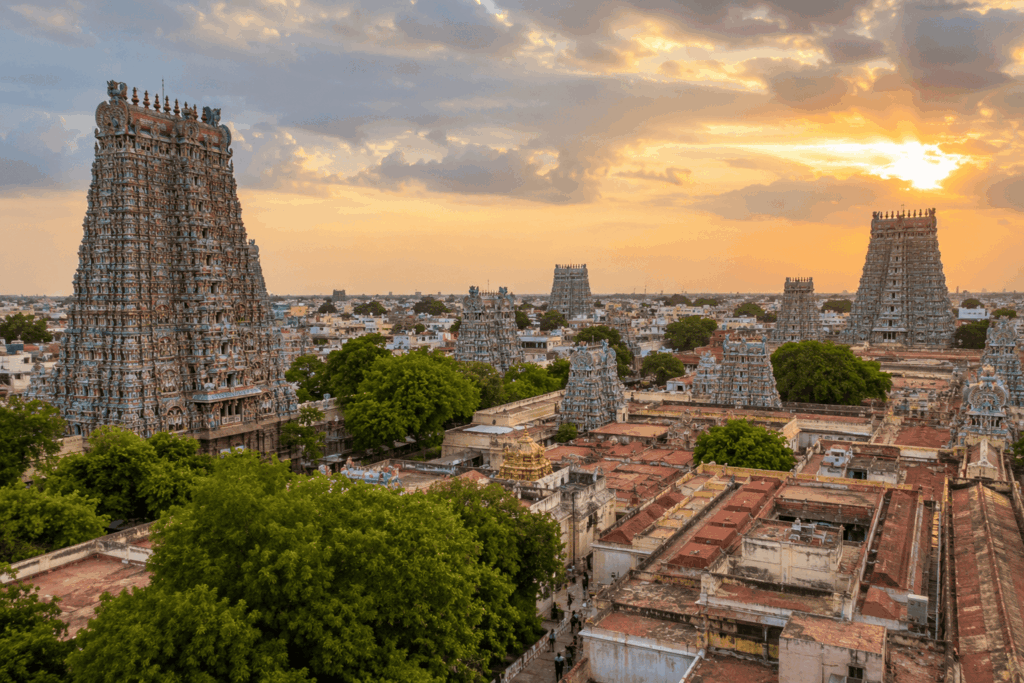
Madurai is one of India’s oldest continuously inhabited cities and a shining symbol of Tamil civilization. Located on the banks of the Vaigai River in southern Tamil Nadu, Madurai has been a centre of culture, literature, trade, religion, and education for more than two millennia. Often referred to as the **”Athens of the East,”** the city is celebrated for its magnificent temples, rich heritage, thriving markets, and enduring contribution to Tamil language and culture.
Throughout history, Madurai has been ruled by several powerful dynasties, including the Pandyas, Cholas, Madurai Sultanate, Vijayanagara Empire, Nayaks, and the British. Despite political changes and invasions, the city has preserved its unique identity as one of South India’s most important cultural and spiritual centres.
The world-famous **Meenakshi Amman Temple**, the vibrant streets surrounding it, ancient inscriptions, literary traditions, and historic monuments continue to attract millions of pilgrims, tourists, historians, and researchers every year. For students preparing for competitive examinations, Madurai holds immense significance due to its association with the Sangam Age, the Pandya Kingdom, and Tamil literature.
This article explores the fascinating history of Madurai—from its legendary origins and ancient kingdoms to its role in shaping Tamil civilization and modern India.
The Origin of Madurai
The history of Madurai blends mythology with historical evidence, making it one of the most fascinating cities in India.
According to Hindu tradition, Lord Shiva blessed the city when divine nectar (*Madhu*) fell upon the land from his matted hair. This sacred event is believed to have inspired the name **Madurai**, derived from the Tamil word associated with sweetness or nectar.
Another popular legend tells the story of Goddess Meenakshi, an incarnation of Goddess Parvati, who ruled the Pandya Kingdom before marrying Lord Sundareshwarar (Shiva). Their divine wedding is celebrated annually during the grand Chithirai Festival, one of Tamil Nadu’s largest religious events.
While mythology gives Madurai its spiritual identity, archaeological discoveries confirm that the region has been inhabited for thousands of years.
Madurai in Ancient History
Archaeological evidence suggests that settlements around Madurai existed long before the Common Era.
Excavations in and around the city have revealed:
Ancient pottery
Iron tools
Beads
Coins
Burial sites
Early inscriptions
These discoveries indicate that Madurai developed into an important urban centre due to its fertile surroundings and strategic location along trade routes.
Its proximity to the Vaigai River supported agriculture, while nearby roads connected the city to ports on the eastern and western coasts of India.
Madurai During the Sangam Age
Madurai occupies a central place in the history of Tamil literature because it served as the heart of the Sangam Age.
The Sangam period, generally dated between approximately 300 BCE and 300 CE, witnessed extraordinary achievements in poetry, language, philosophy, and scholarship.
According to tradition, Tamil scholars gathered in literary assemblies known as **Sangams**, where poets presented their works before learned scholars and royal patrons.
Although historians continue to debate certain details of the Sangams, there is little doubt that Madurai became the foremost centre of classical Tamil learning.
Many famous literary works emerged during this period, describing:
Society
Agriculture
Warfare
Trade
Love
Nature
Ethics
Kingship
These texts remain invaluable sources for understanding ancient South India.
The Rise of the Pandya Kingdom
The Pandyas were among the earliest ruling dynasties of South India, and Madurai became their political and cultural capital.
Classical Greek and Roman writers mentioned the Pandya Kingdom in their accounts, highlighting its prosperity and international trade.
Under Pandya rule, Madurai flourished because of:
Strong administration
Agricultural prosperity
Active trade
Patronage of literature
Religious tolerance
Urban planning
The city emerged as one of India’s leading centres of commerce and education.
Madurai as a Centre of International Trade
Trade played a major role in Madurai’s growth.
Merchants transported valuable goods to ports along the Tamil coast, where ships carried them to:
Rome
Greece
Egypt
Arabia
Sri Lanka
Southeast Asia
Important exports included:
Pearls
Cotton textiles
Pepper
Spices
Ivory
Precious stones
Roman gold coins discovered in Tamil Nadu demonstrate the strength of these international trading connections.
The wealth generated through commerce contributed to the construction of temples, public buildings, irrigation systems, and markets.
Importance of the Vaigai River
The Vaigai River has shaped Madurai’s history for centuries.
Its waters supported:
Agriculture
Drinking water
Religious ceremonies
Trade
Urban development
Ancient rulers invested heavily in irrigation tanks and canals connected to the Vaigai, helping surrounding villages cultivate rice, sugarcane, and other crops.
This agricultural prosperity strengthened the city’s economy and supported population growth.
Religion and Spiritual Life
Madurai developed into one of India’s most important centres of Hindu worship.
Temples served not only as places of prayer but also as centres for:
Education
Music
Dance
Charity
Literature
Community gatherings
Various religious traditions, including Jainism and Buddhism, also flourished in different periods, contributing to Madurai’s diverse cultural landscape.
This atmosphere of intellectual exchange enriched Tamil society for centuries.
Growth of the Meenakshi Temple
Although the present-day Meenakshi Amman Temple reached its magnificent form during the Nayak period, earlier temple structures existed in ancient Madurai.
Successive Pandya rulers supported temple construction and renovation.
The temple gradually became the spiritual heart of the city, influencing its urban layout.
Markets, residential streets, and public spaces developed around the sacred complex, creating a city plan that continues to define Madurai today.
Architecture in Ancient Madurai
Ancient Madurai displayed remarkable urban planning.
The city included:
Fortified walls
Gates
Markets
Palaces
Temples
Water tanks
Residential neighbourhoods
Roads radiated outward from the temple complex, reflecting both religious beliefs and practical city planning.
Stone sculptures, inscriptions, and temple architecture showcased the artistic excellence of Tamil craftsmen.
Education and Literature
Madurai’s reputation as a learning centre attracted scholars from across South India.
Royal patronage encouraged the study of:
* Tamil grammar
Poetry
Philosophy
Astronomy
Mathematics
Medicine
Many celebrated Tamil poets found support in the Pandya court, helping preserve one of the world’s oldest literary traditions.
Why Madurai Became Famous
Several factors contributed to Madurai’s enduring prominence:
Strategic location
Fertile agricultural lands
International trade
Powerful Pandya rulers
Rich literary traditions
Religious significance
Architectural achievements
Cultural patronage
These strengths enabled the city to remain influential for more than two thousand years despite repeated political changes.
Madurai’s Legacy Today
Modern Madurai continues to preserve its ancient heritage while growing as an important educational, commercial, and tourism centre.
Visitors from around the world come to experience:
Historic temples
Traditional markets
Classical Tamil culture
Ancient architecture
Local cuisine
Colourful festivals
Its combination of history and living traditions makes Madurai one of India’s most remarkable cities.