
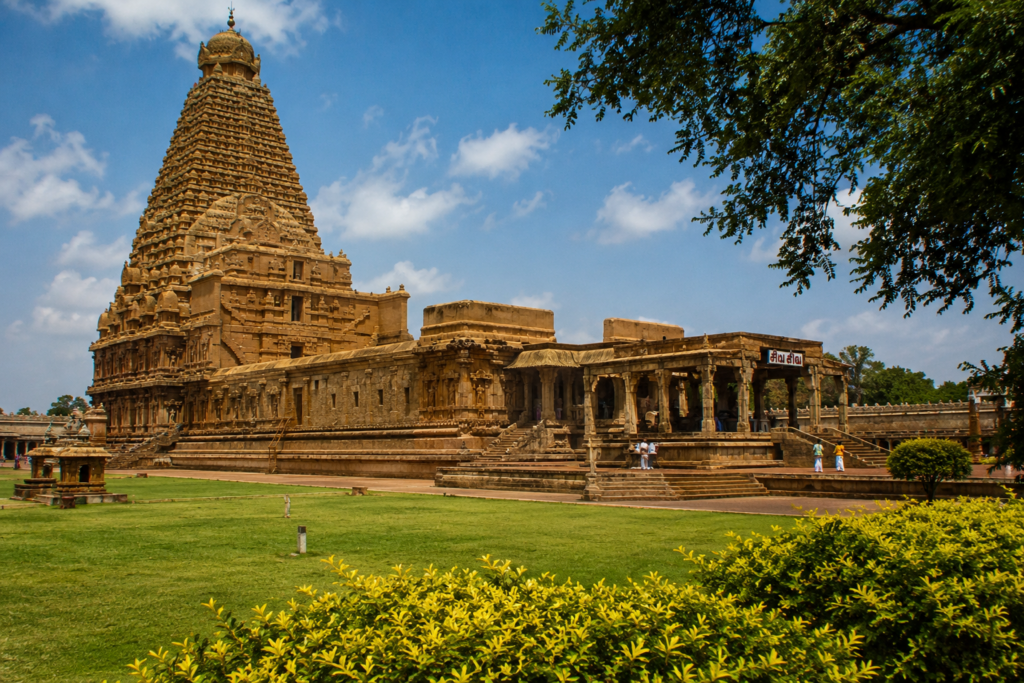
Thanjavur, often called the **Cultural Capital of Tamil Nadu , is one of India’s most historically significant cities. Situated in the fertile Cauvery Delta, this ancient city has been a centre of political power, art, architecture, literature, music, religion, and education for more than a thousand years. Best known as the capital of the mighty Chola Empire, Thanjavur is home to the magnificent **Brihadeeswarar Temple , a UNESCO World Heritage Site and one of the greatest architectural masterpieces in the world.
The city’s rich history extends far beyond the Cholas. Over the centuries, Thanjavur was ruled by the Mutharaiyars, Pandyas, Vijayanagara rulers, Nayaks, Marathas, and the British. Each dynasty contributed to the city’s growth, leaving behind magnificent temples, palaces, libraries, irrigation systems, and cultural traditions that continue to shape Tamil Nadu’s identity today.
Thanjavur is also famous for its classical Carnatic music, Bharatanatyam, Thanjavur paintings, bronze sculptures, traditional handicrafts, and the world-renowned Saraswathi Mahal Library. These achievements have made the city an important destination for historians, researchers, students, pilgrims, and tourists from around the world.
For competitive exam aspirants, Thanjavur represents an important chapter in South Indian history, particularly the rise of the Chola Empire and its contribution to administration, maritime trade, architecture, and culture.
This article explores the fascinating journey of Thanjavur from its ancient origins to its modern status as one of India’s greatest heritage cities.
The Origin of Thanjavur
The origin of Thanjavur is closely connected with mythology, history, and geography.
According to local legend, the city derives its name from a demon called **Tanjan**, who was defeated by Lord Vishnu. Before dying, Tanjan requested that the city be named after him, giving rise to the name **Thanjavur**.
Another explanation links the name to the Tamil word **”Thanjai,”** meaning a place of refuge or fertile land. Given its location in the fertile Cauvery Delta, Thanjavur became a natural centre for agriculture and human settlement.
Regardless of its exact origin, historical evidence confirms that Thanjavur has been an important settlement for well over a thousand years.
Early History of Thanjavur
Before becoming the capital of the Chola Empire, Thanjavur was ruled by local chieftains and regional dynasties.
The fertile plains surrounding the city encouraged:
Agriculture
Irrigation
Trade
Settlement growth
Archaeological discoveries indicate that the region supported prosperous farming communities long before the rise of the medieval kingdoms.
Its strategic location between inland trade routes and the eastern coastline further contributed to its development.
The Mutharaiyar Dynasty
Before the Cholas established their capital, Thanjavur was ruled by the **Mutharaiyars**, a powerful regional dynasty.
The Mutharaiyars governed large parts of central Tamil Nadu between the 7th and 9th centuries CE.
They strengthened local administration, encouraged agriculture, and constructed temples and irrigation works that supported economic development.
Although many of their monuments have been modified over time, inscriptions provide valuable information about their contribution to the region’s early history.
Rise of the Chola Empire
The history of Thanjavur changed dramatically during the 9th century when **Vijayalaya Chola** captured the city from the Mutharaiyars.
This victory marked the beginning of the Imperial Chola Empire.
Vijayalaya chose Thanjavur as his capital because of its:
Fertile agricultural land
Strong defensive position
Excellent irrigation network
Access to trade routes
Central location within the Cauvery Delta
From this point onward, Thanjavur became one of the most powerful political centres in South India.
Thanjavur as the Chola Capital
Under the Cholas, Thanjavur experienced extraordinary growth.
Successive rulers transformed the city into a thriving centre of:
Administration
Trade
Religion
Literature
Art
Education
Architecture
The Cholas established an efficient administrative system supported by village assemblies, land surveys, taxation, and irrigation management.
Their governance contributed to political stability and economic prosperity across much of South India.
Rajaraja Chola I and the Golden Age
The greatest transformation of Thanjavur occurred during the reign of **Rajaraja Chola I (985–1014 CE).**
He expanded the Chola Empire across South India, Sri Lanka, and parts of Southeast Asia, making it one of the most powerful maritime empires of its time.
His achievements included:
Administrative reforms
Naval expansion
Temple construction
Promotion of trade
Patronage of literature and arts
His reign is widely regarded as the golden age of Chola civilization.
Brihadeeswarar Temple
One of Rajaraja Chola’s greatest achievements was the construction of the magnificent **Brihadeeswarar Temple**, completed in 1010 CE.
Dedicated to Lord Shiva, this temple remains one of India’s finest examples of medieval architecture.
Remarkable features include:
Towering granite vimana
Massive Nandi statue
Intricate sculptures
Chola frescoes
Detailed inscriptions
Advanced engineering techniques
The temple demonstrates the extraordinary architectural and engineering skills of Chola craftsmen.
More than a thousand years later, it continues to inspire architects, historians, engineers, and pilgrims from around the world.
Trade and Economic Prosperity
Thanjavur prospered because of both agriculture and international trade.
The fertile Cauvery Delta produced abundant:
Rice
Sugarcane
Pulses
Cotton
Meanwhile, Chola merchants traded with:
Sri Lanka
Southeast Asia
China
Arabia
Major exports included:
textiles
Spices
Bronze sculptures
Precious stones
Ivory
Fine handicrafts
The wealth generated through trade financed temples, irrigation systems, roads, and public works.
Irrigation and Agriculture
One of the greatest strengths of the Chola administration was its irrigation system.
Building upon earlier works such as the ancient **Kallanai (Grand Anicut)**, the Cholas expanded canals, tanks, and reservoirs throughout the Cauvery Delta.
These irrigation projects:
Increased agricultural productivity
Reduced famine risks
Supported population growth
Strengthened the kingdom’s economy
Even today, many irrigation structures trace their origins to the Chola period.
Art, Literature, and Culture
Thanjavur became a flourishing centre of Tamil culture.
The Chola rulers encouraged:
Tamil literature
Sanskrit scholarship
Temple music
Classical dance
Bronze sculpture
Painting
Temples functioned not only as religious centres but also as institutions supporting education, arts, and charitable activities.
The city’s cultural traditions laid the foundation for many artistic practices that continue to thrive in Tamil Nadu today.
Architecture of the Chola Period
Chola architecture emphasized grandeur, symmetry, and durability.
Its key characteristics included:
Massive granite structures
Towering temple towers
Sculptured pillars
Elaborate carvings
Spacious courtyards
Monumental gateways
These innovations influenced temple architecture across South India and beyond.
The Brihadeeswarar Temple remains the finest surviving example of this architectural style.
Why Thanjavur Became Famous
Several factors contributed to Thanjavur’s lasting importance:
Capital of the Chola Empire
Advanced irrigation systems
International maritime trade
Monumental temple architecture
Rich literary traditions
Flourishing arts and crafts
Strong administrative system
Agricultural prosperity
Together, these achievements established Thanjavur as one of the greatest cities of medieval India.