
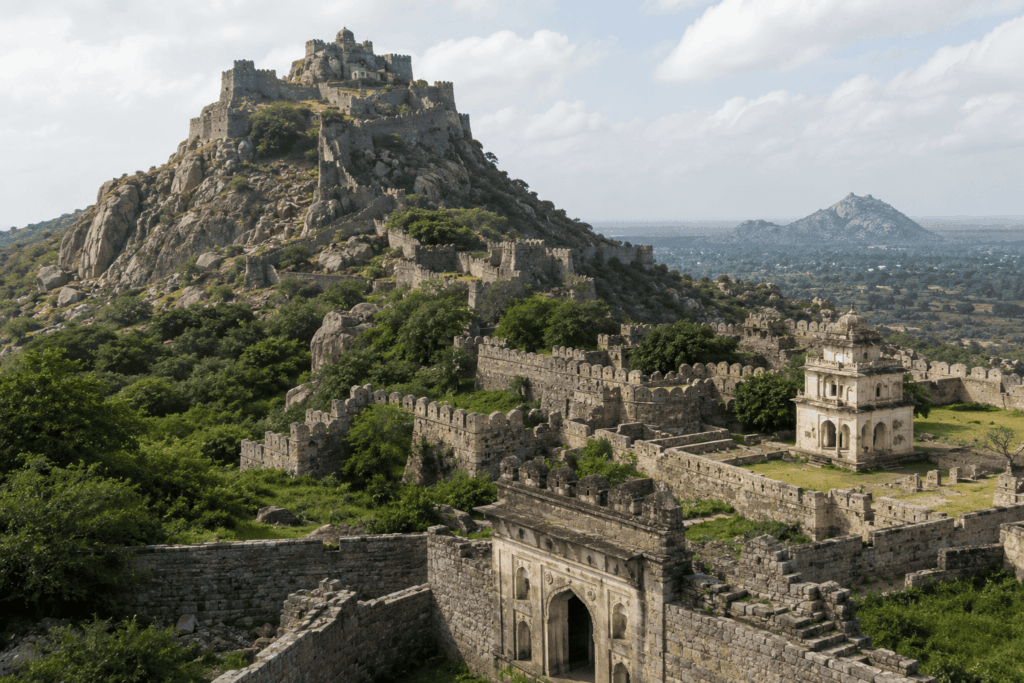
Perched dramatically atop three rocky hills in the Villupuram district of Tamil Nadu, Gingee Fort (also known as Senji Fort) is one of India’s most remarkable military fortifications. With its towering granite walls, steep hilltop citadels, secret pathways, massive granaries, and centuries-old temples, the fort stands as a symbol of courage, engineering brilliance, and strategic planning.
Often referred to as the “Troy of the East,” Gingee Fort earned this title because of its extraordinary defensive design, which made it one of the most difficult forts in India to conquer. Over the centuries, it witnessed the rise and fall of several powerful dynasties, including the Cholas, Vijayanagara Empire, Nayaks, Marathas, Mughals, French, and the British.
Today, Gingee Fort is a protected monument managed by the Archaeological Survey of India (ASI). It attracts history enthusiasts, trekkers, photographers, students, and tourists who come to explore its majestic ruins and learn about its fascinating past.
Whether you are preparing for competitive examinations, planning a heritage trip across Tamil Nadu, or simply interested in Indian history, Gingee Fort offers an unforgettable journey through nearly a thousand years of military and cultural heritage.
Where Is Gingee Fort Located?
Gingee Fort is located in Villupuram district, about:
- 38 km from Tindivanam
- 65 km from Puducherry
- 160 km from Chennai
The fort occupies a vast area spread across three rocky hills:
- Rajagiri
- Krishnagiri
- Chandrayandurg (also called Chakkili Durg)
Together, these hills form one of the strongest natural defensive systems in South India.
Origin of Gingee Fort
The earliest fortifications at Gingee are believed to have been established around the 9th century CE by the local Konar chiefs. Initially, the settlement consisted of simple defensive structures built on naturally elevated rocky hills.
Its strategic location between northern Tamil Nadu and the Coromandel Coast made it an important military outpost. Over time, successive rulers expanded the fort into a massive fortified complex.
Expansion Under the Vijayanagara Empire
The fort underwent significant development during the Vijayanagara Empire in the 15th and 16th centuries.
The Vijayanagara rulers recognized Gingee’s strategic importance and strengthened its defenses by constructing:
- High stone walls
- Watchtowers
- Fortified gateways
- Granaries
- Water reservoirs
- Temples
- Barracks
These additions transformed Gingee into one of the strongest hill forts in South India.
The Nayak Period
Following the decline of the Vijayanagara Empire after the Battle of Talikota (1565), Gingee came under the control of the Gingee Nayaks.
The Nayaks expanded the fort considerably by adding:
- Defensive bastions
- Palaces
- Audience halls
- Marriage halls
- Storehouses
- Secret escape routes
Many of the structures visible today date back to this period.
Maratha Rule and Chhatrapati Rajaram
One of the most significant chapters in Gingee’s history began during the late 17th century.
Following the death of Chhatrapati Shivaji Maharaj, the Mughal emperor Aurangzeb intensified his campaign against the Marathas.
In 1689, Chhatrapati Rajaram, Shivaji’s younger son, escaped from Maharashtra and took refuge in Gingee Fort. From here, he continued organizing Maratha resistance against the Mughal Empire.
Because of its formidable defenses, Gingee became the temporary capital of the Maratha Empire in the south.
The Mughal Siege
Aurangzeb considered Gingee Fort a major obstacle to Mughal expansion.
The Mughal army, under the command of Zulfiqar Khan, laid siege to the fort.
The siege lasted nearly eight years (1690–1698), making it one of the longest sieges in Indian history.
Despite sustained attacks, the fort’s natural defenses, ample water storage, and food reserves allowed the defenders to hold out for years.
Eventually, the Mughals captured the fort after Rajaram had already escaped safely.
This prolonged resistance further enhanced Gingee’s reputation as an almost impregnable fortress.
French and British Occupation
During the 18th century, Gingee Fort changed hands several times.
It came under:
- Mughal administration
- Carnatic Nawabs
- French East India Company
- British East India Company
Both the French and British recognized its strategic importance during the Carnatic Wars.
Eventually, the British gained control and used the fort for military purposes before its strategic significance declined with the advent of modern warfare.
Why Is Gingee Called the “Troy of the East”?
British military historians compared Gingee Fort to the legendary city of Troy because of its exceptional defensive design.
Several factors contributed to this reputation:
- Three independently fortified hills
- Massive stone walls
- Narrow access routes
- Natural rocky cliffs
- Deep moats
- Watchtowers with panoramic views
- Secret passages
- Strong gateways
- Excellent water storage systems
These features made Gingee one of the most secure forts in India.
Architecture of Gingee Fort
Gingee Fort is admired for its blend of military engineering and traditional South Indian architecture.
Rajagiri Fort
Rajagiri is the tallest and most impressive hill within the complex.
Highlights include:
- Nearly 800 stone steps
- Massive entrance gate
- Seven fortified gateways
- Granaries
- Audience hall
- Kalyana Mahal (Marriage Hall)
- Temple ruins
- Water tanks
The panoramic view from the summit is breathtaking.
Krishnagiri Fort
Located opposite Rajagiri, Krishnagiri served as an additional defensive position.
Features include:
- Stone walls
- Watchtowers
- Granaries
- Temples
- Water reservoirs
It provided a clear view of approaching armies.
Chandrayandurg
Although less developed than the other two hills, Chandrayandurg formed an important part of the fort’s defensive network.
Its elevated position strengthened the overall security of the complex.
Remarkable Structures Inside the Fort
Kalyana Mahal
One of the most photographed monuments inside Gingee Fort, the Kalyana Mahal features a tall pyramidal tower and elegant arches.
Historians believe it may have served as a royal residence or ceremonial building rather than solely as a marriage hall.
Granaries
Large circular granaries were built to store food during prolonged sieges.
Their design helped preserve grains for extended periods, enabling the fort to withstand lengthy military blockades.
Water Management System
One of Gingee’s greatest strengths was its sophisticated water management.
The fort contains:
- Rainwater harvesting tanks
- Reservoirs
- Wells
- Stone-lined channels
These ensured a reliable water supply even during sieges.
Temples
Several temples within the fort reflect the religious life of its inhabitants.
Although some structures are partially damaged, they display beautiful carvings and traditional Dravidian architectural features.
Military Engineering
Gingee Fort demonstrates exceptional knowledge of medieval military architecture.
Important defensive features include:
- Multi-layered fortifications
- Thick granite walls
- Elevated watchtowers
- Narrow stairways
- Hidden pathways
- Defensive bastions
- Controlled entry points
The natural rocky terrain significantly enhanced its defensive capabilities.
Cultural Importance
Beyond warfare, Gingee Fort served as:
- A royal administrative center
- A trading hub
- A religious center
- A refuge during invasions
- A symbol of regional power
Its multicultural history reflects the influence of Tamil, Telugu, Marathi, Mughal, French, and British traditions.
Conservation and Tourism
Today, Gingee Fort is protected by the Archaeological Survey of India.
Conservation efforts focus on:
- Structural restoration
- Vegetation control
- Visitor safety
- Preservation of historical monuments
- Archaeological documentation
The site has become a popular destination for:
- History lovers
- Trekking enthusiasts
- Photographers
- Architecture students
- Heritage tourists
Travel Tips
If you plan to visit Gingee Fort:
- Visit between October and February for pleasant weather.
- Wear comfortable trekking shoes.
- Carry sufficient drinking water.
- Start early in the morning to avoid afternoon heat.
- Allow at least 3–4 hours to explore the complex.
- Follow ASI guidelines and avoid climbing on protected structures.
Importance for Competitive Exams
Gingee Fort is a frequently asked topic in UPSC, TNPSC, SSC, Railways, and state-level examinations.
Key facts to remember:
- Located in Villupuram district, Tamil Nadu.
- Known as the “Troy of the East.”
- Built on three hills: Rajagiri, Krishnagiri, and Chandrayandurg.
- Expanded under the Vijayanagara rulers and Gingee Nayaks.
- Served as a Maratha stronghold under Chhatrapati Rajaram.
- Withstood an eight-year Mughal siege.
- Protected today by the Archaeological Survey of India.
Lesser-Known Facts
- Gingee Fort covers an area of approximately 13 square kilometers.
- The fort’s natural rocky terrain reduced the need for artificial defenses.
- Some water tanks inside the fort still collect rainwater during the monsoon.
- The Kalyana Mahal’s distinctive pyramidal design makes it unique among South Indian forts.
- The fort has appeared in several documentaries and films because of its dramatic landscape and historical significance.