
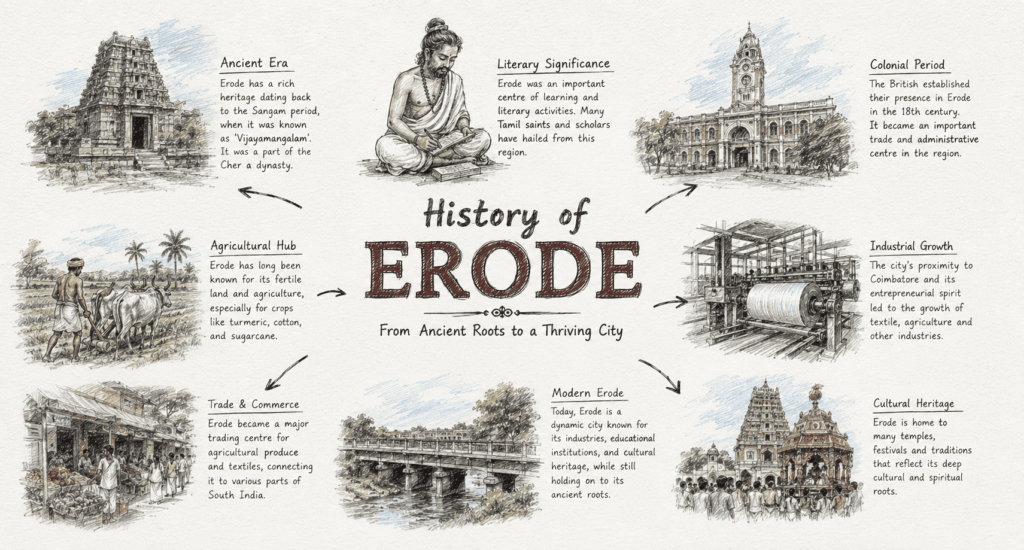
Erode, one of Tamil Nadu’s most vibrant cities, is widely recognized today as India’s “Turmeric City” and an important centre for textiles, agriculture, and commerce. Situated on the fertile plains near the confluence of the Cauvery and Bhavani Rivers, Erode has grown into a major commercial hub while preserving a rich historical legacy that stretches back over two thousand years.
For many international visitors, particularly those from the United States, Erode may be less familiar than cities like Chennai or Madurai. Yet its history tells an important story about South India’s economic development, ancient trade networks, agricultural innovation, and cultural heritage.
Long before modern highways and textile markets transformed Erode into a thriving business destination, the region formed part of the historic Kongu Nadu, an ancient Tamil territory renowned for fertile farmland, skilled artisans, and prosperous trade. Throughout its history, Erode witnessed the rise and fall of powerful dynasties including the Chera, Chola, Pandya, Vijayanagara, Mysore, and British rulers, each leaving a lasting influence on the city’s culture, economy, and architecture.
Today, Erode is internationally known for its turmeric production, textile industries, educational institutions, and entrepreneurial spirit. Understanding its history provides valuable insight into how this regional trading town became one of Tamil Nadu’s most significant economic centres.
Where is Erode?
Erode is located in the western part of Tamil Nadu, approximately 400 kilometres southwest of Chennai. The city lies on the banks of the Cauvery River, with the Bhavani River flowing nearby.
Its strategic location has influenced its development for centuries. The surrounding plains offer fertile agricultural land, while nearby mountain passes through the Western Ghats have historically connected Tamil Nadu with Kerala and Karnataka.
Today, Erode serves as an important transportation and commercial hub, linking major cities such as Coimbatore, Salem, Tiruppur, and Karur.
The Origin of the Name “Erode”
The exact origin of the name “Erode” remains uncertain, but historians and linguists have proposed several explanations.
One popular theory suggests that the name evolved from the Tamil word “Eeru Odai,” meaning “two streams,” referring to the rivers and water channels surrounding the area.
Another interpretation connects the name to the region’s naturally fertile landscape shaped by rivers and irrigation systems that supported agriculture for thousands of years.
Regardless of its precise origin, the name reflects the close relationship between Erode and its abundant water resources.
Ancient Erode: The Beginning of Human Settlement
Human habitation in the Erode region dates back to prehistoric times.
Archaeological discoveries throughout western Tamil Nadu indicate that early communities settled in the fertile plains because of:
Reliable water sources
Productive agricultural land
Mild climate
Rich natural resources
Easy access to trade routes
Excavations in and around the Kongu region have uncovered:
Megalithic burial sites
Iron Age artefacts
Ancient pottery
Stone tools
Early agricultural evidence
These findings demonstrate that organized settlements existed long before recorded history.
Erode in Ancient Kongu Nadu
One cannot understand the history of Erode without understanding Kongu Nadu, the historic region that covered much of western Tamil Nadu.
Kongu Nadu included modern districts such as:
Erode
Coimbatore
Tiruppur
Salem
Namakkal
Karur
Parts of Dharmapuri and Dindigul
The region became famous for:
Agriculture
Cattle breeding
Textile weaving
Trade
Metal craftsmanship
Unlike many coastal regions that depended heavily on maritime trade, Kongu Nadu developed through agriculture, inland commerce, and strategic overland trade routes connecting southern India.
Because of its fertile soil and dependable rivers, Erode became one of the agricultural centres of Kongu Nadu.
Natural Geography That Shaped History
The geography surrounding Erode played a significant role in its historical development.
Important rivers include:
Cauvery River
Often called the “Ganges of South India,” the Cauvery has supported farming communities for thousands of years through irrigation and fertile floodplains.
Bhavani River
Flowing from the Western Ghats, the Bhavani River joins the Cauvery near Bhavani, north of Erode. This confluence has long held religious, cultural, and economic importance.
Noyyal River
Although it flows mainly through neighbouring districts, the Noyyal contributed to the wider agricultural network of the Kongu region.
These rivers enabled farmers to cultivate:
Rice
Millets
Sugarcane
Cotton
Turmeric
Pulses
Oilseeds
Agriculture formed the economic foundation of ancient Erode.
Erode During the Sangam Age
The Sangam Age marks one of the earliest documented periods in Tamil history.
During this era, Kongu Nadu emerged as an important inland region known for:
Prosperous agriculture
Cattle wealth
Skilled craftsmen
Local chieftains
Active trade
Ancient Tamil literature describes the landscapes and communities of Kongu Nadu, highlighting fertile fields, pastoral life, and trade networks.
Although Erode itself is not frequently mentioned by name in surviving Sangam poems, the wider Kongu region appears in literary sources that describe its strategic and economic importance.
Trade During the Sangam Period
Trade played a crucial role in Erode’s development.
Its inland location allowed merchants to transport goods between:
The western coast of Kerala
The Tamil plains
Karnataka
Ancient ports connected to Roman trade
Important goods included:
Cotton
Pepper
Turmeric
Rice
Iron tools
Spices
Forest products
Roman coins discovered across Tamil Nadu illustrate the extensive commercial links that existed between South India and the Mediterranean world during this period.
Agriculture: The Foundation of Prosperity
Agriculture has shaped Erode’s identity for more than two thousand years.
The fertile plains surrounding the Cauvery enabled farmers to develop sophisticated irrigation systems that supported year-round cultivation.
Early agricultural communities grew:
Paddy
Sesame
Cotton
Sugarcane
Turmeric
Millets
Livestock farming also played a major role, with cattle providing labour, dairy products, and trade opportunities.
The region’s agricultural abundance supported population growth and encouraged the establishment of permanent settlements.
The Chera Dynasty and Erode
One of the earliest major dynasties associated with Erode was the Chera Kingdom.
The Cheras controlled large areas of present-day Kerala and western Tamil Nadu during the Sangam period.
Their kingdom benefited from:
Spice trade
Inland commerce
Agricultural wealth
Mountain resources
Because Erode lay within the broader Kongu region, it became an important agricultural and trading centre under Chera influence.
The Chera rulers promoted:
Road development
Trade routes
Agricultural expansion
Regional administration
Merchants travelling between the western coast and inland Tamil regions frequently passed through Kongu Nadu, increasing economic activity around Erode.
Religious and Cultural Life
Ancient Erode was home to a diverse religious environment.
Early communities practiced forms of worship centred on:
Nature
Local guardian deities
Ancestor traditions
Over time, Hinduism became more deeply established, with devotion to:
Lord Shiva
Lord Vishnu
Murugan
Village goddesses
Temples gradually evolved into centres of:
Religious worship
Education
Community gatherings
Artistic expression
These institutions helped preserve Tamil culture through literature, music, sculpture, and festivals.
Early Craftsmanship and Trade
Besides farming, Erode developed a reputation for skilled craftsmanship.
Local artisans produced:
Cotton textiles
Handwoven fabrics
Iron tools
Agricultural equipment
Pottery
Jewellery
These products were exchanged through local markets and regional trade networks, laying the foundation for Erode’s later reputation as a textile and commercial centre.
Strategic Importance of Kongu Nadu
The Kongu region occupied a strategic position between the eastern and western parts of South India.
Mountain passes through the Western Ghats connected inland Tamil Nadu with Kerala’s ports, making the region an important transit corridor for merchants and travellers.
Erode’s location within this network contributed to its growth as a centre for commerce, agriculture, and administration.
Legacy of Ancient Erode
By the end of the Sangam Age, Erode had already established several characteristics that continue to define the city today:
Strong agricultural traditions
Strategic trading importance
Skilled textile craftsmanship
Rich Tamil cultural heritage
Prosperous inland commerce
Deep connection to the Cauvery River
These foundations enabled the city to flourish under subsequent dynasties and later emerge as one of Tamil Nadu’s leading commercial centres.