
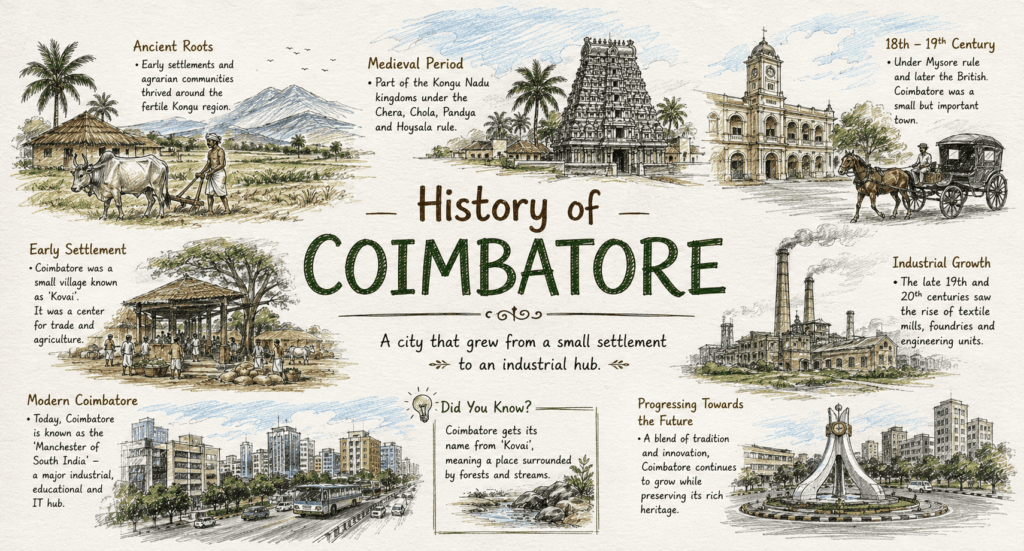
Coimbatore, often called the “Manchester of South India,” is one of Tamil Nadu’s most important cities. Located on the banks of the Noyyal River and surrounded by the scenic Western Ghats, Coimbatore has a fascinating history that combines ancient Tamil culture, powerful dynasties, colonial influences, industrial growth, and modern innovation.
For many international visitors, especially from the United States, Coimbatore is known today as a centre for textiles, engineering, education, healthcare, and entrepreneurship. However, behind its modern identity lies a history that stretches back thousands of years.
The city’s story begins in the ancient Kongu Nadu region, where early Tamil communities developed agriculture, trade, and cultural traditions. Over centuries, Coimbatore witnessed the rise and fall of several South Indian kingdoms, including the Chera, Chola, Pandya, Vijayanagara, and Mysore rulers, before becoming a major industrial city during British rule and independent India.
This article explores the complete history of Coimbatore, including its ancient origins, royal dynasties, cultural heritage, colonial transformation, industrial revolution, and present-day significance.
Ancient History of Coimbatore
Coimbatore and the Kongu Nadu Region
The history of Coimbatore is closely connected with Kongu Nadu, an ancient cultural region of western Tamil Nadu. Historically, Kongu Nadu included areas around present-day Coimbatore, Erode, Tiruppur, Salem, Namakkal, and parts of Kerala and Karnataka.
The region was naturally rich because of:
- Fertile agricultural land
- The Noyyal River system
- Mountain resources from the Western Ghats
- Trade routes connecting Tamil Nadu and Kerala
Ancient communities settled here because the land was suitable for farming, cattle raising, and commerce.
Archaeological discoveries around Coimbatore reveal evidence of early human settlements dating back thousands of years. Excavations in nearby areas have uncovered:
- Stone tools
- Burial sites
- Ancient pottery
- Iron-age artifacts
- Megalithic remains
These findings show that the region had an active civilization before the rise of major Tamil kingdoms.
Coimbatore During the Sangam Age
The Sangam period (approximately 300 BCE–300 CE) represents one of the earliest documented phases of Tamil history.
During this period, Kongu Nadu played an important role in:
- Agriculture
- Cattle farming
- Trade
- Cultural exchange
Ancient Tamil literature refers to the Kongu region and describes its landscapes, people, warriors, and economic activities.
The region was connected to important trade networks between:
- The western coast
- Tamil inland regions
- Roman traders
Roman coins and archaeological findings discovered in Tamil Nadu indicate active trade relations between South India and the Roman Empire.
Coimbatore’s location made it an important connection point between the ancient ports of the western coast and the Tamil plains.
The Chera Influence in Coimbatore
The earliest major rulers associated with the Kongu region were the Chera dynasty.
The Cheras controlled large parts of western Tamil Nadu and Kerala. Their influence helped develop:
- Trade routes
- Agriculture
- Local administration
- Cultural traditions
The Western Ghats provided natural resources, while mountain passes allowed movement between Tamil Nadu and Kerala.
The famous Palakkad Gap, located near Coimbatore, became a significant geographical gateway connecting eastern and western South India.
Because of this strategic location, Coimbatore gained importance as a trading and military region.
Chola Period and Coimbatore
The rise of the Chola Empire brought significant changes to Kongu Nadu.
The Cholas were among the greatest South Indian dynasties, known for:
- Efficient administration
- Temple construction
- Maritime trade
- Agricultural development
During Chola rule, Coimbatore region experienced improvements in:
- Irrigation systems
- Village administration
- Agriculture
- Temple-based economy
The Cholas encouraged the construction of temples, many of which became centres of:
- Education
- Social activities
- Cultural preservation
Several ancient temples around Coimbatore reflect the architectural influence of this period.
Pandya and Later Medieval Rule
After periods of Chola dominance, the region came under the influence of the Pandyas.
The Pandyas expanded their control across parts of western Tamil Nadu and contributed to:
- Trade development
- Religious activities
- Regional administration
However, political control over Kongu Nadu frequently changed because of conflicts among powerful South Indian kingdoms.
The strategic location of Coimbatore made it valuable for controlling trade routes between Tamil Nadu and Karnataka.
Vijayanagara Empire Influence
During the medieval period, Coimbatore became part of the expanding Vijayanagara Empire.
The Vijayanagara rulers controlled large parts of South India and introduced administrative changes through local governors known as Nayaks.
Their influence contributed to:
- Temple development
- Agricultural expansion
- Military organization
- Regional governance
The Nayak period also strengthened cultural traditions across Tamil Nadu.
Mysore Kingdom and Coimbatore
From the 17th century onwards, Coimbatore came under the influence of the Mysore Kingdom.
The rulers of Mysore, including:
- Hyder Ali
- Tipu Sultan
played important roles in the region’s political history.
Coimbatore became strategically important during conflicts between Mysore and the British East India Company.
The area witnessed military movements during the:
- First Anglo-Mysore War
- Second Anglo-Mysore War
- Third Anglo-Mysore War
- Fourth Anglo-Mysore War
After Tipu Sultan’s defeat in 1799, British control expanded over the region.
British Era and Transformation of Coimbatore
Formation of Coimbatore District
Under British administration, Coimbatore developed into an important district headquarters.
The British introduced:
- Modern administrative systems
- Road networks
- Railways
- Commercial agriculture
The introduction of transportation infrastructure played a major role in Coimbatore’s economic development.
Growth of Agriculture
During British rule, agriculture became a major economic activity.
Important crops included:
- Cotton
- Sugarcane
- Rice
- Coconut
- Vegetables
Cotton cultivation became especially important because it supported the growth of textile industries later.
The fertile lands around Coimbatore helped establish the region as an agricultural centre.
Birth of the Textile Industry
The most significant transformation in Coimbatore’s history was the rise of its textile industry.
Because of:
- Availability of cotton
- Skilled workers
- Water resources
- Transport connectivity
Coimbatore became a major textile manufacturing centre.
The establishment of textile mills in the early 20th century changed the city’s economy.
Important industrial pioneers helped build Coimbatore’s reputation as:
“The Manchester of South India.”
The textile sector created:
- Employment opportunities
- Business growth
- Urban development
- Industrial entrepreneurship
Industrial Growth After Independence
After India gained independence in 1947, Coimbatore continued expanding as an industrial powerhouse.
The city became known for:
Textile Manufacturing
Coimbatore remains one of India’s largest textile centres, with thousands of:
- Spinning mills
- Garment manufacturers
- Textile businesses
Engineering Industry
The city also developed a strong engineering sector producing:
- Pumps
- Motors
- Machinery
- Industrial equipment
Coimbatore became a major manufacturing centre for small and medium enterprises.
Education and Knowledge Development
Modern Coimbatore has become an important educational destination.
The city is home to:
- Universities
- Engineering colleges
- Research institutions
- Management schools
Education has played a major role in developing skilled professionals who contribute to India’s technology and business sectors.
Cultural Heritage of Coimbatore
Coimbatore has a rich cultural identity shaped by centuries of Tamil traditions.
Important cultural elements include:
- Tamil literature
- Classical music
- Temple traditions
- Festivals
- Traditional arts
Major festivals celebrated include:
- Pongal
- Tamil New Year
- Diwali
- Local temple festivals
The city represents a blend of traditional Tamil culture and modern urban lifestyle.
Marudamalai Temple
Located on a hill near Coimbatore, the Marudamalai Temple is one of the region’s most important religious sites.
Dedicated to Lord Murugan, the temple reflects centuries-old Tamil spiritual traditions.
Perur Pateeswarar Temple
The Perur Pateeswarar Temple is one of Coimbatore’s oldest temples.
It showcases:
- Traditional Dravidian architecture
- Ancient sculptures
- Historical religious importance
The temple represents the artistic achievements of South Indian temple builders.
VOC Park
VOC Park is named after freedom fighter V.O. Chidambaram Pillai and reflects the city’s connection with India’s independence movement.
Coimbatore in the Freedom Movement
Coimbatore contributed to India’s independence struggle.
Several freedom fighters from the region participated in:
- Swadeshi movements
- Anti-colonial campaigns
- National awareness activities
The city became a centre for political and social movements during the freedom struggle.
Modern Coimbatore: A Global City
Today, Coimbatore is one of India’s fastest-growing cities.
It is recognized for:
- Textile exports
- Manufacturing
- Information technology
- Healthcare
- Education
- Startups
- Entrepreneurship
The city attracts visitors from around the world because of its:
- Business opportunities
- Natural beauty
- Cultural heritage
- Proximity to hill stations like Ooty
Coimbatore’s Importance for International Visitors
For visitors from the United States and other countries, Coimbatore offers a unique combination of:
- Ancient history
- Industrial innovation
- Spiritual tourism
- Nature experiences
- Modern business opportunities
The city provides a window into how traditional South Indian communities evolved into a globally connected economy.