
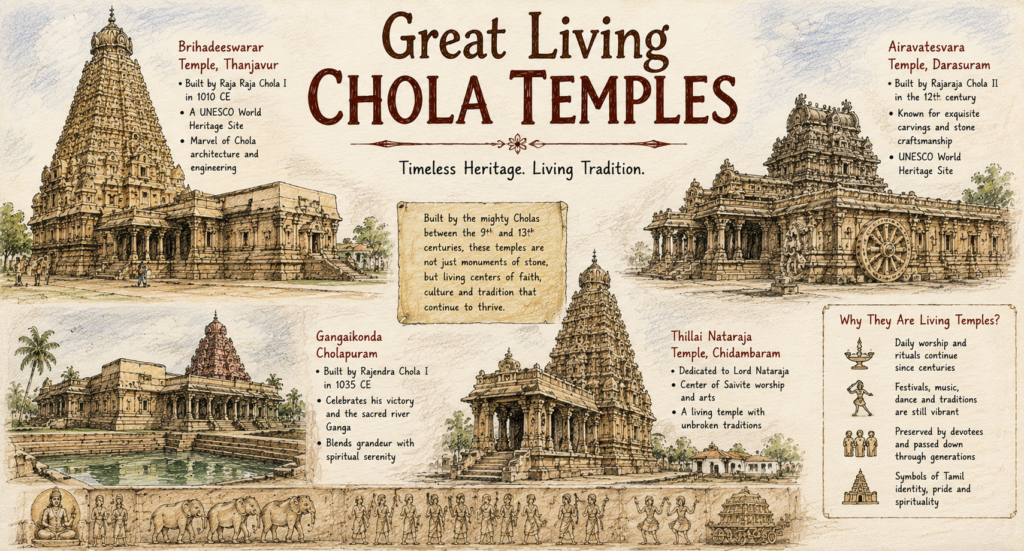
Few monuments in the world capture the grandeur, artistic excellence, and engineering brilliance of a civilization as magnificently as the Great Living Chola Temples of Tamil Nadu, India. Built more than a thousand years ago by the powerful Chola dynasty, these temples continue to serve as active places of worship while standing as extraordinary examples of medieval architecture, sculpture, and cultural achievement.
Unlike many ancient monuments that survive only as archaeological ruins, the Great Living Chola Temples remain vibrant centers of religious life. Daily prayers, traditional festivals, classical music, and sacred rituals continue within their walls, creating an unbroken connection between the past and the present.
For readers in the United States who enjoy history, architecture, archaeology, or world heritage, these temples offer an inspiring look at one of humanity’s greatest architectural traditions. Their scale, precision, and artistic sophistication rival many of the world’s most celebrated historic landmarks, demonstrating the remarkable accomplishments of the Chola Empire.
What Are the Great Living Chola Temples?
The Great Living Chola Temples are a group of three magnificent Hindu temples constructed between the 11th and 12th centuries during the height of the Chola Empire in southern India.
The three temples are:
- Brihadisvara Temple, Thanjavur
- Brihadisvara Temple, Gangaikonda Cholapuram
- Airavatesvara Temple, Darasuram
Together, they represent the pinnacle of Chola architecture and are recognized as a UNESCO World Heritage Site for their outstanding universal value.
These temples continue to function as active places of worship, making them unique among many ancient monuments that are no longer used for their original purpose.
The Rise of the Chola Empire
The Chola dynasty ruled large parts of South India and Southeast Asia between the 9th and 13th centuries CE.
At its peak, the empire controlled:
- Most of present-day Tamil Nadu
- Parts of Sri Lanka
- Coastal regions of eastern India
- Strategic maritime trade routes across the Indian Ocean
The Cholas built one of Asia’s strongest naval powers, encouraging trade with Southeast Asia, China, and the Middle East. Their prosperity enabled them to invest heavily in art, literature, education, irrigation, and monumental architecture.
The Great Living Chola Temples stand as lasting symbols of this remarkable period of political stability and cultural flourishing.
1. Brihadisvara Temple, Thanjavur
The Brihadisvara Temple in Thanjavur is the most famous of the three and is often regarded as one of the greatest achievements in Indian architecture.
Commissioned by King Rajaraja I around 1010 CE, the temple was dedicated to Lord Shiva and designed to reflect the power and devotion of the Chola Empire.
Its most striking features include:
- A towering granite temple rising over 60 meters (approximately 216 feet)
- A massive central dome carved from a single block of stone
- Intricately sculpted walls and pillars
- Beautiful frescoes and inscriptions
- One of India’s largest monolithic Nandi (sacred bull) statues
Remarkably, the structure was built almost entirely from granite, even though suitable granite quarries are located many miles from the site. Historians believe enormous stones were transported using carefully engineered ramps, rollers, and human labor, demonstrating extraordinary planning and engineering skills.
2. Brihadisvara Temple, Gangaikonda Cholapuram
After successfully expanding the empire into northern India, King Rajendra I, the son of Rajaraja I, established a new capital known as Gangaikonda Cholapuram.
To commemorate his victories, he commissioned another magnificent Shiva temple.
Although inspired by the temple at Thanjavur, this structure introduced several architectural refinements.
Highlights include:
- A gracefully curved central tower
- Exquisitely detailed stone sculptures
- Large ceremonial halls
- Monumental gateways
- Intricate carvings depicting Hindu mythology
The temple illustrates how Chola architects continued refining their techniques while maintaining the grandeur established by earlier monuments.
3. Airavatesvara Temple, Darasuram
Built during the reign of King Rajaraja II in the 12th century, the Airavatesvara Temple is celebrated for its exceptional artistic detail rather than its massive scale.
Among its remarkable features are:
- Stone chariots carved into the entrance
- Musical steps that produce different tones when tapped
- Delicately carved pillars
- Intricate depictions of dancers, musicians, and deities
- Beautiful narrative sculptures illustrating stories from Hindu epics
Many art historians consider Airavatesvara Temple one of the finest surviving examples of medieval Indian stone carving.
Engineering That Was Centuries Ahead of Its Time
One of the most fascinating aspects of the Great Living Chola Temples is the remarkable engineering behind their construction.
Builders achieved extraordinary precision without modern machinery.
Their accomplishments included:
- Transporting massive granite blocks over long distances
- Constructing towering stone temples without steel reinforcement
- Aligning buildings with astronomical and religious principles
- Creating sophisticated drainage systems
- Designing structures capable of withstanding earthquakes, monsoon rains, and centuries of weathering
Even after more than a thousand years, these temples remain structurally stable, reflecting the exceptional knowledge of Chola architects and engineers.
Art That Tells Stories
Every surface of the Great Living Chola Temples serves as a canvas for artistic expression.
Visitors can find:
- Hindu deities
- Royal processions
- Mythological narratives
- Classical dancers
- Musicians
- Floral decorations
- Animal figures
- Decorative geometric patterns
These carvings provide valuable insight into the clothing, jewelry, architecture, music, dance, and religious practices of medieval South India.
In addition, hundreds of inscriptions engraved on temple walls document royal donations, land grants, taxation systems, and temple administration. For historians, these inscriptions are invaluable primary sources that reveal how the Chola state functioned.
Centers of Learning and Community Life
The temples were much more than religious structures.
They served as:
- Educational institutions
- Cultural centers
- Libraries
- Music and dance academies
- Economic hubs
- Employers of artisans and craftsmen
- Administrative offices
Temple complexes supported sculptors, painters, bronze casters, musicians, dancers, priests, accountants, and scholars, making them central to everyday life during the Chola period.
UNESCO World Heritage Recognition
The Great Living Chola Temples were inscribed on the UNESCO World Heritage List because they represent an outstanding achievement in architecture, engineering, sculpture, and cultural history.
Their recognition reflects several factors:
- Exceptional architectural innovation
- Outstanding artistic craftsmanship
- Continuous religious use for over a millennium
- Well-preserved inscriptions documenting medieval society
- Significant influence on temple architecture across South and Southeast Asia
Today, these temples attract visitors, researchers, architects, and historians from around the world.
Why the Temples Are Called “Living”
Unlike many ancient monuments that function only as museums or archaeological sites, these temples remain active places of worship.
Every day, priests perform traditional rituals that have been practiced for centuries. Annual festivals draw thousands of devotees, while classical music and dance performances continue to celebrate Tamil cultural traditions.
This uninterrupted continuity gives the temples a unique identity as “living” monuments, where history is not only preserved but also actively experienced.
A Lasting Influence on Architecture
The architectural innovations pioneered by Chola builders influenced temple construction across South India and beyond.
Features that became widely adopted include:
- Monumental entrance towers
- Large temple courtyards
- Elaborate stone sculptures
- Advanced structural engineering
- Detailed inscriptions integrated into architecture
The Chola style also inspired temple construction in Sri Lanka and parts of Southeast Asia through trade and cultural exchange.
Why the Great Living Chola Temples Matter Today
The Great Living Chola Temples are more than architectural masterpieces—they are enduring symbols of human creativity, engineering excellence, and cultural continuity. They demonstrate how a medieval civilization combined advanced technical knowledge with artistic vision to create monuments that continue to inspire people more than a thousand years later.
For American readers exploring world history, these temples provide a powerful reminder that some of humanity’s greatest achievements emerged far beyond the familiar civilizations of Europe and the Mediterranean. The Chola Empire’s contributions to architecture, sculpture, urban planning, maritime trade, and cultural heritage deserve recognition alongside the world’s most celebrated historical accomplishments.
As active places of worship and internationally recognized heritage sites, the Great Living Chola Temples continue to connect past and present. They preserve the legacy of a remarkable civilization while offering future generations an opportunity to experience one of the finest examples of medieval architecture anywhere in the world.
Quick pros:
+ Fast loading times
+ Mobile friendly interface
+ Easy account setup
+ Good customer support available
[url=https://jeetwin-onlinecasino.com/]jeetwinlive.net[/url]
Your comment is awaiting moderation.