
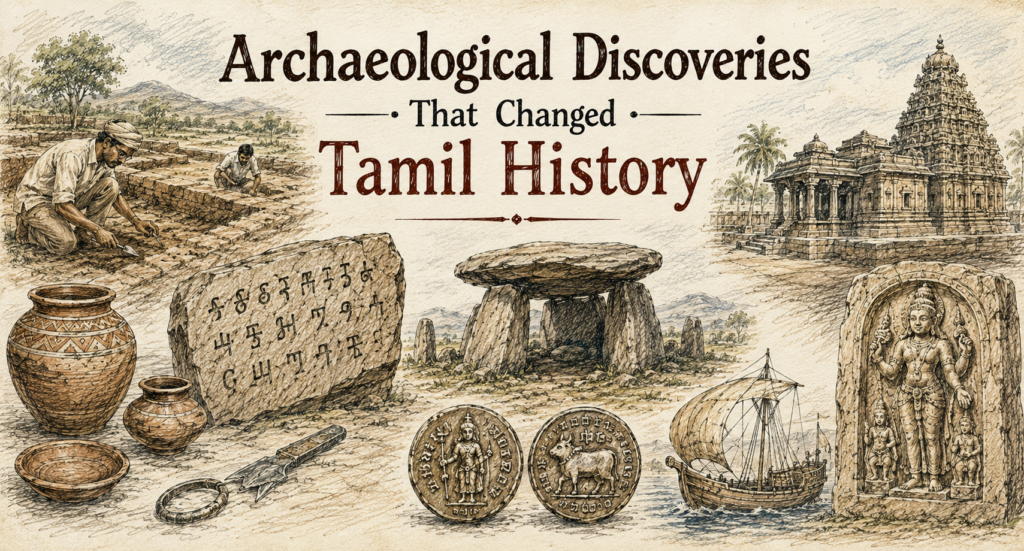
Tamil Nadu is one of India’s richest archaeological landscapes, preserving evidence of human activity that spans more than a million years. While ancient Tamil literature, particularly the Sangam texts, has long celebrated the region’s history, archaeology has added an entirely new dimension by uncovering physical evidence of early settlements, industries, trade, literacy, and cultural development. These discoveries have transformed historians’ understanding of Tamil civilization, revealing that it was more technologically advanced, globally connected, and historically deep than previously believed.
For readers in the United States interested in archaeology, ancient history, and world civilizations, Tamil Nadu offers a compelling case study of how scientific excavation can reshape historical narratives. Every artifact, inscription, and settlement uncovered has helped bridge the gap between literary tradition and archaeological evidence, making Tamil Nadu one of the most exciting regions for archaeological research in South Asia.
Why Archaeology Matters in Understanding Tamil History
Historical texts provide valuable information, but archaeology offers direct physical evidence. Excavated artifacts, ancient buildings, burial sites, inscriptions, and tools allow researchers to reconstruct daily life, economic systems, religious practices, and technological progress with remarkable accuracy.
Over the past century—and especially in the last two decades—excavations across Tamil Nadu have revealed:
- Some of India’s earliest Stone Age settlements
- Iron Age burial complexes
- Early urban planning
- Ancient trade networks
- Tamil-Brahmi inscriptions
- Evidence of advanced metallurgy
- Craft industries and manufacturing centers
- Maritime trade linking South India with the Mediterranean and Southeast Asia
These discoveries have significantly expanded our understanding of the origins and development of Tamil civilization.
1. Keeladi: Evidence of an Early Urban Civilization
Perhaps no archaeological discovery has attracted more international attention than Keeladi, located near Madurai.
Excavations have uncovered:
- Brick-built houses
- Sophisticated drainage systems
- Wells and water-management structures
- Pottery workshops
- Iron tools
- Beads made from semi-precious stones
- Textile production evidence
- Tamil-Brahmi inscriptions
Scientific dating indicates that the settlement flourished around the 6th century BCE, suggesting that organized urban communities existed in Tamil Nadu much earlier than many historians once believed.
The discoveries have strengthened the view that early Tamil society possessed literacy, skilled craftsmanship, and well-planned settlements during the Early Historic period. The findings also demonstrate continuity between the archaeological record and descriptions found in Sangam literature.
2. Adichanallur: Unlocking the Iron Age
Located in the Thoothukudi district, Adichanallur is one of India’s most important Iron Age archaeological sites.
Excavations have revealed:
- Hundreds of burial urns
- Human skeletal remains
- Bronze artifacts
- Gold ornaments
- Iron weapons
- Pottery decorated with symbols
- Copper objects
These discoveries indicate that Iron Age communities in southern India had developed sophisticated metalworking skills, complex burial traditions, and organized social structures.
Adichanallur also demonstrates that prehistoric Tamil societies were far more technologically advanced than once assumed, providing evidence of specialized craftsmanship and cultural sophistication long before the rise of classical kingdoms.
3. Attirampakkam: Rewriting Early Human History
Near Chennai lies Attirampakkam, one of the most significant prehistoric sites in Asia.
Archaeologists have uncovered thousands of stone tools dating back more than one million years, making the site one of the oldest known records of human occupation in South Asia.
Even more remarkable, later excavations revealed evidence of a transition from Lower Paleolithic to Middle Paleolithic technologies earlier than previously believed.
These findings have reshaped international discussions about early human evolution and technological innovation, demonstrating that South Asia played a far more significant role in prehistoric development than earlier models suggested.
4. Kodumanal: An Ancient Industrial and Trade Hub
Located in present-day Erode district, Kodumanal has revealed an extraordinary picture of industrial activity during the Early Historic period.
Excavations uncovered:
- Iron-smelting furnaces
- Steel production workshops
- Bead-making industries
- Textile tools
- Semi-precious stone processing
- Roman coins
- Tamil-Brahmi inscriptions
The site demonstrates that Tamil Nadu was not merely an agricultural society but also a major manufacturing and export center.
Artifacts indicate that goods produced at Kodumanal were traded across the Indian Ocean, connecting Tamil merchants with Rome, Egypt, Sri Lanka, and Southeast Asia.
5. Porunthal: New Insights into Early Writing
The archaeological site at Porunthal has become particularly important because of discoveries related to literacy and agriculture.
Researchers found:
- Burial urns
- Rice grains preserved within graves
- Glass beads
- Iron implements
- Pottery bearing Tamil-Brahmi inscriptions
Scientific dating of these materials has contributed to debates about the age of Tamil writing and the development of agriculture in southern India.
The discoveries suggest that literacy may have emerged in the region earlier than previously believed, adding valuable evidence to the history of one of the world’s oldest living classical languages.
6. Poompuhar: A Lost Port City
The ancient port city of Poompuhar (Kaveripoompattinam) is well known from Sangam literature, but underwater archaeology has provided physical evidence supporting its historical importance.
Marine archaeological investigations have identified submerged structural remains, wharves, and artifacts off the coast, suggesting that parts of the ancient city were lost to coastal erosion or rising sea levels.
These discoveries support literary accounts describing Poompuhar as a thriving maritime trading center connected to international commerce.
7. Sivakalai: Ancient Agriculture and Early Rice Cultivation
Excavations at Sivakalai, near Adichanallur, have produced significant evidence of early agriculture.
Researchers discovered:
- Ancient rice grains
- Burial urns
- Pottery
- Iron objects
- Agricultural tools
Scientific dating indicates that organized farming existed in Tamil Nadu much earlier than previously documented, highlighting the importance of agriculture in the growth of early Tamil communities.
8. Mangulam: The Earliest Tamil-Brahmi Inscriptions
The rock-cut inscriptions at Mangulam are among the earliest examples of Tamil-Brahmi writing.
These inscriptions mention workers and patrons associated with the Pandya kingdom, providing direct evidence of:
- Early literacy
- Administrative organization
- Religious patronage
- Political authority
They also confirm that written Tamil was already being used centuries before many historians once believed.
Discoveries That Changed Historical Thinking
Collectively, these archaeological discoveries have challenged several long-held assumptions about Tamil history.
Tamil Civilization Was Older Than Previously Thought
Scientific dating from Keeladi, Attirampakkam, and other sites has pushed back important milestones in the region’s history, demonstrating that organized communities and advanced technologies developed earlier than earlier chronologies suggested.
Literacy Developed Early
Tamil-Brahmi inscriptions found at sites such as Mangulam, Kodumanal, Porunthal, and Keeladi provide strong evidence that writing was in use during the Early Historic period, supporting the emergence of a literate society alongside expanding trade and governance.
Tamil Nadu Was Part of Global Trade Networks
Artifacts recovered across the state—including Roman coins, imported ceramics, glassware, and semi-precious stones—show that Tamil merchants participated in extensive maritime trade across the Indian Ocean.
Trade routes connected southern India with:
- The Roman Empire
- Egypt
- Arabia
- Sri Lanka
- Southeast Asia
These exchanges brought wealth, ideas, and cultural influences that shaped the region’s development.
Iron Technology Was Highly Advanced
Excavations at Adichanallur and Kodumanal demonstrate that ancient Tamil communities mastered iron smelting and metalworking at an early stage.
Archaeologists have uncovered:
- Weapons
- Agricultural tools
- Industrial furnaces
- Steel production evidence
These findings reveal that metallurgy played a crucial role in economic growth and technological innovation.
Modern Science Is Transforming Tamil Archaeology
Today’s archaeologists use advanced scientific methods to gain deeper insights into the past.
These include:
- Radiocarbon dating to establish accurate timelines
- Ancient DNA analysis to study ancestry and migration
- Isotope analysis to reconstruct diet and mobility
- Ground-penetrating radar to identify buried structures
- Digital mapping and 3D modeling to document excavation sites
By combining traditional excavation with cutting-edge technology, researchers continue to refine our understanding of Tamil Nadu’s ancient history.
Why These Discoveries Matter Today
The archaeological discoveries made across Tamil Nadu have done far more than uncover ancient artifacts—they have reshaped the historical narrative of one of the world’s oldest continuous cultural traditions. From the million-year-old stone tools at Attirampakkam to the urban planning of Keeladi and the industrial sophistication of Kodumanal, each excavation has revealed a society that was innovative, literate, and deeply connected to the wider world.
For American readers, these findings offer a broader perspective on global history. They remind us that the story of civilization was never confined to a single region. While ancient Egypt, Greece, and Mesopotamia remain central to world history, the archaeological record of Tamil Nadu demonstrates that South India was also home to thriving communities that made lasting contributions to technology, trade, language, and culture.
As new excavations continue across the state, archaeologists are uncovering evidence that enriches not only Tamil history but also our understanding of humanity’s shared past. Each discovery strengthens the picture of Tamil Nadu as one of the world’s most important archaeological regions, where the past continues to reshape the way we understand early civilization.