
For many industries in Chennai, electricity is one of the biggest operating costs. But the electricity bill is not always the only cost you should be watching.
Sometimes, the real financial loss is hidden inside the electrical system.
A machine may stop for a few minutes. A motor may run hotter than normal. A capacitor bank may fail repeatedly. Production equipment may trip without an obvious reason. Sensitive electronics may develop faults. Energy consumption may slowly increase even though production has not changed significantly.
These problems can sometimes be connected to poor power quality.
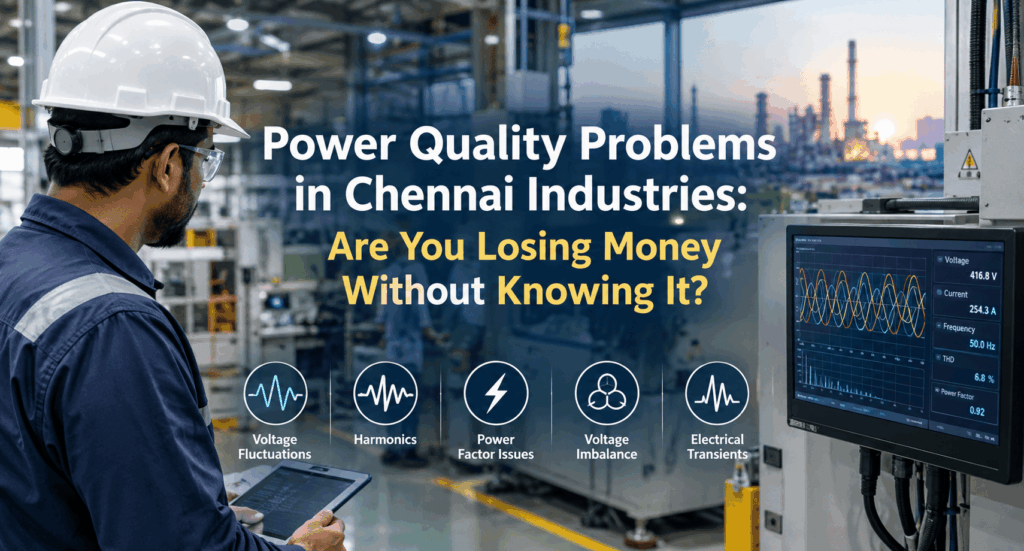
Power quality refers to how stable, clean and reliable the electrical supply is for the equipment using it. Problems such as voltage fluctuations, voltage sags, voltage swells, harmonics, voltage imbalance, poor power factor and electrical transients can affect industrial operations.
For Chennai industries operating manufacturing plants, warehouses, workshops, commercial facilities and processing units, understanding these issues can help prevent avoidable downtime and equipment problems.
What Is Power Quality?
In simple terms, power quality describes whether electrical power is being supplied in a form that allows equipment to operate properly.
An industrial electrical system is not just about having enough electricity. The quality of that electricity matters too.
For example, a factory may have sufficient supply capacity, but its equipment could still experience:
- Voltage fluctuations
- Voltage sags
- Voltage swells
- Harmonic distortion
- Voltage imbalance
- Poor power factor
- Electrical transients
- Flicker
- Unexpected interruptions
The Central Electricity Authority’s technical regulations specifically recognize power quality parameters such as harmonics, voltage sag, swell, flicker and disruptions.
This means power quality should be treated as an engineering issue, not simply as an occasional electrical nuisance.
Why Power Quality Matters for Chennai Industries
Chennai has a large industrial ecosystem covering automobile and auto components, engineering, electronics, manufacturing, food processing, pharmaceuticals, plastics, textiles, warehouses and other industrial activities.
Many of these facilities depend on electrically operated machinery throughout the working day.
A short electrical disturbance that lasts only seconds may appear insignificant.
But consider what happens if a production machine stops:
- The machine stops operating.
- Production is interrupted.
- Material may need to be discarded or reprocessed.
- Operators spend time restarting the system.
- Other connected equipment may also be affected.
- Production schedules can be delayed.
- Maintenance teams need to investigate the problem.
The cost can therefore be much higher than the electricity consumed during the interruption.
1. Voltage Sags Can Cause Unexpected Machine Trips
A voltage sag is a temporary reduction in voltage.
It can occur because of faults, large equipment starting, changes in electrical loading or disturbances elsewhere in the electrical network.
Industrial equipment can react differently to voltage sags.
A motor may struggle during the disturbance. A sensitive control system may trip. A PLC-controlled machine may stop and require a reset.
Imagine a CNC machine operating during a production cycle.
A short voltage disturbance could interrupt the control system even if the disturbance is too brief for employees to notice.
The result may be:
- Lost production time
- Rejected components
- Machine restart time
- Additional labour
- Delayed delivery
If this happens repeatedly, the financial impact can become significant.
2. Harmonics Can Increase Electrical Stress
Modern factories use many power electronic devices.
Variable frequency drives, UPS systems, rectifiers, LED systems, computers, battery chargers and other electronic equipment can contribute to harmonic currents.
Harmonics distort the electrical waveform.
The problem is that harmonic distortion can create additional stress in electrical infrastructure.
Potential effects include:
- Transformer heating
- Cable heating
- Capacitor problems
- Increased losses
- Equipment malfunction
- Reduced electrical-system efficiency
The CEA’s distribution planning material identifies harmonics and other power quality issues as factors that can affect the efficiency and longevity of equipment such as distribution transformers, voltage regulators and capacitors.
For a factory with significant electronic and variable-speed equipment, harmonic analysis can therefore be an important part of electrical-system maintenance.
3. Poor Power Factor Can Increase Costs
Power factor is another important consideration for industrial facilities.
Many industrial loads are inductive, including motors, transformers and certain types of machinery.
When power factor is poor, the electrical system may need to carry more current for the same useful power output.
This can increase electrical losses and put additional loading on the power system.
CEA material notes that low power factor can increase transmission burden and losses, and that regulatory provisions may allow utilities to charge penalties for low power factor, particularly for bulk consumers.
That is why industrial facilities commonly use power-factor correction equipment such as capacitor banks.
However, simply installing capacitors is not always enough.
If harmonics are present, poorly designed capacitor systems can create additional problems. Proper measurement and engineering assessment should come before selecting corrective equipment.
4. Voltage Imbalance Can Affect Three-Phase Motors
Most industrial facilities depend heavily on three-phase electrical systems.
When the voltage across the three phases is not properly balanced, motors can experience additional heating and reduced operating performance.
This is particularly important for industries with large numbers of:
- Motors
- Pumps
- Compressors
- Fans
- Conveyors
- Machine tools
- HVAC systems
A small electrical imbalance may not immediately cause a complete shutdown.
Instead, it can contribute to higher operating temperatures and increased equipment stress over time.
That makes voltage imbalance a problem that can remain unnoticed until maintenance costs or equipment failures start increasing.
5. Electrical Transients Can Damage Sensitive Equipment
Electrical transients are short-duration disturbances that can produce sudden changes in voltage.
Industrial facilities may experience transients from switching operations, large loads, faults and other electrical events.
Sensitive control electronics can be particularly vulnerable.
Modern production lines often contain expensive electronic components, including:
- PLCs
- HMIs
- Servo drives
- Sensors
- Industrial computers
- Automation controllers
- Communication equipment
Protecting these systems requires more than simply installing a circuit breaker.
Protection should be designed around the characteristics of the electrical system and the equipment connected to it.
Where Does the Money Actually Go?
One reason power-quality problems are difficult to identify is that the losses may appear under different headings.
You may see:
Higher electricity consumption
Electrical losses caused by poor operating conditions can contribute to unnecessary energy consumption.
Production downtime
A machine trip may stop production for minutes or hours.
Equipment maintenance
Motors, transformers, drives, capacitors and electronic equipment may require more frequent attention.
Premature equipment replacement
Repeated electrical stress can contribute to equipment problems and shortened service life.
Rejected products
Production interruptions can result in incomplete processes, material waste or quality problems.
Labour costs
Operators and maintenance personnel spend time diagnosing and restarting equipment.
Delivery delays
Repeated production interruptions can affect schedules and customer commitments.
This is why looking only at the monthly electricity bill may not reveal the full cost of poor power quality.
How Can You Tell If Your Factory Has a Power Quality Problem?
There are several warning signs worth investigating.
Frequent unexplained machine trips
If equipment repeatedly trips even though there is no obvious mechanical fault, electrical quality should be investigated.
Motors running hotter than expected
Unexpected heating can indicate electrical imbalance, harmonics, overloading or other issues.
Capacitor bank failures
Repeated capacitor failures can sometimes indicate harmonic-related problems or incorrect system design.
PLC or control-system resets
Sensitive automation equipment that resets unexpectedly deserves investigation.
Flickering lights
Visible flicker can indicate voltage fluctuations, particularly around large changing loads.
Transformers operating unusually hot
Unusual heating can be caused by loading, harmonics, cooling issues or other electrical conditions.
Production interruptions without an obvious cause
If the same machines stop at irregular intervals and maintenance teams cannot identify a mechanical explanation, power quality testing may be useful.
Don’t Guess. Measure the Electrical System.
One of the biggest mistakes an industrial facility can make is trying to solve a power-quality problem without measuring it.
For example, a factory may assume that it needs:
- A larger transformer
- More capacitors
- A new UPS
- A voltage stabilizer
- A harmonic filter
- Additional cabling
But the correct solution depends on the actual electrical conditions.
A professional power-quality assessment can measure parameters such as:
- Voltage
- Current
- Frequency
- Power factor
- Voltage imbalance
- Harmonic distortion
- Voltage sags and swells
- Transients
- Load profile
The collected information can then help engineers determine what is actually happening.
For larger industrial consumers, CEA regulations also address power-quality measurement and monitoring requirements at specified connection levels.
A Practical Power Quality Check for Chennai Factories
If your facility has recurring electrical problems, start with a structured assessment.
Step 1: Review your electricity data
Look at electricity consumption, maximum demand, power factor and unusual changes in the bill.
Step 2: Identify problem equipment
Record which machines trip, when they trip and what operating conditions exist at the time.
Step 3: Check the major loads
Pay particular attention to motors, compressors, pumps, HVAC systems, drives and large production equipment.
Step 4: Conduct power-quality monitoring
Use suitable power-quality monitoring equipment to capture electrical conditions over an appropriate operating period.
A short measurement may miss intermittent problems, so monitoring duration should be determined based on the nature of the issue.
Step 5: Analyse the results
The objective should be to identify the root cause rather than simply treating the symptom.
Step 6: Select the appropriate corrective solution
Depending on the findings, solutions may include power-factor correction, harmonic mitigation, surge protection, voltage regulation, equipment-level protection, system balancing or other electrical improvements.
Can Solar and Battery Storage Help With Power Quality?
Solar power and battery energy storage can support industrial energy strategies, but they should not automatically be considered a complete solution to every power-quality problem.
Grid-connected solar systems and nonlinear industrial loads can themselves involve power-quality considerations. CEA guidance discusses issues including power factor, reactive power, harmonics, voltage regulation, sags, swells and switching transients in the context of solar PV integration.
Therefore, solar, battery storage and power-quality improvements should be designed together when the applications overlap.
For a Chennai factory considering rooftop solar or battery storage, understanding the existing electrical profile first can help avoid designing a system around incomplete information.
Why Chennai Industries Should Take This Seriously
For a small office, a brief electrical disturbance may simply mean a computer restarts.
For a manufacturing facility, the same disturbance can affect an entire production process.
This difference is important.
A factory may have dozens or hundreds of connected electrical loads. A single electrical issue can potentially affect several systems at once.
The cost of poor power quality can therefore remain hidden for months.
You may notice:
“Why is this motor failing so often?”
“Why does this machine trip randomly?”
“Why are our capacitors failing?”
“Why is our electricity consumption higher than expected?”
“Why does production stop occasionally?”
Instead of treating each symptom separately, it may be worth examining the electrical system as a whole.
How Kinetiq Energy Can Help
For Chennai industries looking to improve energy performance, Kinetiq Energy focuses on practical energy and power solutions designed around the needs of industrial and commercial facilities.
A proper approach begins with understanding how your facility consumes and manages electricity.
Rather than immediately recommending equipment, the electrical conditions, load profile and operational requirements should be considered first.
This can help businesses identify opportunities related to:
- Power quality
- Energy efficiency
- Solar power
- Battery energy storage
- Power management
- Industrial electrical performance
- Peak-demand management
You can learn more about the solutions available through kinetiqenergy.com.