
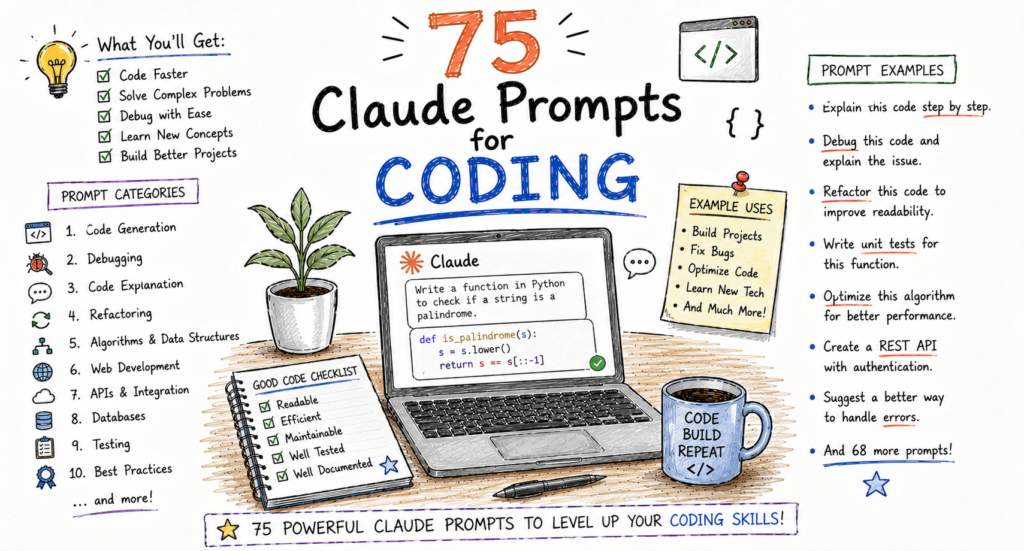
Artificial intelligence has become a valuable partner for software development, helping programmers write cleaner code, solve complex problems, debug applications, and accelerate development workflows. While coding still requires human expertise and critical thinking, AI assistants such as Claude can significantly reduce repetitive work and improve productivity.
Claude is particularly effective for programming because it excels at understanding long codebases, explaining complex logic, refactoring code, documenting projects, reviewing pull requests, and generating well-structured responses. Many developers across the United States use Claude alongside traditional development tools to speed up coding without sacrificing quality.
The quality of Claude’s responses depends largely on the prompts you provide. A detailed prompt that includes programming language, framework, requirements, constraints, and expected output will consistently produce better results than a vague request.
This guide contains 75 practical Claude prompts for coding, beginning with 25 prompts focused on programming fundamentals, code generation, debugging, and software development best practices.
Why Developers Use Claude
Software developers use Claude to:
Write production-ready code
Debug applications
Refactor existing projects
Learn new programming languages
Generate documentation
Build APIs
Create unit tests
Review code quality
Design software architecture
Explain complex algorithms
Claude works best as an intelligent development assistant rather than a replacement for professional software engineering. Developers should always review AI-generated code for correctness, security, and performance before deploying it to production.
Best Practices for Writing Claude Coding Prompts
Before asking Claude to generate code:
Specify the programming language.
Mention the framework or library.
Explain the project goal.
Include performance requirements.
State coding standards.
Request comments where appropriate.
Ask for security best practices.
Request explanations alongside the code.
Include example inputs and outputs.
Test every AI-generated solution before production use.
Programming Fundamentals & Code Generation (Prompts 1–25)
1. Generate a Production-Ready Function
Prompt
Act as a senior software engineer. Write a production-ready [programming language] function that solves [problem]. Follow industry best practices, include error handling, meaningful variable names, comments, and explain the time and space complexity.
Best For: General programming
2. Explain Existing Code
Prompt
Explain the following code line by line as if you’re mentoring a junior developer. Describe what each function does, why it works, potential improvements, and any security or performance concerns.
Best For: Learning codebases
3. Debug an Error
Prompt
Act as an experienced debugging specialist. Review the following code, identify every bug, explain the root cause of each issue, and provide corrected code with explanations.
Best For: Debugging
4. Refactor Legacy Code
Prompt
Refactor the following legacy code using modern [language/framework] best practices while improving readability, maintainability, performance, and security without changing functionality.
Best For: Code modernization
5. Optimize Performance
Prompt
Analyze this code for performance bottlenecks. Recommend optimizations, estimate expected improvements, and explain why each change increases efficiency.
Best For: Performance optimization
6. Generate Unit Tests
Prompt
Create comprehensive unit tests for the following [language] code using [testing framework]. Include positive cases, edge cases, invalid inputs, and error scenarios.
Best For: Testing
7. Build an Algorithm
Prompt
Design an efficient algorithm to solve [problem]. Explain your approach before writing code, analyze complexity, and compare alternative solutions.
Best For: Interview preparation
8. Improve Readability
Prompt
Rewrite the following code to improve readability, consistency, maintainability, and adherence to clean coding principles.
Best For: Code quality
9. Create Documentation
Prompt
Generate professional developer documentation for the following code, including function descriptions, parameters, return values, usage examples, limitations, and best practices.
Best For: Project documentation
10. Add Comments
Prompt
Add clear, concise comments to the following code explaining complex logic while avoiding unnecessary comments for obvious operations.
Best For: Team collaboration
11. Convert Between Languages
Prompt
Convert the following [source language] code into [target language] while maintaining functionality, improving readability, and using language-specific best practices.
Best For: Language migration
12. Create Reusable Components
Prompt
Design reusable, modular components for [framework] that follow SOLID principles and can be easily maintained in large-scale applications.
Best For: Software architecture
13. Identify Security Issues
Prompt
Review the following code from a cybersecurity perspective. Identify vulnerabilities, explain potential attacks, and recommend secure alternatives following OWASP guidelines.
Best For: Secure coding
14. Review Pull Requests
Prompt
Act as a senior code reviewer. Review the following pull request for code quality, readability, maintainability, performance, testing, and security. Provide constructive improvement suggestions.
Best For: Code reviews
15. Generate Error Handling
Prompt
Improve the following code by implementing comprehensive error handling, logging, validation, and graceful failure scenarios.
Best For: Production applications
16. Design Data Structures
Prompt
Recommend the most appropriate data structures for solving [problem]. Compare the advantages and disadvantages of each approach before implementing the solution.
Best For: Algorithm design
17. Explain Design Patterns
Prompt
Explain which software design pattern is most appropriate for [problem], why it fits the use case, and provide a complete implementation example.
Best For: Software engineering
18. Build Utility Functions
Prompt
Generate reusable utility functions for [language/framework] that simplify common development tasks while following clean coding principles.
Best For: Productivity
19. Create Validation Logic
Prompt
Write secure validation logic for [input type], preventing invalid data while providing meaningful error messages and maintaining excellent user experience.
Best For: Input validation
20. Improve Code Architecture
Prompt
Review this project architecture and recommend improvements for scalability, modularity, testing, maintainability, and future expansion.
Best For: Large projects
21. Build Coding Standards
Prompt
Create a coding standards guide for a [language/framework] development team covering naming conventions, formatting, project structure, documentation, testing, and security.
Best For: Engineering teams
22. Create Interview Questions
Prompt
Generate 25 technical interview questions for a [programming language] developer, including model answers and explanations of what each question evaluates.
Best For: Hiring and preparation
23. Learn a New Language
Prompt
Create a structured 30-day learning roadmap for mastering [programming language], including daily exercises, recommended projects, and learning resources.
Best For: Skill development
24. Build a Mini Project
Prompt
Suggest five portfolio-ready project ideas using [language/framework]. For each project, explain the technologies involved, estimated difficulty, features, and learning outcomes.
Best For: Portfolio building
25. Generate a Complete Development Plan
Prompt
Act as a software architect. Create a complete development roadmap for building [application] using [technology stack]. Include architecture recommendations, folder structure, database design, API planning, testing strategy, deployment considerations, CI/CD recommendations, and estimated development phases.
Best For: End-to-end project planning
Why These Prompts Produce Better Code
The prompts above consistently deliver stronger results because they:
Define Claude’s role (such as senior engineer, architect, or reviewer).
Specify the programming language and framework.
Request structured, actionable outputs.
Emphasize security, maintainability, and performance.
Encourage explanations alongside code, making the results useful for both experienced developers and learners.
For the best outcomes, replace placeholders like [programming language], [framework], and [problem] with your project’s specific details. The more context Claude receives, the more relevant and production-ready its suggestions are.