
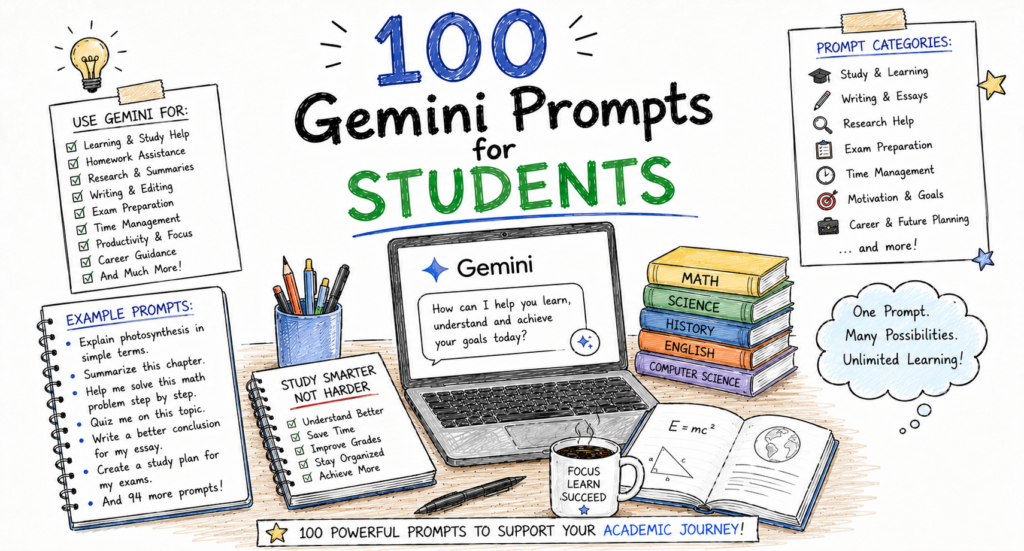
Artificial intelligence is changing the way students learn. Across the United States, high school students, college students, graduate students, and lifelong learners are using AI tools to understand difficult concepts, organize coursework, prepare for exams, improve writing, and manage their academic workload more efficiently.
Among today’s leading AI assistants, Google Gemini has become a popular choice because of its ability to explain complex topics, summarize information, generate study materials, assist with research, and integrate with Google Workspace tools that many students already use.
However, the quality of Gemini’s responses depends largely on the prompts you provide. A detailed prompt that includes your subject, learning objective, academic level, and desired output will produce far better results than a simple question.
This guide contains 100 carefully designed Gemini prompts for students, organized into practical categories. Whether you’re preparing for exams, writing essays, completing research projects, learning to code, or planning your semester, these prompts can help you work more efficiently while supporting your own learning.
Important: Use Gemini as a learning assistant—not a replacement for your own thinking. Always verify facts, cite sources properly, and follow your school’s academic integrity policies.
Why Students Use Gemini
Students use Gemini to:
Understand difficult concepts
Summarize textbooks
Create study guides
Generate flashcards
Organize notes
Prepare presentations
Improve essays
Practice interview questions
Learn programming
Manage study schedules
When used responsibly, Gemini can reduce repetitive work and allow students to spend more time understanding ideas rather than simply organizing information.
Best Practices for Writing Gemini Prompts
For the best results:
Mention your grade level or university level.
Specify the subject.
Explain your learning goal.
Request step-by-step explanations.
Ask for examples.
Specify the desired format (table, outline, checklist, summary, etc.).
Ask Gemini to explain concepts instead of simply giving answers.
Review AI-generated information with reliable academic sources.
Study, Research & Learning Prompts (1–20)
1. Create a Personalized Study Plan
Prompt
Act as an experienced academic coach. Create a four-week study plan for a [subject] course. Include daily study goals, review sessions, practice exercises, recommended breaks, and weekly progress checks.
Best For: Semester planning
2. Explain Difficult Concepts
Prompt
Explain [topic] as if you’re teaching a student with no previous knowledge. Use simple language, everyday examples, diagrams (described in text), and a short quiz at the end.
Best For: Learning new topics
3. Summarize a Chapter
Prompt
Summarize this chapter into concise notes. Highlight the key ideas, important terms, formulas (if applicable), and provide a five-point recap for quick revision.
Best For: Exam preparation
4. Generate Practice Questions
Prompt
Create 30 practice questions about [topic]. Include multiple-choice, true/false, and short-answer questions with explanations for each answer.
Best For: Self-assessment
5. Build Flashcards
Prompt
Generate 40 flashcards covering the most important concepts from [subject]. Format each card with a question on one side and a concise answer on the other.
Best For: Memorization
6. Create a Revision Guide
Prompt
Develop a complete revision guide for [subject]. Organize the material into major topics, key definitions, formulas, examples, and common exam mistakes.
Best For: Final exams
7. Simplify Complex Reading
Prompt
Rewrite the following academic article in plain English while preserving the key ideas. Add brief explanations for technical terms and conclude with a short summary.
Best For: Research comprehension
8. Compare Two Concepts
Prompt
Compare [Concept A] and [Concept B] using a side-by-side table. Explain similarities, differences, advantages, disadvantages, and common exam questions related to both.
Best For: Comparative learning
9. Organize Research Notes
Prompt
Organize my research notes into logical sections with headings, bullet points, key takeaways, and suggested follow-up questions for further study.
Best For: Research projects
10. Learn Through Examples
Prompt
Teach me [topic] using five real-world examples. After each example, explain the underlying concept and ask a reflection question to check my understanding.
Best For: Practical learning
11. Identify Knowledge Gaps
Prompt
Based on the topics I’ve already studied, suggest areas where students commonly struggle and recommend additional resources or exercises to strengthen understanding.
Best For: Targeted revision
12. Create a Weekly Study Schedule
Prompt
Build a balanced weekly study schedule for a student taking [number] courses while also working part-time. Include study blocks, revision sessions, breaks, exercise, and time for rest.
Best For: Time management
13. Prepare for a Class Discussion
Prompt
Generate thoughtful discussion questions and talking points about [topic]. Include different viewpoints and evidence-based arguments to help me participate confidently in class.
Best For: Classroom participation
14. Explain Key Terminology
Prompt
Define the 25 most important terms related to [subject]. Provide a simple definition, an example, and a memory tip for each one.
Best For: Vocabulary building
15. Create a Mind Map
Prompt
Organize [topic] into a text-based mind map showing the relationships between main ideas, supporting concepts, and important examples.
Best For: Visual learners
16. Develop Critical Thinking Skills
Prompt
Ask me ten increasingly challenging questions about [topic]. After each answer, explain whether my reasoning is correct and provide constructive feedback.
Best For: Active learning
17. Build a Research Plan
Prompt
Create a step-by-step research plan for a paper on [topic]. Include research questions, suggested keywords, types of sources to consult, note-taking strategies, and a writing timeline.
Best For: Academic research
18. Summarize Lecture Notes
Prompt
Turn my lecture notes into a structured study guide with headings, key concepts, examples, review questions, and a one-page summary.
Best For: Note organization
19. Prepare for Open-Book Exams
Prompt
Help me prepare for an open-book exam in [subject] by identifying the most important topics, organizing reference materials, and suggesting efficient note-taking techniques.
Best For: Exam strategy
20. Create a Semester Success Plan
Prompt
Act as an academic success coach. Develop a semester-long success plan for a student studying [major or subject]. Include study milestones, assignment planning, exam preparation, productivity habits, stress management tips, and methods for tracking academic progress.
Best For: Long-term academic success
Why These Prompts Work
These prompts consistently produce stronger responses because they:
Clearly define Gemini’s role (such as tutor, academic coach, or research assistant).
Specify the subject and learning objective.
Request structured outputs like study guides, tables, or quizzes.
Encourage explanations instead of simply providing answers.
Focus on understanding concepts rather than completing assignments for the student.
By replacing placeholders such as [subject], [topic], or [major] with your own coursework, you can generate responses tailored to your academic needs.