
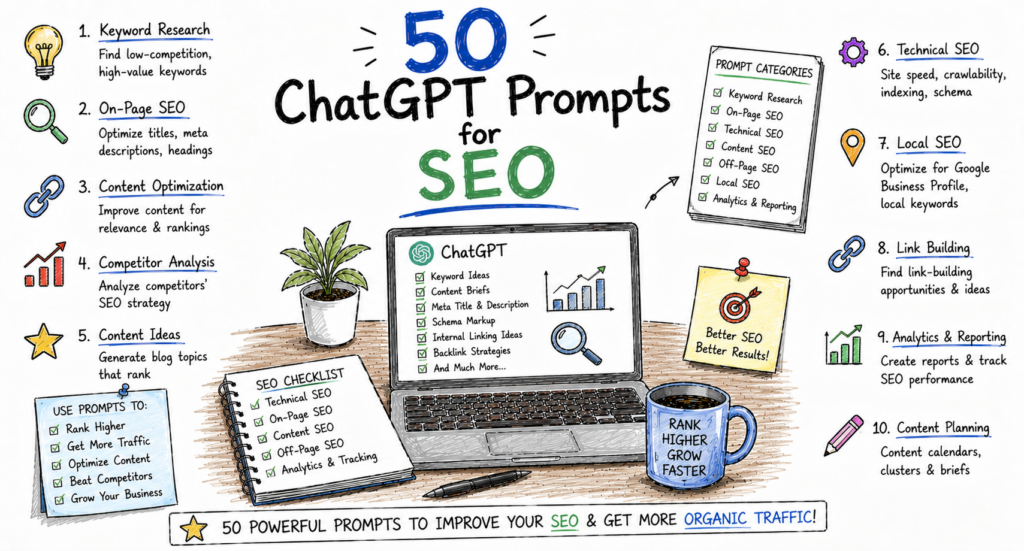
Search engine optimization (SEO) continues to be one of the most effective digital marketing strategies for businesses looking to generate long-term, sustainable traffic. However, modern SEO requires much more than inserting keywords into web pages. Successful SEO professionals conduct keyword research, analyze search intent, optimize content, improve technical performance, build authority, and continuously update existing pages.
This is where ChatGPT has become a valuable productivity tool.
When used correctly, ChatGPT can help marketers brainstorm content ideas, organize keyword clusters, draft meta descriptions, create SEO-friendly outlines, analyze competitors, improve internal linking strategies, and streamline many repetitive SEO tasks. It doesn’t replace professional SEO expertise or specialized SEO tools, but it can significantly reduce the time spent on planning and content creation.
The quality of ChatGPT’s output depends on the quality of the prompt you provide. Well-written prompts give the AI the context it needs to generate useful, actionable recommendations instead of generic responses.
This guide contains 50 practical ChatGPT prompts for SEO, beginning with 20 prompts focused on SEO strategy and keyword research. Each prompt is designed to be copied, customized, and used immediately.
Why SEO Professionals Use ChatGPT
SEO specialists use ChatGPT to:
Generate keyword ideas
Build topic clusters
Understand search intent
Create SEO content outlines
Improve on-page optimization
Brainstorm link-building ideas
Refresh older content
Create FAQs
Optimize metadata
Speed up research
While AI can accelerate many tasks, human expertise remains essential for validating information, ensuring originality, and creating content that genuinely serves users.
Best Practices for Writing SEO Prompts
To get the best results from ChatGPT:
1. Generate Keyword Ideas
Prompt:
Act as an experienced SEO strategist. Generate 100 keyword ideas related to [primary topic] for a website targeting users in the United States. Group the keywords into informational, commercial, transactional, and navigational search intent.
Best For: Keyword research
2. Find Long-Tail Keywords
Prompt:
Generate 50 long-tail keywords related to [primary keyword] with lower competition and high user intent. Explain why each keyword could be valuable for SEO.
Best For: Organic traffic growth
3. Build Topic Clusters
Prompt:
Create a complete topic cluster around the keyword “[primary keyword]”. Include one pillar page, supporting articles, internal linking recommendations, and related keywords.
Best For: Topical authority
4. Analyze Search Intent
Prompt:
Analyze the search intent behind the keyword “[keyword]”. Explain whether users are seeking information, making comparisons, researching products, or preparing to purchase.
Best For: Content planning
5. Create an SEO Content Strategy
Prompt:
Develop a six-month SEO content strategy for a [business type] targeting customers in the United States. Include keyword categories, publishing frequency, content formats, KPIs, and growth opportunities.
Best For: Long-term SEO planning
6. Generate Blog Post Ideas
Prompt:
Suggest 50 SEO-friendly blog post ideas related to [industry]. Organize them by beginner, intermediate, and advanced audiences.
Best For: Editorial planning
7. Build a Keyword Map
Prompt:
Create a keyword mapping strategy for a website about [industry]. Recommend primary keywords, secondary keywords, and the most appropriate page type for each keyword.
Best For: Site architecture
8. Identify Content Gaps
Prompt:
Identify content gaps within the [industry] niche and recommend article topics competitors are likely overlooking.
Best For: Competitive advantage
9. Analyze Competitor Content
Prompt:
Act as an SEO competitor analyst. Review common content strategies used by leading websites in [industry] and recommend ways to create more comprehensive and valuable content.
Best For: Competitor research
10. Generate FAQ Topics
Prompt:
Create 50 frequently asked questions related to [topic] that could improve SEO and increase the chances of appearing in Google’s People Also Ask results.
Best For: FAQ content
11. Create a Content Calendar
Prompt:
Develop a 90-day SEO content calendar for a [business type], including article titles, target keywords, search intent, publication dates, and internal linking suggestions.
Best For: Content scheduling
12. Discover Seasonal Keywords
Prompt:
Identify seasonal keyword opportunities for [industry] throughout the year in the United States. Recommend the best publishing timeline for each topic.
Best For: Seasonal SEO
13. Find Semantic Keywords
Prompt:
Generate semantic keywords, related phrases, entities, and natural language variations associated with “[primary keyword]” to improve topical relevance.
Best For: Content optimization
14. Prioritize Keywords
Prompt:
Evaluate the following keyword list based on estimated search intent, business value, competition, and conversion potential. Rank them from highest to lowest priority.
Best For: SEO prioritization
15. Develop Pillar Page Ideas
Prompt:
Recommend ten pillar page ideas for a [business niche], along with supporting cluster articles and internal linking recommendations.
Best For: Website growth
16. Create Buyer-Focused Keywords
Prompt:
Generate high-intent keywords targeting users who are close to purchasing [product/service]. Explain where each keyword fits within the customer journey.
Best For: Conversion-focused SEO
17. Build Local SEO Topics
Prompt:
Suggest 30 local SEO content ideas for a [business type] serving customers in [city/state]. Include local keywords, FAQs, and location-specific opportunities.
Best For: Local businesses
18. Analyze Emerging Trends
Prompt:
Identify emerging trends in the [industry] sector and recommend SEO content topics that are likely to grow in popularity over the next 12 months.
Best For: Future-focused content
19. Optimize Existing Keyword Lists
Prompt:
Review my keyword list and organize it into logical categories based on search intent, business goals, and content opportunities. Recommend any missing keyword groups.
Best For: SEO organization
20. Create an Annual SEO Roadmap
Prompt:
Develop a 12-month SEO roadmap for a [business type]. Include quarterly goals, priority keyword themes, content initiatives, technical SEO tasks, and performance metrics.
Best For: Annual SEO planning
Why These Prompts Deliver Better Results
Each prompt gives ChatGPT:
A clearly defined expert role
A specific business or SEO objective
The target audience
Structured deliverables
Action-oriented outputs
By replacing the placeholders with your own industry, target keywords, and audience, you can generate responses that are much more relevant than generic AI requests.