
Launching a startup in the United States is exciting, but managing finances can quickly become one of the biggest challenges. From tracking expenses and sending invoices to managing payroll, tax compliance, and financial reporting, choosing the right accounting software is essential for long-term success.
Today’s accounting platforms do much more than bookkeeping. They automate repetitive tasks, integrate with banks and payment processors, provide real-time financial insights, and help founders make informed business decisions. Whether you’re a solo entrepreneur, an early-stage SaaS startup, an eCommerce business, or a growing company with multiple employees, the right accounting software can save countless hours while improving financial accuracy.
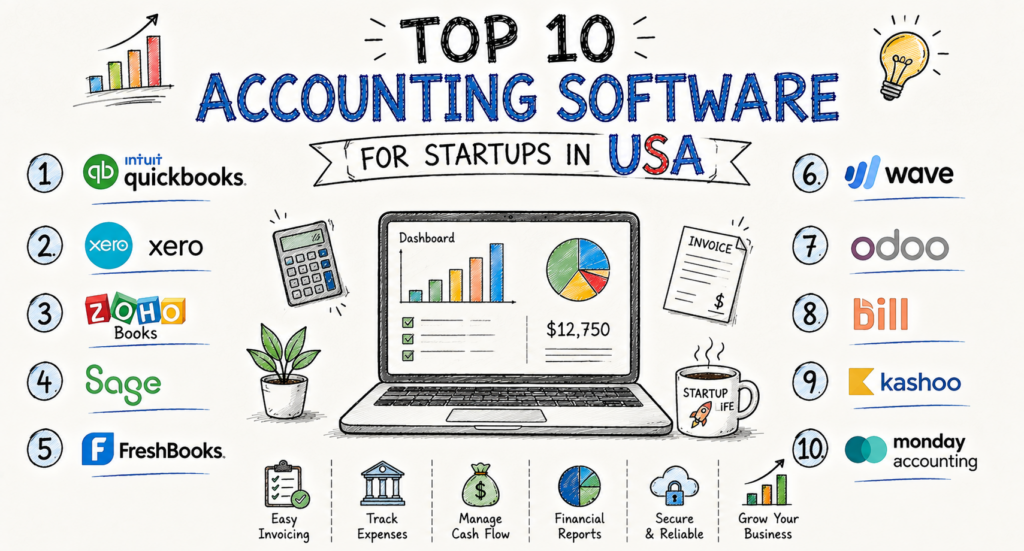
In this guide, we’ve reviewed the Top 10 Accounting Software for Startups in the USA comparing their features, pricing, advantages, drawbacks, and ideal use cases to help you find the best fit for your business.
Why Startups Need Accounting Software
Many startups begin by managing finances in spreadsheets, but as the business grows, manual bookkeeping becomes inefficient and error-prone.
Modern accounting software helps startups:
Track income and expenses automatically
Generate professional invoices
Monitor cash flow
Reconcile bank transactions
Prepare financial statements
Calculate taxes
Manage payroll
Track inventory
Collaborate with accountants
Make better financial decisions
Instead of spending hours on bookkeeping, founders can focus on growing their business.
How We Chose These Software Solutions
Our rankings are based on:
Ease of use
Pricing and scalability
Automation capabilities
Financial reporting
Tax support
Payroll integrations
Third-party app ecosystem
Customer support
Security
Overall value for U.S. startups
Top 10 Accounting Software for Startups in USA
1. QuickBooks Online
Best Overall Accounting Software for Startups
QuickBooks Online remains the industry leader for small businesses and startups because of its balance of powerful features, ease of use, and extensive integrations.
Key Features
Income and expense tracking
Automated bank reconciliation
Invoice creation
Inventory management
Payroll integration
Tax estimation
Financial reports
Mobile app
Pros
Easy to learn
Huge ecosystem of integrations
Excellent reporting
Accountant-friendly
Scales with business growth
Cons
Monthly subscription cost
Advanced features require higher-tier plans
Best For: Most startups, freelancers, agencies, and service businesses.
2. Xero
Best for Growing Startups
Xero is popular among startups looking for cloud-based accounting with unlimited users.
Features
Bank feeds
Invoice automation
Expense management
Inventory tracking
Project accounting
Multi-currency support
Payroll integrations
Pros
Unlimited users
Excellent dashboard
Strong automation
Clean interface
Cons
Payroll available through partners in many regions
Learning curve for beginners
Best For: Growing startups and remote teams.
3. FreshBooks
Best for Service-Based Startups
FreshBooks focuses on invoicing, project billing, and client management.
Features
Professional invoices
Time tracking
Expense tracking
Online payments
Project management
Financial reports
Pros
Excellent invoicing
Easy client billing
User-friendly interface
Cons
Limited inventory management
Best For:
Consultants, agencies, freelancers, and creative businesses.
4. Zoho Books
Best Value for Money
Zoho Books offers enterprise-level accounting features at an affordable price.
Features
Automated workflows
Invoice management
Expense tracking
Bank reconciliation
Inventory
Client portal
Tax compliance
Pros
Affordable pricing
Excellent automation
Strong integrations with Zoho ecosystem
Cons
Best experience within Zoho products
Best For
Budget-conscious startups.
5. Wave Accounting
Best Free Accounting Software
Wave is one of the few quality accounting platforms offering free core accounting features.
Features
Income tracking
Expense tracking
Unlimited invoicing
Receipt scanning
Financial reports
Payment processing
Pros
Free accounting
Easy setup
Ideal for startups with limited budgets
Cons
Limited advanced automation
Payroll available in select locations
Best For:
Bootstrapped startups and freelancers.
6. Sage Accounting
Best for Compliance
Sage has decades of accounting expertise and offers reliable bookkeeping with tax-ready reporting.
Features
Bank reconciliation
VAT and tax tracking
Cash flow forecasting
Invoice management
Reporting
Pros
Reliable accounting
Strong compliance tools
Good automation
Cons
Fewer third-party integrations than some competitors
Best For:
Businesses requiring detailed financial compliance.
7. NetSuite ERP
Best for High-Growth Startups
NetSuite combines accounting with enterprise resource planning (ERP), making it ideal for startups preparing to scale rapidly.
Features
General ledger
Financial planning
Inventory management
CRM integration
Procurement
Multi-entity accounting
Revenue recognition
Pros
Enterprise-grade capabilities
Highly scalable
Advanced reporting
Cons
Expensive
Longer implementation process
Best For:Venture-backed startups and fast-growing businesses.
8. Kashoo
Best for Simplicity
Kashoo is designed for entrepreneurs who want straightforward bookkeeping without unnecessary complexity.
Features
Expense tracking
Invoicing
Bank reconciliation
* Reporting
Tax preparation
Pros
Simple interface
Quick setup
Affordable pricing
Cons
Limited advanced features
Best For Solo founders and small teams.
9. Patriot Accounting
Best for Payroll Integration
Patriot combines accounting and payroll in a single platform.
Features
Payroll
Tax filing
General ledger
Financial reports
Invoicing
Expense tracking
Pros
Excellent payroll
Affordable
Easy to use
Cons
Fewer integrations than larger competitors
Best For:
Small businesses with employees.
10. OneUp
Best AI-Powered Automation
OneUp uses artificial intelligence to automate bookkeeping tasks and financial forecasting.
Features
AI bookkeeping
CRM
Inventory
Sales management
Financial forecasting
Automated accounting
Pros
Smart automation
Inventory support
Modern interface
Cons
Smaller ecosystem than leading competitors
Best For:
Tech startups looking to automate accounting.
Features Every Startup Should Look For
Before investing in accounting software, consider whether it offers:
Automatic bank synchronization
Cloud access
Mobile applications
Invoice automation
Recurring billing
Tax preparation tools
Payroll integration
Financial dashboards
Inventory tracking
Multi-user access
Role-based permissions
Third-party integrations (Stripe, PayPal, Shopify, Amazon, Square, Slack, CRM tools)
Secure cloud backups
Audit trails
Cloud vs Desktop Accounting Software
Cloud-Based Software
Advantages
Access from anywhere
Automatic updates
Secure backups
Collaboration with accountants
Easier integrations
Scalable for growing businesses
Desktop Software
Advantages
One-time licensing (for some products)
Local data storage
Suitable for businesses with limited internet access
For most startups, cloud-based accounting software is the preferred option because of its flexibility, automation, and ease of collaboration.
Tips for Choosing the Right Accounting Software
1. Define your business needs before purchasing.
2. Estimate how quickly your startup will grow.
3. Choose software that integrates with your payment processors and banking services.
4. Prioritize automation to reduce manual work.
5. Consider payroll and tax features if you plan to hire employees.
6. Evaluate reporting capabilities for investors and lenders.
7. Test the software using free trials whenever possible.
8. Ensure your accountant is familiar with the platform you choose.