
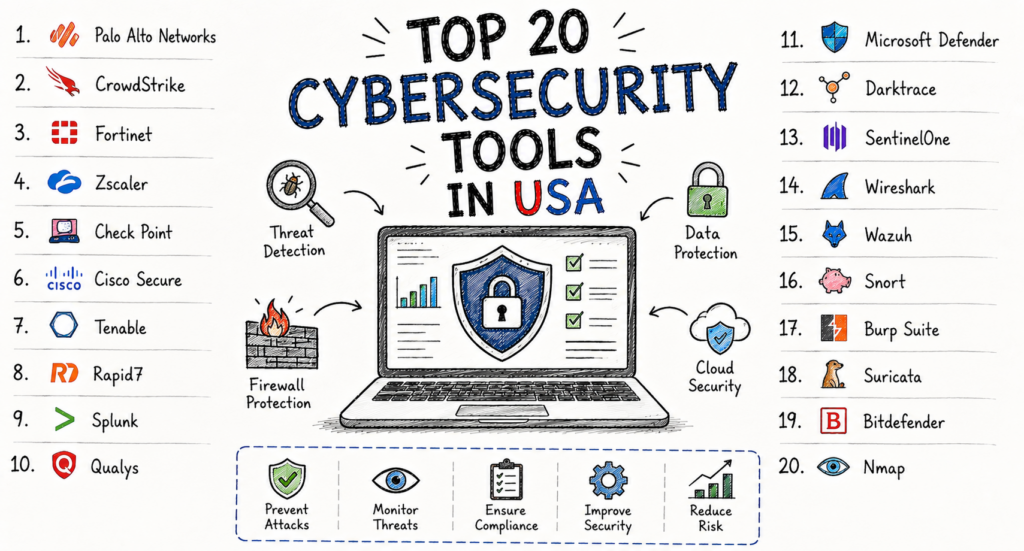
Cybersecurity has become one of the biggest priorities for businesses across the United States. From ransomware attacks and phishing scams to cloud security risks and insider threats, organizations of every size face increasingly sophisticated cybercriminals. According to industry reports, cyberattacks cost U.S. businesses billions of dollars annually, making proactive security investments more important than ever.
Whether you’re running a startup, managing a growing eCommerce business, or leading an enterprise IT department, choosing the right cybersecurity tools can significantly reduce your risk. Modern security platforms do far more than traditional antivirus software—they offer endpoint protection, threat intelligence, identity management, cloud security, vulnerability scanning, and AI-powered threat detection.
This guide reviews the **Top 20 Cybersecurity Tools in the USA**, focusing on solutions trusted by American businesses. We evaluated these platforms based on security effectiveness, ease of deployment, scalability, integrations, customer support, pricing, and overall value.
Why Cybersecurity Tools Matter
Every connected device, cloud application, employee account, and network endpoint represents a potential entry point for attackers. Cybersecurity tools help businesses defend against these threats before they become costly incidents.
Some of the key benefits include:
Detecting malware and ransomware
Preventing phishing attacks
Protecting sensitive customer data
Monitoring suspicious network activity
Securing remote workers
Managing passwords and identities
Meeting compliance requirements (HIPAA, PCI DSS, SOC 2, GDPR, CCPA)
Reducing downtime from cyber incidents
Improving visibility across IT infrastructure
For U.S. businesses, cybersecurity is no longer optional—it’s a critical part of business continuity and customer trust.
How We Selected These Cybersecurity Tools
Our recommendations are based on the following criteria:
Threat detection capabilities
Ease of deployment
Cloud security features
Endpoint protection
Identity and access management
Automation and AI capabilities
Integration with existing IT systems
Customer support
Scalability for startups and enterprises
Overall reputation in the cybersecurity industry
Top 20 Cybersecurity Tools in USA
1. CrowdStrike Falcon
Best Overall Endpoint Protection Platform**
CrowdStrike Falcon is widely recognized as one of the leading endpoint detection and response (EDR) platforms. It uses cloud-native architecture and artificial intelligence to detect and stop threats in real time.
Key Features
AI-powered threat detection
Endpoint protection
Managed threat hunting
Ransomware prevention
Cloud workload security
Identity protection
USB device control
Pros
Outstanding malware detection
Lightweight agent
Fast cloud deployment
Excellent reporting
Enterprise-grade security
Cons
Premium pricing
Advanced configuration may require experienced administrators
Best For: Medium and large businesses, enterprises, and security-focused organizations.
2. Microsoft Defender for Endpoint
Best for Microsoft Ecosystem
Organizations already using Microsoft 365 often choose Microsoft Defender because of its seamless integration with Windows, Azure, and Microsoft security services.
Features
Endpoint protection
Threat analytics
Automated investigation
Vulnerability management
Cloud protection
Email security
Identity monitoring
Pros
Excellent Windows integration
Strong ransomware protection
Built-in Microsoft ecosystem
Centralized management
Cons
Advanced features require higher Microsoft licensing plans
Best For: Businesses heavily invested in Microsoft products.
3. Palo Alto Networks Cortex XDR
Best AI Threat Detection Platform
Cortex XDR combines endpoint security, network monitoring, and cloud analytics into one platform.
Features
Extended detection and response (XDR)
AI-driven analytics
Threat intelligence
Automated incident response
Cloud security monitoring
Pros
Excellent visibility
Reduces false positives
Powerful analytics
Enterprise-ready
Cons
Higher learning curve
Best For: Large organizations and enterprises.
4. SentinelOne Singularity
Best Autonomous Security Platform
SentinelOne has gained popularity for its AI-powered autonomous endpoint protection that can detect and remediate attacks without human intervention.
Features
Autonomous threat detection
Behavioral AI
Ransomware rollback
Cloud workload security
Endpoint detection and response
Pros
Fast automated response
Strong ransomware defence
Easy deployment
Cons
Premium pricing
Best For: Businesses wanting automated security operations.
5. Bitdefender GravityZone
Best Value Enterprise Antivirus
Bitdefender offers excellent malware detection while remaining affordable for small and medium businesses.
Features
Antivirus
Endpoint security
Risk analytics
Patch management
Device control
Email protection
Pros
Excellent malware detection
Affordable pricing
Low system impact
Cons
Reporting can be improved
Best For: SMBs and growing companies.
6. Sophos Intercept X
Best Anti-Ransomware Protection
Sophos combines deep learning AI with exploit prevention to stop advanced attacks before they spread.
Features
Anti-ransomware
Deep learning malware detection
Web protection
Device encryption
Endpoint detection
Pros
Outstanding ransomware defence
Easy management
Excellent security dashboard
Cons
Advanced reporting requires experience
Best For: Businesses prioritizing ransomware protection.
7. Cisco Secure Endpoint
Best for Large IT Networks
Cisco provides a complete security ecosystem integrating networking, email security, VPN, and endpoint protection.
Features
Malware prevention
Threat hunting
Device isolation
File reputation analysis
Secure networking
Pros
Enterprise integration
Strong global threat intelligence
Excellent support
Cons
Best suited to Cisco environments
Best For: Enterprises using Cisco infrastructure.
8. Trend Micro Apex One
Trend Micro protects physical devices, virtual machines, and cloud workloads from modern cyber threats.
Features
Endpoint protection
Behavioral monitoring
Email security
Web reputation
Vulnerability shielding
Reliable malware detection
Good cloud protection
Flexible deployment
Cons
Interface feels dated
Best For:Mid-sized businesses.
9. Fortinet FortiEDR
Best Network and Endpoint Integration
Fortinet combines endpoint security with its broader network security ecosystem.
Features
Real-time threat detection
Endpoint monitoring
Incident response
Threat intelligence
Forensic analysis
Pros
Excellent integration
Strong network visibility
Fast response
Cons
Better suited to existing Fortinet customers
Best For: Businesses using Fortinet firewalls.
10. Check Point Harmony Endpoint
Best Unified Endpoint Security
Check Point delivers comprehensive endpoint protection with strong phishing prevention and zero-day attack defence.
Features
Endpoint security
Threat emulation
Anti-phishing
Data protection
Behaviour analysis
Pros
Excellent phishing defence
Good zero-day protection
Easy deployment
Cons
Premium licensing
Best For Organizations requiring advanced endpoint security.