
For businesses in Chennai, electricity is more than just another operating expense. For manufacturing units, IT companies, commercial buildings, warehouses, hospitals, educational institutions, and other large power consumers, the way electricity is purchased can have a direct impact on operating costs and energy planning.
Tamil Nadu has a strong industrial base and a growing renewable energy ecosystem. As electricity markets become more flexible, businesses have more options to explore beyond traditional power procurement. Power exchanges, open access, renewable energy procurement, real-time markets, and other electricity market mechanisms can give eligible consumers additional ways to manage their power requirements.
However, power trading is not simply about finding the lowest electricity price. Businesses need to consider market prices, transmission and wheeling charges, open access requirements, scheduling, demand patterns, renewable energy requirements, regulatory conditions, and the actual landed cost of electricity.
This is where professional energy and power trading support can make a difference.
Kinetiq Energy helps businesses understand their electricity requirements and explore practical energy solutions based on their consumption profile, commercial objectives, and long-term energy strategy.
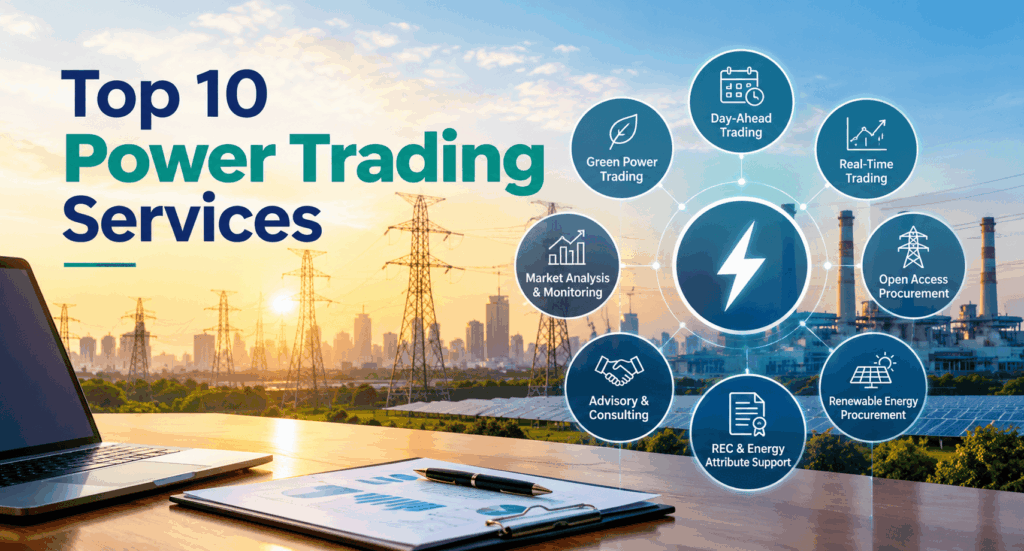
Here are 10 important power trading services that businesses in Chennai and across Tamil Nadu should understand.
1. Day-Ahead Power Trading
Day-Ahead Market (DAM) procurement allows eligible market participants to buy or sell electricity for the following day through a power exchange.
For a business with reasonably predictable electricity consumption, day-ahead procurement can become an important part of short-term power planning. Prices are determined through market-based bidding, so the cost can change depending on demand, supply, transmission constraints, and other market conditions.
For Chennai industries, understanding day-ahead power prices can help energy teams evaluate whether exchange-based procurement may complement their existing electricity arrangement.
The Indian Energy Exchange describes DAM as a physical electricity market where electricity for the next day is bought and sold through a double-sided auction process.
A power trading consultant can help businesses evaluate consumption patterns and understand when this type of procurement may be commercially relevant.
2. Real-Time Power Trading
Electricity demand does not always follow a perfect forecast.
A manufacturing plant may increase production unexpectedly. A facility may experience a change in operating hours. Renewable generation can also vary depending on weather conditions.
Real-Time Market (RTM) mechanisms are designed to provide a way of managing electricity requirements closer to the actual delivery period.
IEX currently describes RTM as a market with multiple bidding sessions during the day, with electricity delivered approximately one hour after market closure.
For businesses with changing loads, real-time market awareness can be useful for managing short-term deviations between expected and actual electricity requirements.
3. Green Power Trading
More Chennai businesses are looking beyond electricity cost alone. Sustainability targets, customer expectations, ESG commitments, and corporate renewable energy goals are encouraging companies to consider cleaner sources of electricity.
Green power trading provides businesses with opportunities to explore renewable electricity through available market mechanisms.
The Indian power market includes products such as Green Day-Ahead Market (G-DAM), Green Term-Ahead Market and other renewable energy-related mechanisms.
For a Chennai manufacturing company, choosing renewable power is not simply a matter of selecting a solar project. The business must also consider its load profile, contractual structure, open access requirements, applicable charges, and regulatory framework.
A structured energy assessment can help determine which option fits the business.
4. Open Access Power Procurement
Open access can allow eligible electricity consumers to procure power from sources other than their traditional distribution arrangement, subject to applicable regulations and approvals.
This is particularly relevant for larger commercial and industrial consumers.
For businesses considering open access in Tamil Nadu, the important question is not just:
“What is the generator’s power price?”
The better question is:
“What will be my actual landed cost after all applicable charges, losses and other costs?”
Power procurement decisions should therefore consider the complete commercial picture.
The Ministry of Power has also established a framework for Green Energy Open Access, with the national rules providing eligibility provisions including a 100 kW threshold under specified conditions. State-level implementation and applicable regulations still need to be considered.
This is one area where professional energy advisory support can help businesses avoid looking at only the headline tariff.
5. Renewable Energy Procurement
Solar and wind power have become important components of India’s electricity ecosystem.
Businesses in Chennai and Tamil Nadu can explore renewable procurement models depending on their electricity consumption, location, operational requirements, and applicable regulatory framework.
Renewable procurement can be considered for several reasons:
Lower exposure to conventional power costs
Corporate sustainability objectives
Renewable energy consumption targets
Long-term energy planning
ESG reporting requirements
Reducing dependence on conventional electricity sources
However, renewable procurement should be evaluated based on the company’s actual consumption pattern rather than simply choosing the cheapest available generation source.
Kinetiq Energy can help businesses examine their energy requirements and understand how renewable power can fit into a broader electricity procurement strategy.
6. Power Trading Through Term-Ahead Markets
Not every business wants to make electricity procurement decisions one day at a time.
Term-Ahead Market products provide opportunities to buy or sell electricity for periods extending beyond the immediate day-ahead requirement.
According to IEX, its Term-Ahead Market includes products that allow participants to buy or sell electricity for periods up to 11 days ahead.
This can be relevant for businesses that want additional flexibility in managing their electricity portfolio.
For example, a manufacturing company may have a reasonably predictable production schedule for the coming week. Understanding available term-ahead products can help the company evaluate different procurement strategies rather than relying entirely on short-term spot purchases.
7. Power Procurement and Trading Advisory
Power trading can become complicated when businesses have to evaluate multiple variables at the same time.
An energy advisory service can help companies understand:
Current electricity requirements
Historical consumption
Peak demand patterns
Power purchase options
Market prices
Open access considerations
Renewable energy opportunities
Transmission and wheeling costs
Applicable charges
Contract structures
Potential commercial risks
The objective is not simply to trade electricity. The objective is to develop a procurement approach that makes commercial sense for the business.
This distinction is particularly important for Chennai industries because two companies with similar electricity consumption can have very different procurement requirements.
8. Power Market Analysis and Price Monitoring
Electricity prices can change based on supply, demand, weather conditions, generation availability, transmission constraints, and other market factors.
For a business that purchases significant quantities of electricity, regularly monitoring the market can provide useful information for energy planning.
Power market analysis may include reviewing:
Day-ahead prices
Real-time market trends
Renewable power prices
Demand patterns
Market volatility
Available procurement options
Transmission constraints
Historical consumption
Expected electricity requirements
IEX provides market price and trading information across several electricity market segments, helping participants understand current market conditions.
For a business, however, raw market data is only the starting point. The more important step is connecting market information with the company’s own electricity consumption.
9. Renewable Energy Certificate and Energy Attribute Support
Businesses increasingly want to demonstrate their use of renewable energy.
Renewable Energy Certificates (RECs) are one mechanism within India’s electricity market that can support renewable energy accounting and compliance-related requirements, depending on the organization’s circumstances and applicable rules.
Power exchanges provide REC-related market infrastructure, alongside other electricity market products
Businesses considering RECs should first understand their specific sustainability objectives and regulatory requirements.
Instead of treating certificates as a standalone purchase, companies can evaluate them as part of a broader renewable energy strategy that may include solar procurement, open access power, energy efficiency, and other measures.
10. Customized Power Procurement Strategy
Perhaps the most valuable power trading service is not a single trading product at all.
It is a customized power procurement strategy.
Every business has a different electricity profile.
A textile manufacturing unit may operate multiple shifts. A data-intensive facility may have a relatively consistent load. A commercial building may have significant daytime consumption. A cold-storage facility may have a different demand pattern again.
Because of these differences, a standard electricity procurement strategy may not work equally well for every company.
A customized strategy can consider:
Consumption Profile: How much electricity does the business use, and when does it use it?
Peak Demand: When does the facility experience its highest electricity requirement?
Operating Hours: Is electricity consumption concentrated during daytime, nighttime, or spread throughout the day?
Renewable Potential: Can solar, wind, or another renewable source contribute meaningfully?
Market Exposure: How much electricity should be exposed to short-term market prices?
Contract Requirements: Would longer-term or structured procurement provide greater predictability?
Landed Cost: What is the actual cost after applicable charges, losses, and other components?
Business Objectives: Is the company primarily focused on cost management, renewable energy consumption, sustainability, or a combination of these?
This approach helps turn electricity procurement from a routine utility expense into a more structured energy management decision.
Why Power Trading Matters for Chennai Businesses
Chennai is surrounded by a wide range of electricity-intensive industries, including automotive and automobile components, engineering, electronics, manufacturing, IT, logistics, healthcare, textiles, commercial real estate, and other sectors.
For these businesses, even a small difference in electricity cost can become significant when multiplied across thousands or millions of units of annual consumption.
At the same time, electricity procurement decisions cannot be based on price alone.
A lower exchange price does not automatically mean a lower final electricity cost. Businesses need to account for applicable open access charges, transmission and wheeling costs, losses, scheduling requirements, regulatory conditions and other components.
IEX’s landed-cost calculator, for example, specifically notes that an open-access transaction can involve additional charges and losses beyond the exchange price.
That is why businesses should evaluate the landed cost of electricity, rather than comparing only the quoted power price.
How Kinetiq Energy Can Help
Kinetiq Energy focuses on helping businesses make more informed energy and power procurement decisions.
Instead of approaching power trading as a simple buying-and-selling activity, Kinetiq Energy can help businesses look at the complete energy picture — from consumption patterns and procurement requirements to renewable energy opportunities and commercial considerations.
For a business in Chennai, the process can begin with understanding the current electricity situation.
The first step is to review the company’s electricity consumption and operating pattern. From there, potential procurement options can be evaluated based on commercial requirements.
Depending on the business profile, this may include examining power trading opportunities, open access, renewable energy procurement, market-based electricity purchases, or a combination of different approaches.
The goal is to develop an energy strategy that is practical for the business rather than recommending a generic solution.
What Businesses Should Check Before Choosing a Power Trading Service
Before working with a power trading or energy advisory provider, businesses should ask a few important questions.
Does the provider understand the electricity market and applicable regulations?
Can they evaluate the company’s actual consumption profile?
Do they consider landed electricity costs rather than only quoted power prices?
Can they explain open access requirements clearly?
Do they understand renewable energy procurement?
Can they provide transparent commercial calculations?
Can they explain the risks associated with market-based procurement?
Does the proposed strategy match the company’s operating hours and electricity demand?
These questions can help businesses separate a genuine energy strategy from a simple price comparison