
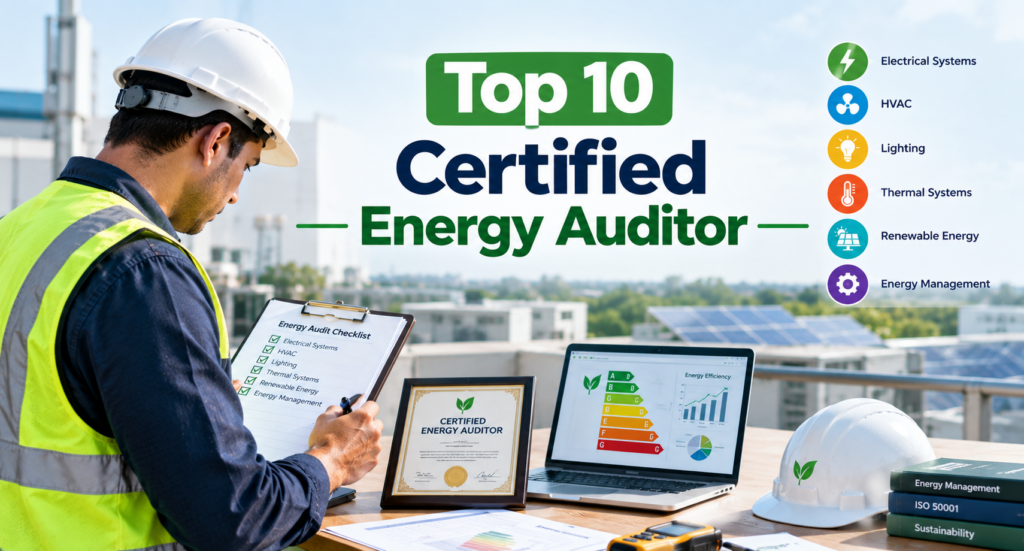
For many businesses in Chennai, electricity is one of those expenses that quietly grows month after month. A factory may be running additional machinery, an office may be using more air conditioning, a hospital may have equipment operating around the clock, or an apartment community may have rising common-area consumption. The electricity bill tells you how much you are paying, but it does not always tell you where the energy is being wasted.
That is where a certified energy auditor can make a meaningful difference.
A professional energy audit examines how energy is consumed across a facility, identifies inefficiencies and recommends practical measures to improve performance. In India, the Bureau of Energy Efficiency (BEE) has a national certification framework for Energy Auditors and Energy Managers, and BEE maintains information on accredited energy auditors.
For Chennai companies, choosing the right auditor is particularly important because facilities can have very different energy profiles. An automobile-component manufacturer in Ambattur will have different requirements from an IT office on OMR, a hospital in Chennai, or a large residential community in Sholinganallur.
This guide explains 10 important areas of certified energy auditing and what businesses should consider before appointing an energy auditor.
What Is a Certified Energy Auditor?
A certified energy auditor is a professional who has obtained the relevant certification under India’s energy-efficiency framework.
BEE conducts national certification examinations for Energy Auditors and Energy Managers. BEE also maintains qualified lists and information relating to accredited energy auditors.
It is important to understand the difference between Certified Energy Auditor and Accredited Energy Auditor.
Certification demonstrates that an individual has obtained the relevant professional certification through the BEE framework. Accreditation is a further status maintained by BEE for auditors who meet its applicable requirements. BEE’s published material explains that certified energy auditors can apply for accreditation subject to the applicable eligibility criteria.
For organisations that fall under mandatory energy-audit requirements, this distinction matters. BEE’s framework states that designated energy consumers are required to have applicable energy audits conducted by an Accredited Energy Auditor.
So, before hiring someone, a company should verify the specific credential required for its facility and audit purpose.
Top 10 Certified Energy Auditor Services and Areas to Consider
1. Electrical Energy Audit
Electrical systems are usually one of the first areas examined during a professional energy audit.
An electrical audit looks at how power enters the facility, how it is distributed and how major equipment consumes electricity. Depending on the site, the auditor may study transformers, panels, cables, motors, power factor, electrical loads and demand patterns.
For example, a manufacturing unit may discover that some equipment is consuming significant electricity during periods when production is relatively low. Another facility might have avoidable losses associated with electrical distribution or inefficient equipment operation.
A proper audit involves measurements and analysis rather than simply looking at the monthly electricity bill.
For Chennai industries, this can be particularly useful where multiple production lines, large motors and heavy electrical loads operate simultaneously.
2. Power Quality Audit
Energy consumption is only one part of electrical performance.
Power quality can also affect equipment reliability and efficiency. Voltage fluctuations, harmonics, load imbalance and power-factor issues may affect certain types of electrical equipment.
A power-quality audit uses appropriate measurement instruments to understand what is happening within the electrical system.
This is particularly relevant for facilities using automation, variable-frequency drives, CNC equipment, IT infrastructure and other sensitive loads.
KinetiQ Energy includes power-factor and harmonic analysis within its electrical audit scope and also provides power-quality-related solutions.
Instead of guessing whether a power-quality correction system is required, measurement helps identify the actual issue first.
3. HVAC Energy Audit
In Chennai, air conditioning is an important energy consideration for many commercial buildings.
The city’s hot and humid conditions mean that offices, hospitals, hotels, shopping centres, IT facilities and other buildings can spend substantial amounts of energy on cooling.
An HVAC audit examines the performance and operating conditions of cooling systems.
Depending on the facility, the assessment may include:
- Chillers
- AHUs
- Pumps
- Cooling towers
- Ventilation
- Operating schedules
- Temperature settings
- Variable-frequency drives
- Control systems
KinetiQ Energy lists HVAC efficiency checks, including AHU and chiller assessments, as part of its energy-auditing services
Sometimes the answer is not to replace an entire air-conditioning system. Better controls, operating schedules, maintenance or optimisation may provide an opportunity for improvement.
4. Lighting Energy Audit
Lighting is another area where businesses can identify energy-efficiency opportunities.
Large factories, warehouses, offices, hospitals, retail stores and apartment communities can have hundreds or thousands of lighting fixtures.
A lighting audit examines:
- Lighting technology
- Operating hours
- Illumination levels
- Switching arrangements
- Occupancy
- Control systems
- Opportunities for efficient lighting
The objective should not simply be “replace everything with LED.”
An experienced auditor should also consider whether the current illumination is appropriate for the activity being performed.
KinetiQ Energy’s listed lighting audit scope includes lux-level optimisation.
For a Chennai warehouse, for example, there may be opportunities to reduce unnecessary lighting in low-occupancy areas without affecting safety or visibility.
5. Thermal Energy Audit
Thermal energy becomes especially important in manufacturing and process industries.
Factories that use boilers, furnaces, dryers, ovens, steam systems or hot-water systems can lose energy through inefficient operation, poor insulation, steam leakage or inefficient heat transfer.
A thermal energy audit investigates how heat is produced and where it goes.
Typical areas include boiler performance, steam lines, insulation and hot-water systems.
KinetiQ Energy specifically lists steam-line efficiency, insulation losses, boiler performance and hot-water systems as part of its thermal audit services.
For an industrial facility, identifying thermal losses can be valuable because energy savings can continue month after month once the underlying problem is corrected.
6. Motor and Pump Energy Audit
Motors are everywhere in industrial facilities.
They operate pumps, fans, compressors, conveyors, machine tools and many other systems.
The important question is whether each motor-driven system is operating according to actual demand.
An oversized pump, for example, may use more energy than necessary. A motor running continuously despite changing production requirements may also create unnecessary consumption.
A professional audit can examine loading, operating hours, system requirements and control methods.
In suitable applications, variable-frequency drives or improved controls may help match motor output to actual demand.
For Chennai’s manufacturing sector, this can be especially relevant to factories with multiple motor-driven systems operating throughout the day.
7. Compressed-Air Energy Audit
Compressed air can be convenient, but producing it requires electricity.
Manufacturing facilities sometimes lose energy because compressors operate at unnecessarily high pressure, systems have leaks or compressed air is being used for applications where another solution may be more appropriate.
A compressed-air audit can examine:
- Compressor loading
- Operating pressure
- Leakage
- Air demand
- Pressure drops
- Storage capacity
- Operating schedules
- Control systems
A leak that sounds small may not appear important when viewed individually. Across an entire factory, however, multiple leaks can create a continuous demand on the compressor.
For engineering and manufacturing companies around Chennai, compressed-air assessment can therefore be a useful part of an industrial energy audit.
8. Building Energy Audit
A building energy audit looks at the facility as a complete system.
Rather than concentrating on one machine, the auditor considers multiple energy-consuming systems and how they interact.
For a commercial building, this could include HVAC, lighting, pumps, lifts, ventilation, electrical distribution and common-area equipment.
For apartments, the assessment may include water pumps, lighting, lifts, air-conditioning in common areas and other shared electrical loads.
This approach can reveal problems that may not be obvious when systems are analysed independently.
For example, excessive cooling demand may be connected to operating schedules, building conditions or heat entering the building.
A whole-building audit therefore helps facility managers decide where to focus their investment.
9. Solar Feasibility and Energy Audit
Solar energy is attracting growing interest from businesses and property owners that want to manage electricity costs and increase renewable-energy use.
But installing a solar system should begin with understanding the site’s actual energy consumption.
A solar feasibility study can examine available roof space, shading, orientation, system sizing, expected generation and financial returns.
KinetiQ Energy lists shadow and tilt analysis, PV yield simulation and ROI/payback calculations among its solar-feasibility services.
This is important because the largest possible solar installation is not necessarily the most suitable one.
The system should be designed around the site’s consumption profile, available space and project objectives.
10. Industrial and Comprehensive Energy Audit
For large manufacturing facilities, an individual system audit may not provide the complete picture.
A comprehensive industrial energy audit brings different areas together.
The assessment can examine electrical systems, thermal processes, motors, pumps, compressed air, HVAC, lighting and production-related energy consumption.
The auditor can then compare energy use with production output and identify areas where efficiency improvements may be possible.
This becomes especially important for facilities where energy is directly linked to production costs.
BEE’s framework also provides specific requirements for designated consumers and energy-intensive industries, making professional compliance and audit expertise particularly important for organisations that fall within those categories.
How to Choose a Certified Energy Auditor in Chennai
Finding an energy auditor should not be based only on the lowest quotation.
The first thing to check is the auditor’s credentials.
BEE publishes information on certified and accredited energy auditors, including qualified lists and an accredited-energy-auditor listing. Companies can use these official resources when verifying credentials.
The second consideration is industry experience.
A factory, hospital, hotel, office and residential community all consume energy differently. Ask whether the auditor has experience with the type of facility you operate.
The third consideration is measurement.
A meaningful audit should involve appropriate measurements and analysis. A report based entirely on assumptions and general recommendations may not provide the same level of insight as an assessment supported by actual site data.
The fourth consideration is financial analysis.
Energy-saving recommendations should ideally explain the expected investment, potential savings and estimated payback. This allows management to decide which projects should be implemented first.
The fifth consideration is implementation support.
An audit is more useful when the recommendations can be converted into practical projects.
Why KinetiQ Energy Is Relevant for Chennai Businesses
For organisations searching for certified energy-audit services in Chennai, KinetiQ Energy offers a local option with a broad energy-auditing scope.
According to KinetiQ Energy, its team includes Bureau-certified energy auditors with experience across commercial and industrial facilities, residential communities and utility-scale facilities. Its services cover electrical auditing, thermal auditing, lighting and HVAC auditing and solar feasibility studies.
The company states that its audit process includes an on-site assessment followed by a detailed report containing findings, recommendations and an ROI table, along with an implementation roadmap and benchmarking information.
KinetiQ Energy is located in Chennai and lists its office address in Ponmar, Chennai, along with contact details on its website.
For a Chennai business, working with a local energy specialist can also make practical coordination easier when site visits, measurements and implementation discussions are required.
What Should You Ask Before Hiring an Energy Auditor?
Before signing an agreement, it is worth asking a few straightforward questions.
Is the auditor BEE certified or accredited where applicable?
Ask for the relevant certification or accreditation details rather than relying only on marketing claims.
What will be measured during the audit?
Understand whether the assessment includes electrical loads, power quality, HVAC, thermal systems, lighting, motors or other relevant equipment.
Will the audit include financial calculations?
A good report should help you understand potential savings, investment requirements and payback periods.
Does the auditor understand your industry?
An auditor experienced with manufacturing may approach a factory differently from an office or apartment complex.
What happens after the report?
Ask whether the company can help with implementation, monitoring or verification of recommended improvements.
These questions can help a company distinguish between a basic inspection and a genuinely useful energy-management exercise.
Why Energy Auditing Matters in Chennai
Chennai is home to a wide range of energy-intensive activities, from manufacturing and automobile-related industries to IT, healthcare, hospitality, retail and residential developments.
Every facility has its own energy pattern.
Some businesses struggle with peak demand. Others have cooling costs that continue rising. Manufacturing units may have inefficient motors or compressed-air systems. Older buildings may have outdated lighting and HVAC controls.
There is therefore no single energy-saving solution that works for everyone.
The purpose of an energy audit is to identify the actual situation first.
Measure. Analyse. Prioritise. Implement.
That simple process can help businesses make energy decisions based on data rather than assumptions.