
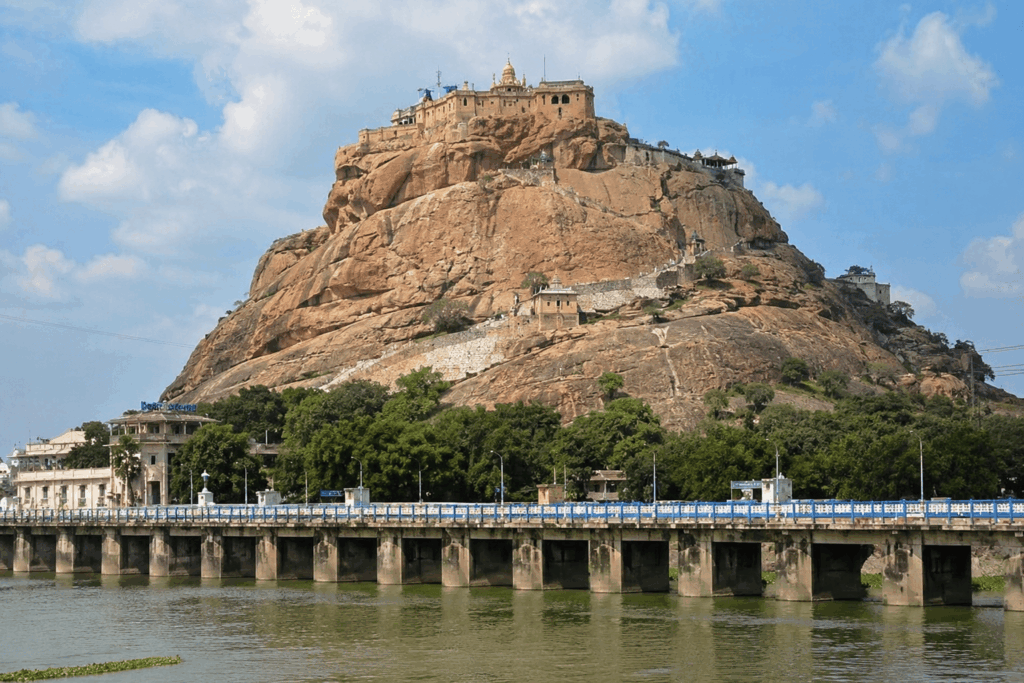
Standing majestically above the bustling city of Tiruchirappalli (commonly known as Trichy), the Tiruchirappalli Rock Fort is one of Tamil Nadu’s most iconic historical landmarks. Rising approximately 83 metres (273 feet) above the surrounding plains, this magnificent fort is built atop one of the oldest rock formations in the world, estimated by geologists to be over 3.8 billion years old. Long before kingdoms rose and fell across South India, this ancient rock had already witnessed millions of years of Earth’s history.
Today, the Rock Fort is much more than a tourist destination. It is a remarkable blend of history, spirituality, military architecture, geology, and culture. Visitors climbing its hundreds of stone steps not only enjoy breathtaking panoramic views of Trichy and the Cauvery River but also experience centuries of South Indian history preserved in stone.
For history enthusiasts, the Rock Fort represents the power struggles of the Pallavas, Cholas, Pandyas, Vijayanagara rulers, Madurai Nayaks, the Carnatic Nawabs, the French, and the British. For pilgrims, it is home to the famous Ucchi Pillayar Temple and the ancient Thayumanaswamy Temple. For students and competitive exam aspirants, it serves as an important topic in Tamil Nadu history and Indian architecture.
This historic monument continues to attract lakhs of visitors every year, making it one of Tamil Nadu’s most visited heritage attractions.
Why Tiruchirappalli Rock Fort Is So Famous
Few monuments in India combine natural wonder and human achievement as beautifully as the Rock Fort. Unlike ordinary forts built on hills, this fortress was constructed directly on an enormous granite outcrop that predates even the Himalayan mountain range.
Its strategic location allowed rulers to monitor enemy movements across the fertile Cauvery plains. The height of the fort made it nearly impossible for invading armies to capture without prolonged battles.
The Rock Fort is famous for several reasons:
One of the oldest exposed rock formations on Earth.
A masterpiece of South Indian military engineering.
Home to centuries-old Hindu temples.
Significant battlefield during the Carnatic Wars.
Excellent viewpoint overlooking Trichy city.
Important cultural and religious centre.
One of Tamil Nadu’s most photographed monuments.
These unique characteristics make the Rock Fort an unforgettable destination for every traveller.
Geological Wonder: A Rock Older Than the Himalayas
One of the most fascinating aspects of Tiruchirappalli Rock Fort is its incredible geological history.
Scientists estimate that this rock formed nearly **3.8 billion years ago**, making it among the oldest surviving rock formations on Earth. By comparison:
The Himalayan Mountains are approximately 50 million years old.
The Western Ghats are around 150 million years old.
The Rock Fort’s granite is billions of years older.
This ancient granite belongs to the Earth’s earliest continental crust. Over countless ages, volcanic activity, continental shifts, erosion, and weathering shaped the massive outcrop that dominates Trichy today.
Because of its immense age, geologists from around the world study the Rock Fort to understand Earth’s earliest geological evolution.
Standing atop this rock is like standing on one of the oldest surviving pieces of our planet.
Early Human Settlements Around the Rock
The fertile plains surrounding the Cauvery River have supported human civilisation for thousands of years. Archaeological evidence suggests that early communities settled near the rock because it provided several advantages:
Natural protection from enemies.
Elevated observation point.
Easy access to fresh water.
Fertile agricultural land nearby.
Convenient trade routes along the Cauvery.
As settlements expanded, the rock gradually became both a military stronghold and a sacred religious site.
Its commanding position ensured that successive rulers recognised its strategic importance.
The Pallava Period
The earliest significant historical developments at the Rock Fort are associated with the Pallavas.
During the 6th and 7th centuries CE, the Pallava rulers expanded their influence across northern Tamil Nadu. They were renowned patrons of art, architecture, literature, and temple construction.
One of the Rock Fort’s oldest surviving monuments is the **Lalitankura Pallava Griham**, a rock-cut cave temple attributed to the reign of **Mahendravarman I**. The Pallavas pioneered the technique of carving temples directly into living rock, and this cave is an excellent example of their craftsmanship.
The cave features:
Intricately carved pillars.
Sculptures of Hindu deities.
Early Tamil inscriptions.
Beautiful examples of Pallava rock-cut architecture.
This cave temple marks the beginning of the Rock Fort’s transformation into both a religious and defensive centre.
The Rise of the Cholas
Following the Pallavas, the mighty Chola Empire emerged as one of India’s greatest dynasties.
Between the 9th and 13th centuries, the Cholas transformed the Cauvery delta into a prosperous kingdom known for agriculture, maritime trade, temple architecture, and efficient administration.
Although the Cholas concentrated on monumental temples such as those at Thanjavur and Gangaikonda Cholapuram, they recognised the military significance of Tiruchirappalli Rock Fort.
The fort served as:
A defensive outpost.
A military observation station.
A regional administrative centre.
Protection for trade routes connecting the Cauvery delta.
Under Chola rule, the surrounding region flourished economically, and the Rock Fort became increasingly important for safeguarding the empire’s heartland.
The Pandya Influence
The decline of the Cholas paved the way for the resurgence of the Pandya Kingdom.
The Pandyas frequently contested control of the fertile Cauvery basin, making Tiruchirappalli an important strategic location.
During this period:
Defensive structures were strengthened.
Trade routes remained active.
Religious institutions continued receiving royal patronage.
Local communities prospered through agriculture and commerce.
Although political control shifted multiple times between rival dynasties, the Rock Fort retained its status as an invaluable military stronghold.
Importance of the Cauvery River
The history of Tiruchirappalli Rock Fort cannot be understood without appreciating the role of the Cauvery River.
Often called the “Ganga of South India,” the Cauvery has nurtured civilisation for thousands of years.
Its waters supported:
Extensive irrigation systems.
Rice cultivation.
Inland trade.
Religious pilgrimages.
Urban development.
The Rock Fort’s elevated position allowed rulers to monitor movement across the river, protect valuable agricultural lands, and defend important transportation routes.
This close relationship between geography and political power explains why nearly every major South Indian dynasty sought to control Trichy.
A Centre of Religion and Culture
Even in its early history, the Rock Fort was not merely a military installation.
Temples carved into the rock attracted saints, scholars, poets, and pilgrims. Religious festivals brought communities together, while inscriptions recorded donations from kings, merchants, and local residents.
Over centuries, the site evolved into a vibrant centre where faith, art, education, and governance coexisted.
This combination of military strength and spiritual significance remains one of the defining characteristics of Tiruchirappalli Rock Fort.