
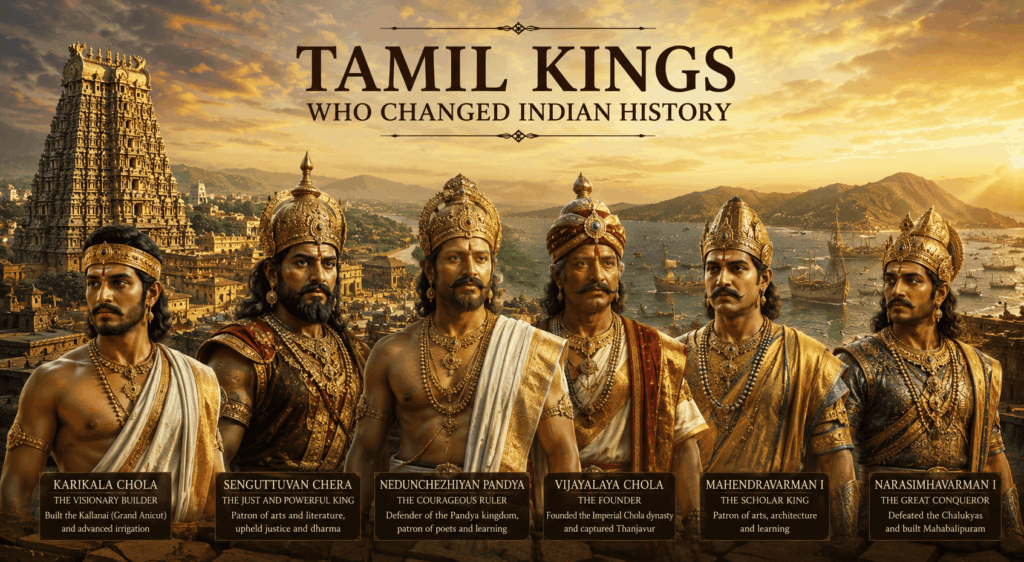
Tamil Kings Who Changed Indian History
India’s rich history has been shaped by many great rulers, but few have left as profound and lasting an impact as the kings of ancient Tamil Nadu. For over two thousand years, Tamil rulers built prosperous kingdoms, encouraged literature and learning, expanded maritime trade, constructed magnificent temples, and developed systems of governance that influenced generations. Their achievements not only transformed South India but also strengthened India’s cultural and economic connections with the wider world.
The Cholas, Pandyas, Cheras, and Pallavas were among the most influential dynasties in Indian history. Their rulers expanded kingdoms through military campaigns, promoted agriculture through innovative irrigation projects, encouraged international trade with Rome and Southeast Asia, and created architectural masterpieces that continue to attract millions of visitors every year.
Many of these kings are remembered not simply for their victories in battle but for their vision, leadership, and contributions to society. Their reigns saw the growth of literature, education, religion, art, and public administration, laying the foundations of Tamil culture that continue to thrive today.
This article explores some of the greatest Tamil kings who changed Indian history, examining their achievements, leadership, and lasting legacy.
Why Tamil Kings Hold a Special Place in Indian History
The Tamil kingdoms were among the earliest organized states in the Indian subcontinent. Their strategic location along the Indian Ocean enabled them to become major centres of agriculture, commerce, and maritime trade.
Unlike many ancient kingdoms that remained regionally focused, Tamil rulers established diplomatic and commercial links with:
- The Roman Empire
- Sri Lanka
- Southeast Asia
- Arabia
- China
Their ports became gateways for the exchange of spices, pearls, textiles, precious stones, and ideas.
Many historians regard the Tamil kingdoms as pioneers of India’s maritime history.
Karikala Chola – The Visionary Builder
Among the earliest and most celebrated Tamil rulers was Karikala Chola, who ruled during the Sangam Age.
Although many details of his reign come from classical Tamil literature, his contributions remain legendary.
Major Achievements
Construction of the Kallanai
Karikala Chola is traditionally credited with building the Kallanai (Grand Anicut) across the Kaveri River.
Constructed nearly two thousand years ago, it remains one of the world’s oldest functioning water-diversion structures.
The dam transformed agriculture across the fertile Kaveri Delta and continues to benefit farmers even today.
Agricultural Development
Karikala understood that prosperity depended on reliable irrigation.
His investments in water management significantly increased agricultural production and strengthened the kingdom’s economy.
Military Success
He successfully defeated rival Tamil kingdoms and expanded Chola influence throughout the region.
His leadership laid the foundation for later Chola greatness.
Senguttuvan Chera – The Just and Powerful King
The Chera ruler Senguttuvan Chera occupies an important place in Tamil literary tradition.
He is celebrated in the Tamil epic Silappadikaram and remembered as a courageous warrior and patron of justice.
Military Leadership
Senguttuvan strengthened Chera authority through successful military campaigns while maintaining political stability.
Promotion of Culture
His reign encouraged poets, scholars, and artists.
Literature flourished under royal patronage.
Pattini Tradition
He is closely associated with the worship of Kannagi (Pattini), symbolizing justice, virtue, and righteousness.
This tradition later spread to Sri Lanka and other regions.
Nedunchezhiyan – Defender of the Pandya Kingdom
Among the early Pandya rulers, Nedunchezhiyan is remembered as a brave military leader.
Sangam literature praises him for:
- Courage in battle
- Fair administration
- Protection of his people
- Patronage of poets
His victories strengthened the Pandya Kingdom during the Sangam period.
Vijayalaya Chola – The Founder of the Imperial Cholas
After centuries of political decline, the Cholas experienced a remarkable revival under Vijayalaya Chola during the 9th century CE.
His capture of Thanjavur marked the beginning of the Imperial Chola Empire.
Why Vijayalaya Matters
He:
- Rebuilt the Chola military
- Restored political stability
- Established Thanjavur as the capital
- Laid the foundation for future expansion
Without Vijayalaya’s achievements, the later successes of Rajaraja Chola and Rajendra Chola might never have been possible.
Mahendravarman I – The Scholar King
The Pallava king Mahendravarman I was one of the most remarkable rulers of early medieval India.
Unlike many kings remembered only for warfare, he excelled in literature, architecture, music, and philosophy.
Contributions
- Introduced rock-cut temple architecture
- Encouraged Sanskrit and Tamil learning
- Supported artists and sculptors
- Strengthened the Pallava administration
Many cave temples across Tamil Nadu date to his reign.
Narasimhavarman I – The Great Conqueror
The son of Mahendravarman I, Narasimhavarman I, elevated the Pallava Empire to its greatest heights.
Victory Over the Chalukyas
One of his greatest achievements was defeating the powerful Chalukya king Pulakeshin II.
The Pallava army even captured the Chalukya capital, Vatapi, earning Narasimhavarman the title “Vatapikonda.”
Mahabalipuram
He expanded the artistic centre of Mahabalipuram, where magnificent rock-cut monuments and monolithic temples continue to stand today.
These monuments are now recognized as UNESCO World Heritage Sites.
What Made These Kings Exceptional?
Although they belonged to different dynasties, these rulers shared several important qualities:
Visionary Leadership
They looked beyond immediate military success and invested in long-term prosperity.
Public Welfare
They promoted irrigation, agriculture, education, and trade.
Cultural Patronage
Poets, scholars, musicians, sculptors, and architects flourished under their rule.
Religious Tolerance
Many supported multiple religious traditions, helping create a culturally vibrant society.
Strong Administration
Efficient governance ensured political stability and economic growth.
Tamil Kingdoms and International Influence
The achievements of Tamil kings were not limited to India.
Their influence reached:
- Sri Lanka
- Maldives
- Indonesia
- Malaysia
- Thailand
- Cambodia
Tamil merchants established thriving trade networks, while cultural exchanges spread Indian art, architecture, language, and religion across Southeast Asia.
This international outlook distinguished the Tamil kingdoms from many contemporary states.