
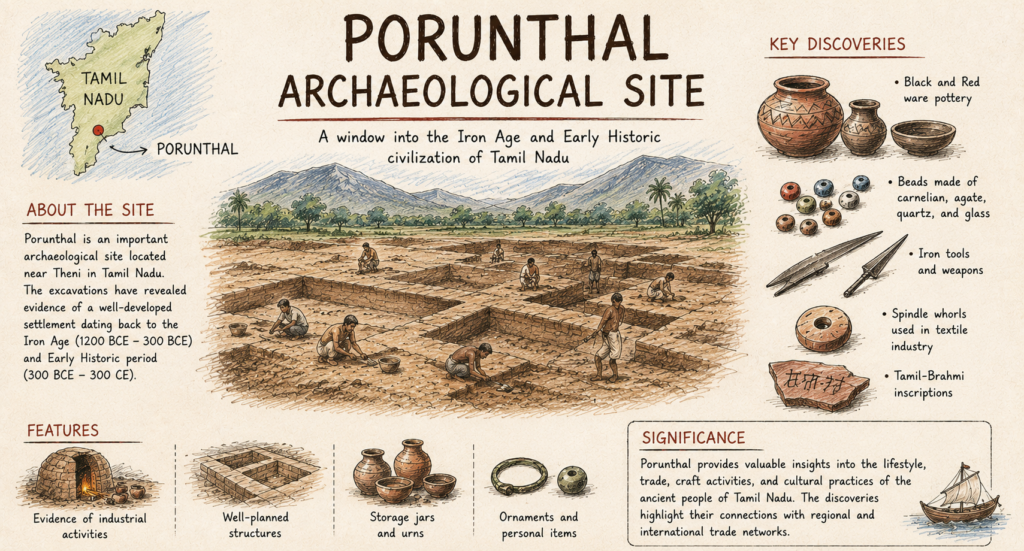
The story of human civilization is often told through famous archaeological sites such as Egypt’s pyramids, the Roman Forum, or the cities of the Indus Valley Civilization. Yet, many remarkable discoveries remain relatively unknown outside their home countries. One such place is Porunthal, a quiet village in the southern Indian state of Tamil Nadu that has become one of the most important archaeological sites for understanding early Tamil civilization.
Although less famous than Keezhadi or Adichanallur, Porunthal has attracted international attention because of discoveries that include megalithic burials, Tamil-Brahmi inscriptions, glass bead workshops, and scientifically dated rice grains. Together, these findings provide valuable evidence for the development of agriculture, literacy, trade, and social organization in southern India during the Iron Age and Early Historic period.
For readers in the United States, Porunthal offers a fascinating example of how archaeology can transform our understanding of ancient societies. Rather than revealing monumental palaces or temples, the site tells the story of ordinary people—farmers, artisans, merchants, and community leaders—whose lives contributed to the growth of one of South India’s earliest cultural landscapes.
Today, Porunthal is regarded as one of the key archaeological sites helping historians reconstruct the history of ancient Tamilakam.
Where Is Porunthal?
Porunthal is located in Dindigul District in the Indian state of Tamil Nadu, approximately 12 kilometers (7.5 miles) southwest of Palani, at the foothills of the Western Ghats. The settlement lies near the Porunthilar River, a tributary within the Amaravathi river basin.
Its location offered several advantages:
- Fertile agricultural land
- Fresh water from nearby rivers
- Access to mountain resources
- Natural trade corridors
- Connections between ancient kingdoms
Porunthal occupied an important position on trade routes linking the Pandya Kingdom in southern Tamil Nadu with the Chera Kingdom on India’s western coast, making it an ideal settlement for agriculture and commerce.
Discovery of the Site
Although villagers had long noticed ancient pottery fragments and stone structures, Porunthal was identified as an archaeological site in 2006 by researcher V. P. Yathees Kumar.
Formal excavations were carried out in 2009 and 2010 under the direction of Professor K. Rajan of Pondicherry University.
The excavations revealed both a habitation area and a burial ground, allowing archaeologists to study everyday life alongside ancient funerary practices. This combination makes Porunthal particularly valuable because many archaeological sites preserve only one type of evidence.
Why Porunthal Is Important
Porunthal is considered significant because it combines several important archaeological discoveries in a single location.
Researchers uncovered evidence of:
- Early farming communities
- Megalithic burials
- Glass bead manufacturing
- Iron tools
- Pottery
- Tamil-Brahmi inscriptions
- Rice cultivation
- Long-distance trade
Together, these discoveries indicate that Porunthal was not an isolated farming village but part of a broader network of settlements that contributed to the cultural and economic development of ancient Tamil society.
Dating the Settlement
One of the reasons Porunthal became internationally recognized is the use of modern scientific dating techniques.
Radiocarbon analysis of carbonized rice recovered from a burial context suggests activity at the site during the early first millennium BCE. The findings have contributed to scholarly discussions about the chronology of early Tamil society, agriculture, and the emergence of writing in South India. Archaeologists continue to evaluate these results alongside evidence from other sites, making Porunthal an important reference point in ongoing research.
Rather than relying only on historical texts, scientists used laboratory methods to establish the site’s antiquity, giving archaeologists greater confidence in interpreting the evidence.
A Window into Ancient Tamil Life
Unlike monumental cities, Porunthal offers insight into the lives of ordinary people.
Archaeologists found evidence that residents engaged in:
- Farming
- Craft production
- Bead making
- Ironworking
- Trading
- Burial rituals
These discoveries show that the settlement supported a stable and organized community where different occupations worked together to sustain economic growth.
The Famous Megalithic Burials
Porunthal is especially well known for its megalithic burials.
These burials typically consist of stone-built chambers or cists covered with large slabs and surrounded by carefully arranged stones.
Excavations uncovered burials containing:
- Human skeletal remains
- Pottery vessels
- Iron implements
- Glass beads
- Rice grains
- Personal ornaments
The presence of grave goods suggests that burial ceremonies held important cultural and spiritual meaning.
The discoveries also indicate that ancient communities believed certain possessions accompanied individuals after death.
The Rice Discovery
One of Porunthal’s most celebrated discoveries was carbonized rice grains recovered from a burial.
Scientific analysis showed that rice formed part of burial rituals, indicating its importance in both agriculture and religious traditions.
The discovery also demonstrates that settled farming had become well established in southern Tamil Nadu during the Iron Age.
Researchers studying phytoliths (microscopic silica structures left by plants) concluded that rice and millet cultivation were already practiced, with evidence suggesting organized agricultural systems and possibly irrigated farming.
Glass Bead Manufacturing
Another remarkable discovery at Porunthal was evidence of glass bead production.
Archaeologists recovered:
- Glass beads
- Semi-finished beads
- Manufacturing waste
- Stone drills
- Polishing tools
These finds indicate that local artisans possessed specialized knowledge and produced beads not only for local use but also for regional trade.
Glass beads were highly valued in the ancient world and frequently appear at archaeological sites involved in long-distance commerce.
Tamil-Brahmi Inscriptions
Among the site’s most important discoveries are pottery fragments bearing Tamil-Brahmi inscriptions.
These inscriptions are among the earliest examples of written Tamil and provide evidence that writing was already being used in daily life.
The inscriptions may have served purposes such as:
- Identifying ownership
- Marking goods
- Recording names
- Supporting commercial transactions
Combined with discoveries at Keezhadi and Kodumanal, Porunthal strengthens the archaeological evidence for literacy during the Early Historic period in Tamil Nadu.
Porunthal and Ancient Trade
Porunthal’s location placed it along one of southern India’s important trade corridors.
Archaeological evidence and nearby discoveries of Roman coin hoards suggest that the wider region participated in commercial networks connecting the Chera and Pandya kingdoms and, indirectly, the Indian Ocean trade system. While Roman coins have not been the defining find at Porunthal itself, the surrounding landscape demonstrates the area’s importance in long-distance exchange.