
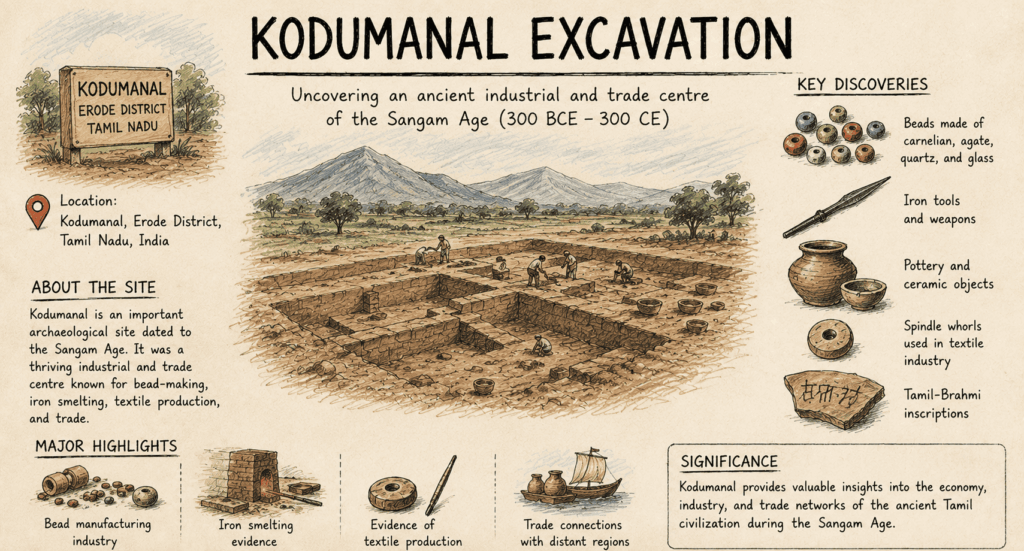
When people think of the ancient world, they often picture the pyramids of Egypt, the cities of Mesopotamia, or the Roman Empire. India also boasts a rich archaeological heritage, with sites like Mohenjo-daro, Harappa, and Dholavira attracting global attention. Yet, in the southern state of Tamil Nadu lies another remarkable archaeological site that is gradually reshaping our understanding of ancient trade, industry, and urban life—Kodumanal.
Kodumanal is one of South India’s most important archaeological sites because it reveals that ancient Tamil communities were not only skilled farmers but also expert metalworkers, gemstone craftsmen, textile producers, and international traders. Excavations have uncovered evidence of an industrial settlement that flourished more than 2,000 years ago and maintained commercial links extending across the Indian Ocean and into the Mediterranean world.
For readers in the United States, Kodumanal offers an exciting glimpse into an ancient manufacturing center that participated in global trade long before the modern era. The discoveries show that southern India played an important role in international commerce during the Early Historic period.
Today, archaeologists regard Kodumanal as one of the best-preserved examples of an early industrial settlement in South India, providing invaluable evidence of the technological achievements of ancient Tamil society.
Where Is Kodumanal?
Kodumanal is located in Erode District in the Indian state of Tamil Nadu. The ancient settlement stands on the banks of the Noyyal River, an important tributary of the Cauvery River.
Its location was ideal for ancient communities because it provided:
Reliable water supplies
Fertile agricultural land
Access to trade routes
Nearby mineral resources
Easy transportation across southern India
The settlement also occupied a strategic position on an ancient overland trade route connecting the Chera Kingdom on India’s western coast with the Chola and Pandya regions in the east and south.
This advantageous location helped Kodumanal become both a manufacturing center and a trading hub.
Why Kodumanal Matters
Kodumanal is unique because it combines several characteristics rarely found together at a single archaeological site.
Excavations reveal evidence of:
Industrial production
Iron and steel manufacturing
Gemstone processing
Bead-making workshops
Textile activities
Long-distance trade
Ancient writing
Megalithic burials
Rather than being merely a farming village, Kodumanal functioned as an organized industrial settlement where skilled craftsmen produced goods for local use and export.
This makes the site particularly valuable for understanding how early economies operated in southern India.
Discovery of Kodumanal
Although local villagers had long encountered ancient pottery fragments and stone structures while farming, Kodumanal attracted scholarly attention during the twentieth century.
Archaeological investigations began in earnest during the 1960s and intensified under the leadership of archaeologist Dr. K. Rajan, whose excavations significantly expanded understanding of the site. Subsequent work by universities and the Tamil Nadu State Department of Archaeology has continued to uncover new evidence.
Each excavation season revealed more of the settlement’s industrial character.
Researchers uncovered:
Workshops
Furnaces
Iron slag
Bead-making equipment
Burial structures
Pottery
Inscriptions
These discoveries transformed Kodumanal from a little-known village into one of India’s most important archaeological sites.
Dating the Settlement
Scientific dating methods, including radiocarbon analysis and the study of associated artifacts, indicate that Kodumanal was occupied during the Early Iron Age and continued to flourish into the Early Historic (Sangam) period, roughly between the 5th century BCE and the early centuries CE.
Rather than representing a short-lived settlement, Kodumanal appears to have been inhabited for several centuries.
Its long occupation allowed industries to develop and trade networks to expand across southern India and beyond.
A Major Industrial Center
One of Kodumanal’s greatest archaeological contributions is the evidence that it functioned as a manufacturing town.
Excavations have uncovered:
Industrial furnaces
Iron slag
Metalworking tools
Stone polishing equipment
Gem-cutting waste
Kilns
Workshop floors
These remains indicate specialized production rather than household-level craft activity.
Different groups of artisans likely worked in dedicated areas, producing goods on a significant scale.
This level of specialization is usually associated with well-organized economies.
Iron and Steel Production
Perhaps the most impressive discoveries at Kodumanal involve iron technology.
Archaeologists found:
Iron smelting furnaces
Blacksmith workshops
Iron tools
Spears
Arrowheads
Knives
Agricultural implements
The quality of the iron artifacts suggests that local craftsmen possessed advanced metallurgical knowledge.
Southern India later became famous for producing high-quality crucible steel, often called wootz steel, which was exported to many parts of the ancient world. While Kodumanal provides evidence of sophisticated ironworking, archaeologists continue to study the extent of its role in early steel production.
The Famous Bead-Making Industry
Kodumanal is internationally recognized for its remarkable bead-making industry.
Excavations have uncovered thousands of:
Carnelian beads
Agate beads
Quartz beads
Sapphire fragments
Garnet beads
Beryl
Amethyst
Crystal ornaments
Researchers also found unfinished gemstones, drilling equipment, polishing stones, and manufacturing waste.
These discoveries demonstrate that Kodumanal was not simply importing finished jewelry—it was producing luxury goods using highly skilled craftsmanship.
Many of these beads were likely traded across India and overseas.
Trade Across the Ancient World
Kodumanal occupied a strategic location on one of ancient South India’s most important trade corridors.
Merchants traveling between the western coast, eastern coast, and southern Tamil kingdoms would likely have passed through the region.
Archaeological evidence suggests that goods produced at Kodumanal entered wider commercial networks that connected southern India with:
Sri Lanka
The Arabian Peninsula
Southeast Asia
The Roman world through Indian Ocean trade
Artifacts such as imported ceramics and the broader pattern of Roman trade with Tamilakam support the conclusion that settlements like Kodumanal participated in extensive exchange networks during the Early Historic period.
Tamil-Brahmi Inscriptions
Another important discovery at Kodumanal is the presence of Tamil-Brahmi inscriptions engraved on pottery.
These inscriptions are among the earliest written records associated with the Tamil language.
The inscribed pottery indicates that literacy was used in everyday contexts, possibly for:
Identifying ownership
Marking merchandise
Recording names
Commercial transactions
The evidence reinforces the view that writing formed part of economic and social life during the Sangam period.
Textile Production
In addition to metallurgy and bead making, archaeologists believe Kodumanal was associated with textile production.
Evidence includes:
Spindle whorls
Loom-related objects
Cotton-processing tools
Ancient Tamil literature frequently praises the fine textiles produced in the region, and archaeological evidence from Kodumanal complements these literary references.
High-quality fabrics likely formed another important export.
Life in Kodumanal
The archaeological evidence suggests that Kodumanal supported a diverse population including:
Metalworkers
Gem cutters
Potters
Farmers
Textile artisans
Traders
Merchants
Rather than relying on a single occupation, the settlement functioned as a vibrant economic center where different industries worked together.
Its prosperity was built on craftsmanship, innovation, and commerce.