
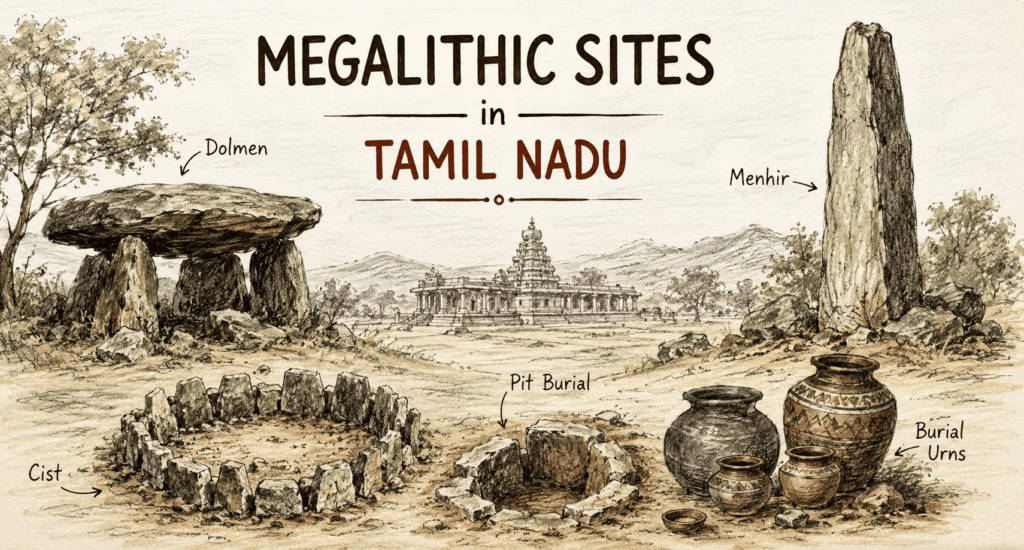
When most Americans think of ancient civilizations, names like Egypt, Greece, or Rome usually come to mind. Yet, thousands of years before modern cities emerged, southern India was home to sophisticated communities that built remarkable stone monuments, practiced advanced metalworking, and maintained extensive trade networks. Tamil Nadu’s megalithic sites are among the most significant archaeological treasures in Asia, offering fascinating insights into the lives, beliefs, and technological achievements of early societies.
These archaeological sites are more than collections of old stones—they tell the story of how ancient communities lived, honored their dead, developed iron technology, and laid the cultural foundations that would eventually influence the celebrated Tamil civilization.
What Are Megalithic Sites?
The term “megalith” comes from two Greek words: mega (large) and lithos (stone). Megalithic sites contain large stone structures constructed primarily as burial monuments or memorials.
In Tamil Nadu, these monuments date largely from the Iron Age and Early Historic Period (approximately 1200 BCE to 300 CE). Archaeologists have identified thousands of megalithic monuments across the state, making it one of the richest regions for megalithic archaeology anywhere in the world.
Unlike pyramids or monumental temples, Tamil Nadu’s megaliths were closely tied to everyday communities. They reveal how people organized society, practiced rituals, manufactured tools, and interacted with neighboring cultures.
Why Tamil Nadu Is Archaeologically Significant
Tamil Nadu occupies a unique place in India’s archaeological history because it preserves evidence spanning prehistoric settlements, Iron Age communities, and early urban civilization.
Excavations suggest that many Iron Age settlements eventually evolved into thriving urban centers connected through trade routes. Discoveries at sites such as Keeladi have strengthened evidence for an advanced society with literacy, industries, drainage systems, and organized settlement planning dating back to the 6th century BCE.
This continuity helps researchers understand how ancient burial traditions gradually transitioned into complex urban societies.
Major Megalithic Sites in Tamil Nadu
1. Adichanallur (Thoothukudi District)
Among India’s most famous archaeological sites, Adichanallur has attracted international attention since excavations began in the late nineteenth century.
Archaeologists have uncovered:
- Hundreds of burial urns
- Human skeletal remains
- Iron weapons
- Bronze artifacts
- Gold ornaments
- Pottery decorated with symbolic graffiti
- Early evidence of metallurgy
The diversity of artifacts suggests a well-developed society with specialized craftsmen, farmers, warriors, and traders.
Recent excavations continue to reveal new information about burial customs and daily life, making Adichanallur one of the most important Iron Age sites in South Asia.
2. Kodumanal (Erode District)
Kodumanal demonstrates that ancient Tamil communities were not isolated villages but active participants in regional and international trade.
Excavations have revealed:
- Iron-smelting workshops
- Steel production
- Bead-making industries
- Semi-precious stone processing
- Roman trade connections
- Tamil-Brahmi inscriptions
These discoveries indicate that Kodumanal functioned as an important industrial center where skilled artisans produced luxury goods traded across the Indian Ocean.
3. Porunthal (Dindigul District)
Porunthal has provided valuable evidence regarding the chronology of early Tamil civilization.
Excavations uncovered:
- Burial urns
- Rice grains preserved within graves
- Glass beads
- Iron implements
- Early inscriptions
Carbon dating from the site has contributed to discussions about the early development of writing and agriculture in southern India.
4. Sanur (Villupuram District)
Sanur contains numerous stone circles and cist burials that showcase the architectural diversity of Tamil Nadu’s megalithic tradition.
Excavated artifacts include:
- Black-and-red ware pottery
- Iron tools
- Weapons
- Decorative beads
These discoveries illustrate both technological advancement and elaborate funerary customs.
5. Mallachandram (Krishnagiri District)
Often called an “open-air museum” of megalithic architecture, Mallachandram contains hundreds of well-preserved stone monuments.
Visitors can observe:
- Dolmens
- Stone circles
- Cairn burials
- Rock-cut chambers
The site provides exceptional insight into prehistoric engineering techniques.
Types of Megalithic Monuments
One remarkable aspect of Tamil Nadu’s archaeology is the variety of burial structures.
Stone Circles
Large circular arrangements of stones marked burial locations and may have held ceremonial significance.
Dolmens
These resemble small stone houses, built using upright slabs supporting a massive capstone.
Cist Burials
Stone-lined underground chambers used for interring the deceased along with grave goods.
Urn Burials
Large ceramic urns containing human remains and offerings were buried beneath the ground.
Cairns
Heaps of stones placed over burial chambers served as visible memorial markers.
Each monument type reflects different regional traditions and evolving cultural practices.
What Archaeologists Have Discovered
Excavations across Tamil Nadu have uncovered thousands of artifacts that help reconstruct ancient life.
Important discoveries include:
- Iron swords and spears
- Agricultural tools
- Bronze vessels
- Gold ornaments
- Carnelian and agate beads
- Pottery with graffiti symbols
- Human skeletons
- Animal remains
- Shell ornaments
These finds reveal societies that possessed sophisticated craftsmanship, long-distance trade connections, agricultural knowledge, and organized social structures.
Evidence of Advanced Technology
One common misconception is that Iron Age societies were technologically primitive.
Tamil Nadu’s megalithic communities demonstrate otherwise.
Researchers have found evidence of:
- Iron smelting
- High-quality steel production
- Advanced ceramic manufacturing
- Bead polishing
- Textile production
- Water management
- Planned settlements
Sites like Kodumanal and Keeladi illustrate that technological innovation played a major role in the region’s development.
Burial Practices Reveal Ancient Beliefs
Burials often included personal belongings, weapons, ornaments, pottery, and food offerings.
This practice suggests that ancient communities believed individuals continued into another stage of existence after death.
The care invested in constructing stone monuments also indicates:
- Respect for ancestors
- Family or clan identity
- Social hierarchy
- Religious traditions
For archaeologists, these burials serve as invaluable records of belief systems that left no written texts.
Connections to the Sangam Age
Although megalithic culture predates the famous Sangam period, many scholars believe there is significant cultural continuity between them.
Excavations at Keeladi have uncovered graffiti marks, Tamil-Brahmi inscriptions, urban planning, and evidence of literacy, helping bridge the transition from Iron Age communities to early historic Tamil society.
This continuity strengthens our understanding of how one of South Asia’s oldest literary cultures emerged.
Why These Sites Matter Today
Megalithic monuments are more than archaeological curiosities.
They contribute to:
- Understanding human migration
- Studying early metallurgy
- Reconstructing ancient trade networks
- Exploring prehistoric belief systems
- Preserving India’s cultural heritage
Modern technologies—including radiocarbon dating, DNA analysis, isotope studies, and 3D mapping—continue to reveal new information from these ancient landscapes.
Visiting Tamil Nadu’s Archaeological Heritage
For history enthusiasts visiting India, Tamil Nadu offers a remarkable archaeological journey.
Many excavation sites are accessible, while museums display artifacts recovered from the region. The state’s archaeology department continues to conduct scientific excavations, expanding knowledge of early South Indian civilization and preserving these discoveries for future generations.