
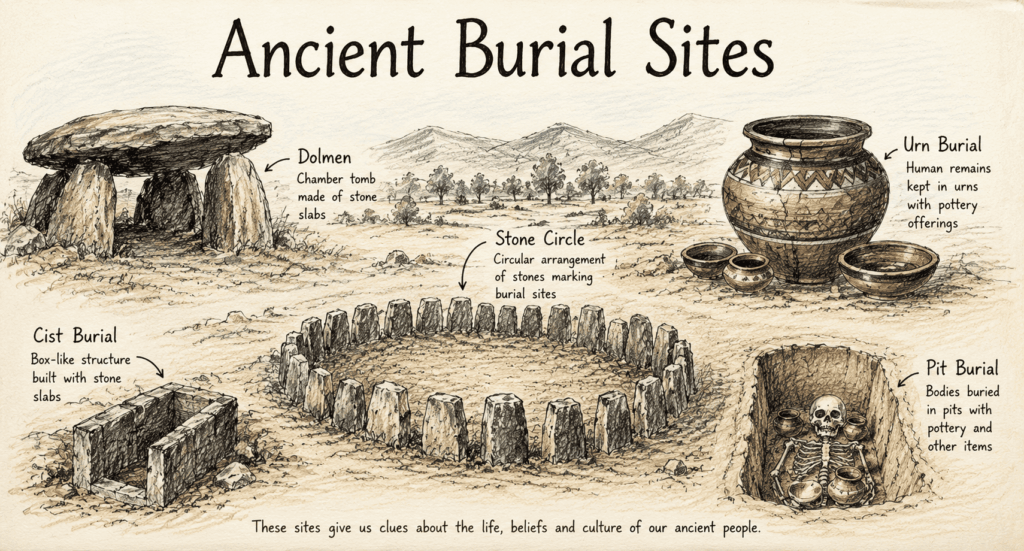
For thousands of years, humans have honored their dead with carefully planned burial rituals. From simple graves dug into the earth to massive stone monuments that still stand today, ancient burial sites provide some of the most valuable evidence about early civilizations. They reveal how people lived, what they believed about death, how societies were organized, and even what technologies they mastered.
For American readers interested in archaeology, history, and anthropology, ancient burial sites are more than historical landmarks—they are time capsules that preserve stories from civilizations that disappeared thousands of years ago. Every excavation helps researchers better understand humanity’s shared past and the cultural traditions that shaped the modern world.
What Are Ancient Burial Sites?
Ancient burial sites are locations where prehistoric and historic communities buried their deceased according to religious, cultural, or social customs. These sites range from individual graves to vast cemeteries containing hundreds or even thousands of burials.
Archaeologists study burial sites because they often preserve artifacts, human remains, and evidence of rituals that are rarely found in ordinary settlements. Burials may include pottery, jewelry, tools, weapons, food offerings, and personal belongings, providing a unique window into the lives of ancient people.
Why Burial Sites Matter to Archaeologists
Unlike abandoned villages or ruined buildings, burial sites often remain relatively undisturbed for centuries. As a result, they preserve detailed evidence about ancient societies.
Burial excavations help researchers answer questions such as:
- What did ancient people believe happened after death?
- How were communities organized?
- Were some individuals wealthier or more influential than others?
- What tools, weapons, and technologies were in use?
- What diseases affected early populations?
- What foods did people eat?
- How did different civilizations interact through trade?
Modern scientific techniques—including DNA analysis, radiocarbon dating, isotope analysis, and forensic anthropology—allow archaeologists to reconstruct remarkable details about individuals who lived thousands of years ago.
Types of Ancient Burial Sites
Burial traditions varied widely across cultures and time periods, but several forms appear repeatedly around the world.
Simple Earth Graves
The earliest humans often buried their dead in shallow pits. These graves usually contained few possessions but occasionally included stone tools, ornaments, or food offerings.
These early burials suggest that symbolic funeral practices developed much earlier than previously believed.
Megalithic Burials
Megalithic burial sites are among the most impressive prehistoric monuments.
Built using enormous stone slabs, they include:
- Dolmens
- Stone circles
- Cist burials
- Passage graves
- Cairns
- Menhirs
These monuments were constructed across Europe, South Asia, Korea, and parts of Southeast Asia over thousands of years, often serving as communal burial places or memorials.
Burial Mounds
Burial mounds, also known as barrows or kurgans, consist of earth or stone piled over graves.
They were common across:
- North America
- Europe
- Central Asia
- Siberia
Some mounds contain a single burial, while others hold dozens or even hundreds of individuals.
These monuments often marked the graves of community leaders, warriors, or elite families.
Rock-Cut Tombs
Several ancient civilizations carved elaborate burial chambers directly into cliffs or solid rock.
Examples include:
- Ancient Egypt
- Petra in Jordan
- Cappadocia in Turkey
These tombs frequently contained artwork, inscriptions, and valuable grave goods.
Chamber Tombs
Large underground chambers built from stone or brick allowed multiple generations of a family or community to be buried together.
Many chamber tombs contain carefully arranged human remains alongside ceremonial objects.
Famous Ancient Burial Sites Around the World
Valley of the Kings (Egypt)
One of history’s most celebrated burial complexes, the Valley of the Kings served as the royal cemetery for Egyptian pharaohs.
The discovery of Tutankhamun’s nearly intact tomb transformed modern archaeology and provided extraordinary insight into ancient Egyptian religion and craftsmanship.
Stonehenge (England)
Although best known as a prehistoric stone monument, archaeological evidence indicates that Stonehenge also functioned as an important ceremonial and burial landscape during the Neolithic period.
Sutton Hoo (England)
This Anglo-Saxon burial site revealed an elaborate ship burial containing weapons, jewelry, coins, and ceremonial artifacts that reshaped historians’ understanding of early medieval Britain.
Newgrange (Ireland)
Built around 3200 BCE, Newgrange is one of Europe’s oldest passage tombs.
Its carefully engineered entrance aligns with the winter solstice sunrise, demonstrating impressive astronomical knowledge.
Megalithic Sites of South India
Southern India contains thousands of Iron Age burial monuments, including dolmens, stone circles, urn burials, and cist graves.
Sites such as Adichanallur, Kodumanal, Brahmagiri, and Hire Benakal have yielded iron weapons, pottery, ornaments, and evidence of sophisticated metallurgy, highlighting the technological and cultural achievements of early South Asian societies.
What Grave Goods Tell Us
Ancient people often buried their dead with objects that held practical, symbolic, or spiritual significance.
Common discoveries include:
- Pottery
- Jewelry
- Bronze ornaments
- Iron weapons
- Stone tools
- Food offerings
- Animal bones
- Coins
- Musical instruments
- Ceremonial objects
These items suggest many cultures believed that the deceased required possessions in the afterlife.
The quality and quantity of grave goods also reveal differences in wealth and social status.
Understanding Ancient Beliefs About Death
Although burial customs differed across civilizations, several common themes emerge.
Many societies believed:
- Life continued after death.
- Ancestors remained spiritually important.
- Proper burial ensured peace for the deceased.
- Personal possessions accompanied the dead into another world.
Some communities practiced cremation, while others preferred full-body burial or secondary burial after the body had decomposed. These differences reflect diverse religious beliefs and cultural traditions.
Modern Science Is Transforming Burial Research
Today’s archaeologists use advanced technology to learn far more than earlier generations could.
Modern methods include:
- Radiocarbon dating to determine age.
- Ancient DNA sequencing to study ancestry and migration.
- Stable isotope analysis to reconstruct diet and mobility.
- CT scanning to examine fragile remains without damage.
- Ground-penetrating radar to locate hidden graves before excavation.
These techniques help researchers preserve sites while extracting valuable historical information.
Preserving Ancient Burial Sites
Ancient cemeteries face growing threats from urban development, looting, agriculture, climate change, and natural erosion.
Governments, universities, museums, and international organizations work together to:
- Protect archaeological landscapes.
- Digitally document fragile monuments.
- Conserve artifacts.
- Educate the public about cultural heritage.
- Promote responsible archaeological tourism.
Preservation ensures that future generations can continue learning from these irreplaceable records of human history.
What Ancient Burial Sites Teach Us Today
Ancient burial sites remind us that, despite differences in language, geography, and culture, humans have long shared a desire to honor loved ones and remember those who came before. These sacred places reveal not only how people faced death but also how they celebrated life, expressed identity, and built communities.
For American readers exploring world history, archaeology, or anthropology, burial sites offer one of the most direct connections to the past. Every excavated grave, carefully preserved artifact, and newly analyzed skeleton adds another chapter to the story of humanity. As scientific techniques continue to evolve, these ancient resting places will remain among the most valuable sources for understanding our collective origins and the remarkable diversity of civilizations that shaped the world we live in today.