
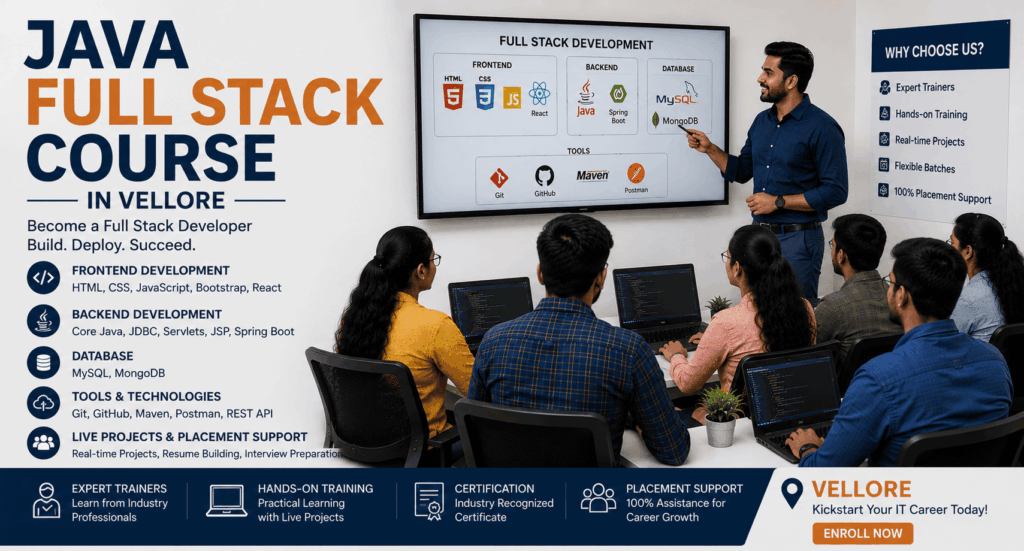
Java Full Stack Course in Vellore – Learn Modern Web Development from Industry Experts
The demand for skilled Full Stack Developers continues to grow as businesses move their services online and build modern web applications. Companies today need professionals who can work on both the front-end and back-end of applications, making Java Full Stack Development one of the most sought-after career options in the IT industry.
Java has been a trusted programming language for decades and is widely used in banking, healthcare, e-commerce, education, manufacturing, and enterprise software development. When combined with front-end technologies like HTML, CSS, JavaScript, and React, it becomes a complete technology stack that opens the door to a wide range of software development careers.
If you are searching for the best Java Full Stack Course in Vellore, this guide will help you understand the course syllabus, career opportunities, salary expectations, and why practical training is essential for becoming an industry-ready developer.
Whether you are a college student, recent graduate, diploma holder, or working professional looking to switch careers, Java Full Stack Development can provide a strong foundation for a successful future in software development.
What is Java Full Stack Development?
Java Full Stack Development involves building complete web applications using both front-end and back-end technologies.
A Java Full Stack Developer is responsible for designing user interfaces, developing business logic, connecting databases, and deploying applications.
Instead of specialising in only one part of software development, Full Stack Developers understand the complete application lifecycle.
This makes them valuable members of software development teams.
Why Choose Java Full Stack Development as a Career?
Java Full Stack Development offers excellent career opportunities because companies prefer professionals who can work across different layers of an application.
Some of the biggest advantages include:
High Demand Across Industries
Java Full Stack Developers are hired by:
- Software companies
- Product-based companies
- Banking and financial institutions
- Healthcare organisations
- E-commerce businesses
- Educational technology companies
- Manufacturing industries
- Government projects
As digital transformation continues, the demand for Full Stack Developers keeps increasing.
Better Career Growth
Since Full Stack Developers possess multiple technical skills, they often have more opportunities to grow into senior development, technical lead, or software architect roles.
Continuous learning can also help professionals move into cloud computing, DevOps, and application architecture.
Attractive Salary Packages
Full Stack Developers are among the highest-paid software professionals because they can contribute to different stages of software development.
With practical experience and strong projects, freshers can secure competitive entry-level salaries, while experienced developers enjoy excellent career progression.
Opportunities in India and Abroad
Java is used by organisations around the world, making it a globally recognised technology.
Skilled Java Full Stack Developers can explore opportunities with Indian IT companies, multinational corporations, startups, and international employers.
Remote work opportunities have also increased significantly in recent years.
Why Learn Java Full Stack in Vellore?
Vellore has become one of Tamil Nadu’s leading education centres, attracting students from nearby locations such as Ranipet, Katpadi, Arcot, Gudiyatham, Ambur, Arakkonam, and Tirupattur.
Learning Java Full Stack in Vellore offers several benefits:
- Easy accessibility from nearby towns
- Affordable course fees
- Experienced trainers
- Practical coding sessions
- Modern computer labs
- Flexible weekday and weekend batches
- Individual mentoring
- Placement guidance
Students can receive quality software training without travelling to larger cities.
Who Can Join the Java Full Stack Course?
Java Full Stack Development is suitable for learners from different educational backgrounds.
This course is ideal for:
- BE and B.Tech students
- BCA graduates
- MCA students
- B.Sc. Computer Science graduates
- Diploma holders
- M.Sc. graduates
- Fresh graduates
- Working professionals
- Career changers
Even beginners can start learning with a structured training programme that begins with programming fundamentals.
Java Full Stack Course Syllabus
A professional Java Full Stack course combines front-end development, back-end programming, databases, frameworks, and project development.
Below are the major topics covered.
Front-End Development
The front-end is the part of a website or web application that users interact with.
Students learn:
HTML5
- Web page structure
- Forms
- Tables
- Semantic elements
- Multimedia integration
CSS3
Students learn how to create attractive and responsive user interfaces.
Topics include:
- Colours
- Fonts
- Layouts
- Flexbox
- Grid
- Responsive design
- Animations
JavaScript
JavaScript adds interactivity to websites.
Students learn:
- Variables
- Functions
- Arrays
- Objects
- DOM manipulation
- Events
- ES6 concepts
Bootstrap
Bootstrap helps developers build responsive websites quickly.
Students learn:
- Grid system
- Navigation bars
- Cards
- Buttons
- Forms
- Responsive layouts
React.js
React is one of the most popular JavaScript libraries for developing modern user interfaces.
Students learn:
- Components
- JSX
- Props
- State
- Hooks
- Routing
- API integration
React enables developers to build fast and interactive web applications.
Back-End Development
The back-end handles application logic, database operations, and business processes.
Core Java
Students begin with Java programming fundamentals.
Topics include:
- Variables
- Data types
- Operators
- Loops
- Conditional statements
- Arrays
- Methods
These concepts build a strong programming foundation.
Object-Oriented Programming (OOP)
Java is based on Object-Oriented Programming.
Students learn:
- Classes
- Objects
- Constructors
- Inheritance
- Polymorphism
- Encapsulation
- Abstraction
OOP concepts are essential for enterprise software development.
Advanced Java
Students expand their programming knowledge through advanced topics such as:
- Collections Framework
- Exception Handling
- Multithreading
- File Handling
- Packages
These topics prepare students for real-world application development.
JDBC
JDBC enables Java applications to communicate with databases.
Students learn:
- Database connectivity
- CRUD operations
- SQL integration
- Prepared Statements
- Transactions
Database programming is a core requirement for Full Stack Developers.
Servlets and JSP
Students learn server-side web development using Java technologies.
Topics include:
- HTTP requests
- Session management
- Form handling
- Dynamic web pages
- MVC concepts
These technologies help students understand enterprise web application development.
Database Management
Most web applications require databases to store information.
Students learn MySQL topics such as:
- Database creation
- Tables
- SQL queries
- Joins
- Indexes
- Stored procedures
Understanding databases is essential for developing scalable applications.
Practical Learning Through Live Projects
Practical experience is one of the most important parts of Java Full Stack training.
Students work on projects such as:
- Student Management System
- Employee Payroll System
- Online Shopping Website
- Hospital Management System
- Library Management System
- Online Examination Portal
- Inventory Management System
- Hotel Booking Application
Working on real-time projects helps students understand software development workflows, improve coding skills, and build a professional portfolio that can be presented during interviews.
Why Live Projects Matter
Employers value candidates who can demonstrate practical experience.
Projects help students:
- Improve coding confidence
- Learn debugging techniques
- Understand software architecture
- Work with databases
- Build teamwork skills
- Create an impressive portfolio
A strong portfolio increases the chances of securing interviews and performing well during the hiring process.