
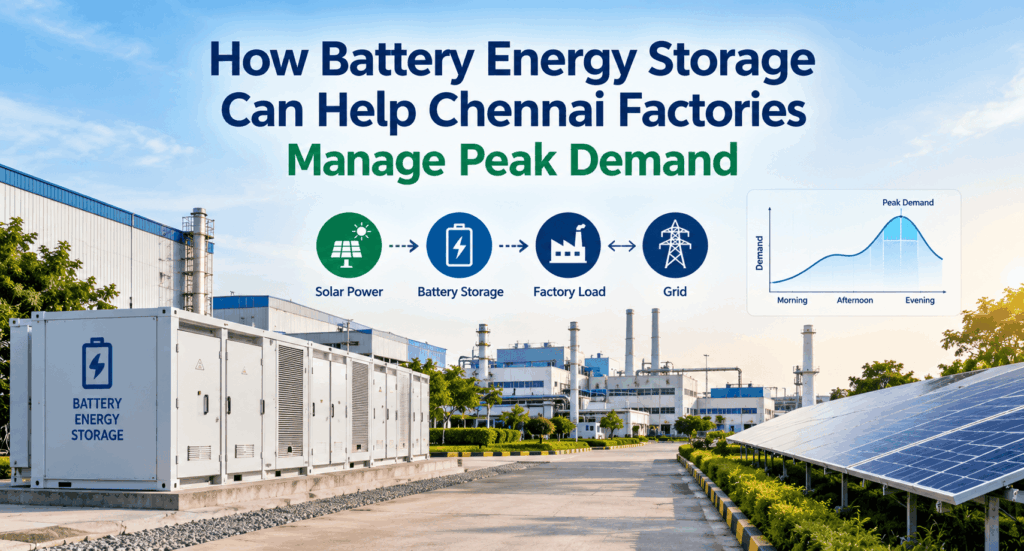
For a factory in Chennai, electricity is more than a monthly utility expense. It can directly affect production costs, machine utilisation, operating margins and the overall competitiveness of the business.
This is especially important for factories with high maximum demand or significant electricity consumption during expensive tariff periods.
Solar power can reduce the amount of electricity purchased from the grid, but solar generation is limited to daylight hours. Battery Energy Storage Systems (BESS) can add another layer of flexibility by storing electricity and releasing it when the factory needs it most.
For industrial businesses in Chennai, this raises an important question:
Can battery storage help reduce peak demand and make electricity management more predictable?
The answer depends on the factory’s load profile, tariff structure, operating schedule, battery size and project economics.
This article explains how industrial battery storage works, where it can help Chennai factories, and what businesses should evaluate before investing.
What Is Battery Energy Storage?
A Battery Energy Storage System stores electrical energy so it can be used later.
A typical industrial BESS includes:
- Battery modules
- Battery management system
- Bidirectional power conversion system
- Energy management system
- Thermal management
- Protection equipment
- Monitoring and control software
Lithium iron phosphate, commonly known as LFP, is one battery chemistry used in modern stationary energy-storage systems.
The battery itself is only one part of the solution. The important part for an industrial customer is how the complete system interacts with the factory’s electricity consumption, solar generation and grid supply.
KinetiQ Energy describes its BESS approach around the customer’s load curve, tariff structure, backup requirements and integration with solar, grid and diesel generation
What Does “Peak Demand” Mean for a Factory?
Peak demand is the highest level of electrical demand recorded by a facility over a billing or measurement period, depending on the applicable metering and tariff arrangement.
Imagine a Chennai factory operating several large machines at the same time.
For most of the day, its demand may remain around:
700 kW
But when several machines start together, the demand could temporarily rise to:
1,000 kW
That higher demand can matter financially.
This is why looking only at monthly electricity units is not enough when evaluating an industrial energy-storage project.
A factory could have reasonable monthly energy consumption but still experience expensive demand peaks.
How Does Battery Storage Reduce Peak Demand?
The basic concept is called peak shaving.
Suppose a factory has:
Grid capacity available: 1,000 kW
Factory demand: 1,000 kW
Instead of taking the entire 1,000 kW from the grid, a battery could provide part of the power.
For example:
Factory demand: 1,000 kW
Battery discharge: 250 kW
Grid supply: 750 kW
The battery effectively reduces the amount of power being drawn from the grid during that period.
When demand falls, the battery can stop discharging and recharge later, depending on the energy-management strategy.
The actual financial benefit depends on the applicable tariff, how demand is measured, the duration of the peak and the battery’s technical characteristics.
Why Peak Shaving Matters in Chennai
Tamil Nadu’s electricity tariff structure makes the timing of electricity consumption important.
Time-of-Day tariffs distinguish between different periods of the day. The broader national framework also recognises the use of higher tariffs during peak periods and lower tariffs during designated solar hours.
For Tamil Nadu industrial consumers, the exact applicable tariff and charges should always be checked against the current TNERC/TNPDCL provisions rather than relying on an old tariff calculator.
KinetiQ Energy’s Chennai factory guidance also distinguishes between a factory’s own operational peak and the regulator-defined tariff peak hours. These are not necessarily the same thing
That distinction is extremely important.
Operational Peak vs Tariff Peak
These two terms sound similar but represent different things.
Operational peak
This is when your factory itself draws the highest amount of electricity.
For example:
10:30 AM → 950 kW
because multiple production lines are running.
Tariff peak
This is a period defined by the applicable electricity tariff during which energy may be priced differently.
A factory’s highest operational demand may happen outside the tariff’s peak period.
Therefore, a battery project should not be designed simply around the phrase “peak demand.”
The energy consultant should examine the actual load curve and the applicable tariff structure together.
Battery + Solar: A Powerful Combination
Battery storage becomes particularly interesting when combined with rooftop solar.
During the day, solar panels generate electricity.
The factory can use that electricity directly.
If solar generation exceeds the immediate requirement, depending on the system configuration and applicable rules, the excess energy can potentially be directed toward storage.
Later, the battery can discharge when solar production falls or when the factory needs additional power.
The basic concept is:
Solar → Factory
and
Solar → Battery → Factory
rather than simply:
Solar → Factory during daylight hours
This can increase the flexibility of the overall energy system.
The Central Electricity Authority has specifically issued an advisory on co-locating energy-storage systems with solar projects to improve grid stability and cost efficiency.
A Simple Chennai Factory Example
Consider a hypothetical manufacturing unit near Sriperumbudur.
Its electricity demand looks like this:
| Time | Factory Demand |
|---|---|
| 8 AM | 600 kW |
| 10 AM | 750 kW |
| 12 PM | 850 kW |
| 2 PM | 800 kW |
| 5 PM | 900 kW |
| 7 PM | 1,000 kW |
| 9 PM | 750 kW |
The factory’s highest demand occurs in the evening.
Solar can help significantly during the daytime, but its output decreases as daylight fades.
A battery could potentially be charged earlier and discharged during the evening period.
For example:
Daytime: Solar → Factory + Battery
Evening: Battery + Grid → Factory
The battery is therefore being used to shift some energy from one period to another.
This is one of the fundamental reasons industrial customers consider energy storage.
What Is Energy Arbitrage?
Energy arbitrage means charging the battery when electricity is relatively cheaper or when surplus renewable electricity is available, and discharging it during a period when electricity has a higher economic value.
For an industrial customer, the strategy might look like:
Lower-cost period → Charge
Higher-cost period → Discharge
When combined with solar:
Solar generation → Battery charging → Evening discharge
However, the economics are not simply the difference between two electricity prices.
Battery losses, degradation, system efficiency, financing, maintenance and applicable charges all need to be included in the calculation.
Can Battery Storage Reduce Maximum Demand?
Potentially, yes.
But battery capacity and power capacity are two different things.
Suppose a factory wants to reduce its grid demand by:
300 kW
for:
2 hours
It would theoretically require at least:
300 kW × 2 hours = 600 kWh
of usable battery energy.
In practice, the required installed battery capacity can be higher because engineers need to consider:
- Round-trip efficiency
- Depth of discharge
- Reserve capacity
- Battery degradation
- Operating temperature
- Conversion losses
- Future performance requirements
This is why simply choosing a battery based on the factory’s maximum demand is not enough.
Power Rating vs Energy Capacity
This is one of the most important concepts for factory owners.
kW or MW
This tells you how much power the battery can deliver at a given moment.
kWh or MWh
This tells you how much energy the battery can store.
For example:
500 kW / 1,000 kWh BESS
could theoretically deliver:
500 kW for 2 hours
under ideal conditions.
But the actual usable duration will depend on system design, operating limits and efficiency.
A factory should therefore specify both the power requirement and energy requirement.
What About Power Cuts?
Peak shaving and backup power are not exactly the same application.
A battery designed primarily for peak shaving may not necessarily provide whole-factory backup during a grid failure.
If backup is required, the system needs to be designed around the factory’s critical loads.
For example, instead of backing up the entire facility, a company might identify:
- Control systems
- Server rooms
- Security systems
- Emergency lighting
- Critical production equipment
- Communication systems
- Sensitive machinery
The battery can then be sized around the loads that genuinely need uninterrupted or rapid backup.
KinetiQ Energy lists backup, peak-load management and solar integration among the applications it considers for industrial BESS projects.
Battery Storage Can Also Help With Solar Variability
Solar output changes throughout the day.
Clouds can suddenly reduce generation.
For some industrial applications, rapid changes in electrical supply can be undesirable.
A battery and energy-management system can help smooth the interaction between renewable generation and factory consumption, depending on the system design.
This can be particularly relevant for facilities with sensitive electrical equipment or processes where power quality matters.
However, battery storage should not automatically be treated as a substitute for dedicated power-quality equipment.
Voltage regulation, harmonics, reactive power and other issues may require separate solutions.
Battery Storage for 24-Hour Factories
A factory operating around the clock has a different energy profile from a single-shift manufacturing unit.
A 24-hour factory may have:
Morning → Production
Afternoon → Production + Solar
Evening → Production
Night → Production
Solar can directly support the factory during daylight hours.
Battery storage can potentially shift some of that energy to later periods.
This can create a broader strategy:
Solar + Battery + Grid
rather than relying entirely on grid electricity outside solar-generation hours.
How Much Battery Does a Chennai Factory Need?
There is no universal answer.
A 500 kWh battery may be appropriate for one facility and completely inadequate for another.
Battery sizing should consider:
1. Maximum demand
What is the highest demand recorded?
2. Load curve
How does demand change every 15 minutes or at the applicable meter interval?
3. Peak duration
Does the peak last for 10 minutes, 30 minutes, 2 hours or longer?
4. Tariff
What are the relevant energy and demand charges?
5. Solar generation
How much solar power is available?
6. Operating schedule
Does the factory run one shift, two shifts or 24 hours?
7. Backup requirement
Does the customer need emergency backup?
8. Future expansion
Will production capacity increase?
9. Battery degradation
How will battery performance change over its operating life?
10. Financial objective
Is the project primarily intended for peak shaving, energy arbitrage, backup, renewable integration or a combination?
Don’t Buy a Battery Before Studying the Load Curve
This is one of the biggest mistakes an industrial customer can make.
A battery vendor may tell you:
“Your factory has 1 MW demand, so install a 1 MW battery.”
That does not necessarily mean it is the right solution.
The factory might only need 400 kW of peak shaving for 30 minutes.
Or perhaps the major opportunity is actually shifting energy into evening tariff periods.
Or perhaps the factory’s biggest problem is power quality rather than peak demand.
An energy audit and interval load data can reveal which problem is actually worth solving.
KinetiQ Energy’s stated BESS design approach starts with the load curve, tariff structure, backup requirements and integration goals rather than treating battery storage as a standard product. (Kinetiq Energy)
What Should Chennai Factory Owners Look at Before Investing?
Before approving a BESS project, management should ask several questions.
1. What problem are we solving?
Is it:
- High demand charges?
- Expensive peak-period electricity?
- Solar energy shifting?
- Backup power?
- Power-quality issues?
- Grid dependence?
The answer determines the system design.
2. What does our load profile look like?
Monthly electricity bills are useful, but interval-level consumption data can provide a much clearer picture.
3. How often does the peak occur?
A peak that occurs for a few minutes requires a different strategy from a peak lasting several hours.
4. How much solar do we already have?
Existing or planned solar capacity can significantly affect battery sizing.
5. What is the battery’s usable capacity?
Do not compare batteries based only on their nameplate capacity.
6. What happens as the battery ages?
Battery degradation needs to be included in long-term financial modelling.
7. What happens during a grid outage?
If backup is important, the system needs an appropriate backup architecture.
8. How will the battery be controlled?
An effective Energy Management System is important for deciding when to charge and discharge.
Battery Safety Is Also Important
Industrial battery installations require proper engineering.
A BESS project should consider:
- Battery chemistry
- Thermal management
- Fire detection
- Fire protection
- Electrical protection
- Ventilation where applicable
- Emergency shutdown
- Battery Management System
- Site layout
- Maintenance access
- Monitoring
- Applicable standards and approvals
Factories should avoid selecting storage systems based solely on the lowest initial equipment price.
The installation environment and safety architecture are equally important.
Is Battery Storage Economically Worth It?
The answer depends on the individual factory.
A useful business-case calculation should compare:
Battery investment
against
Annual demand savings + energy-arbitrage savings + other measurable benefits
while accounting for:
- Battery degradation
- Efficiency losses
- Financing
- Maintenance
- Replacement
- System controls
- Installation
- Applicable electricity charges
- Expected operating life
A battery that looks attractive on paper may produce a different result when actual factory data is used.
Likewise, a facility with high peak charges and a well-defined load profile may have a stronger case for storage.
Why Chennai Industries Are Looking at Energy Storage
Tamil Nadu’s power system is increasingly dealing with the challenge of matching renewable generation with electricity demand across different hours.
Recent CEA analysis cited in reporting on Tamil Nadu’s power planning has highlighted differences between demand during solar and non-solar hours, reinforcing the broader importance of flexible resources such as storage.
For individual factories, the same principle applies at a smaller scale.
The question is not simply:
“How much electricity do we use?”
It is also:
“When do we use it?”
That timing can determine whether battery storage creates meaningful value.
Solar + Battery + Energy Management
For some Chennai factories, the future energy strategy may not be about choosing a single technology.
Instead, it could combine:
Solar
Generate renewable electricity during daylight.
Battery
Store electricity and shift it to more valuable periods.
Energy Management System
Control charging and discharging according to factory demand, solar production and tariff conditions.
Grid
Provide electricity when renewable generation and storage are insufficient.
Energy Audit
Continuously identify opportunities to improve efficiency.
This integrated approach can make energy management more responsive than simply installing solar panels.
How KinetiQ Energy Can Help Chennai Factories
For industrial customers, KinetiQ Energy approaches battery storage as an energy-management project rather than simply a battery purchase.
The company’s solutions include Battery Energy Storage Systems, solar EPC, energy auditing and power-quality solutions, allowing storage to be considered alongside the factory’s broader electricity strategy.
For a Chennai factory, an assessment can look at:
- Electricity bills
- Maximum demand
- Load profile
- Operating hours
- Peak periods
- Solar generation
- Battery requirements
- Backup loads
- Tariff structure
- Expected savings
- Project economics
This helps answer the question that matters most:
“Will battery storage solve a real energy problem for our factory?”
You can learn more about KinetiQ Energy’s solar, storage and energy solutions at kinetiqenergy.com.