
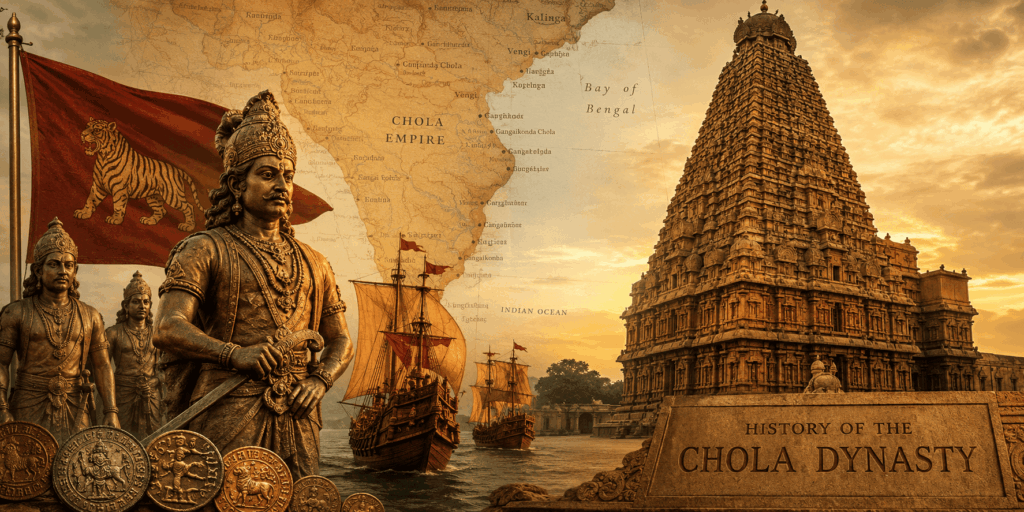
The Chola Dynasty stands as one of the greatest and longest-ruling dynasties in Indian history. Famous for its powerful kings, magnificent temples, advanced administration, naval strength, and cultural achievements, the Cholas transformed South India into a prosperous and influential empire. Their contributions continue to inspire historians, architects, researchers, and travellers from around the world.
From humble beginnings in the fertile Kaveri River basin to becoming a dominant maritime power across South and Southeast Asia, the Cholas left behind an extraordinary legacy. They built some of India’s finest temples, encouraged literature and art, promoted trade with distant kingdoms, and developed an efficient administrative system that many historians still admire today.
Whether you are preparing for competitive examinations such as UPSC, TNPSC, SSC, or simply wish to understand India’s rich heritage, learning about the Chola Dynasty offers valuable insights into one of the golden chapters of Indian civilization.
In this article, we explore the fascinating origins of the Cholas, their rise to power, the remarkable rulers who expanded the empire, and the foundations that made them one of the strongest dynasties in medieval India.
Who Were the Cholas?
The Cholas were a Tamil dynasty that ruled large parts of southern India for many centuries. Their kingdom was mainly centred in present-day Tamil Nadu, particularly around the fertile Kaveri River delta.
The Cholas are among theThree Crowned Kings of Tamilakam, alongside the Cheras and the Pandyas. Ancient Tamil literature frequently mentions these three powerful kingdoms, highlighting their importance in the political and cultural life of southern India.
Although the Cholas existed as early as the Sangam Age (around the 3rd century BCE to the 3rd century CE), their greatest period began in the 9th century CE, when they established what historians call the Imperial Chola Empire.
At their peak, the Chola Empire extended across:
Most of Tamil Nadu
Parts of Karnataka
Andhra Pradesh
Kerala
Sri Lanka
Maldives
Coastal regions of Southeast Asia
Their influence also reached countries like Indonesia, Malaysia, Thailand, Cambodia, and Vietnam through maritime trade and diplomatic relations.
Meaning of the Name Chola
The exact origin of the word “Chola” remains uncertain. Historians have proposed several theories based on Tamil literature and inscriptions.
Some scholars believe the word may have originated from ancient Tamil terms referring to a ruling family, while others connect it with agriculture due to the fertile lands along the Kaveri River.
Regardless of its linguistic origin, the name “Chola” eventually became synonymous with power, prosperity, naval excellence, and cultural brilliance.
The Geographical Advantage of the Cholas
One of the greatest strengths of the Cholas was their geography.
Their kingdom was blessed by the Kaveri River, often called the “Ganga of South India.” The fertile plains supported large-scale agriculture, especially rice cultivation.
The region also enjoyed:
Rich agricultural lands
Extensive irrigation systems
Access to the Bay of Bengal
Natural ports for overseas trade
Strong river networks
These advantages enabled the Cholas to develop a prosperous economy that funded military campaigns, temple construction, education, and public welfare.
Early References to the Cholas
The Cholas appear in several ancient historical sources.
Sangam Literature
Ancient Tamil Sangam poems describe Chola rulers as brave warriors and generous patrons of poets.
These literary works provide valuable information about:
Warfare
Society
Trade
Agriculture
Religious beliefs
Administration
Although poetic in nature, Sangam literature remains one of the most important sources for understanding early Tamil history.
Ashoka’s Inscriptions
The famous Mauryan emperor Ashoka mentioned the Cholas in his rock edicts during the 3rd century BCE.
Interestingly, the Cholas were not part of Ashoka’s empire. Instead, they were recognised as independent southern kingdoms that maintained diplomatic relations with the Mauryan Empire.
This indicates that the Cholas were already an established political power more than 2,200 years ago.
Foreign Accounts
Greek and Roman writers also referred to prosperous ports along the Tamil coast.
Ancient Roman trade records mention commerce involving:
Spices
Pearls
Ivory
Cotton textiles
Precious stones
Roman gold coins discovered in Tamil Nadu provide archaeological evidence of extensive trade between South India and the Roman Empire.
The Early Chola Kingdom
The early Cholas ruled before the rise of the Imperial Cholas.
Their capital is believed to have been Uraiyur near present-day Tiruchirappalli.
Another important port city was Kaveripoompattinam (Poompuhar, which became one of India’s busiest maritime centres.
Merchants from many regions visited this bustling port, making it an important gateway for international trade.
Famous Early Chola Kings
Although historical records from this period are limited, several rulers became legendary.
Karikala Chola
Karikala Chola is widely regarded as one of the greatest early Chola kings.
According to historical traditions, he achieved several remarkable accomplishments:
Defeated rival Tamil kingdoms
Expanded Chola territory
Strengthened agriculture
Encouraged trade
Improved irrigation
His most famous achievement was the construction of the **Kallanai (Grand Anicut)** across the Kaveri River.
Kallanai: One of the World’s Oldest Dams
Built around the 2nd century CE, the Kallanai remains one of the oldest functioning water diversion structures in the world.
Constructed using massive stone blocks without modern cement, the dam redirected river water for irrigation rather than storing it.
Even after nearly two thousand years, it continues to serve farmers in Tamil Nadu, demonstrating the remarkable engineering skills of the Cholas.
This achievement reflects how seriously the Cholas valued agriculture and water management.
Decline of the Early Cholas
After the Sangam period, the Cholas gradually lost influence.
Several factors contributed to their decline:
Rise of neighbouring kingdoms
Political instability
Expansion of the Pallavas and Pandyas
For several centuries, the Cholas survived as relatively minor regional rulers.
However, this period of weakness would not last forever.
The Revival of the Chola Dynasty
The Cholas experienced an extraordinary revival during the 9th century CE.
This resurgence began under **Vijayalaya Chola**, who established a new phase in Chola history.
Around 850 CE, Vijayalaya captured Thanjavur from the Muttaraiyars and made it his capital.
This victory marked the birth of the Imperial Chola Empire.
Why Thanjavur Became Important
Thanjavur was an ideal capital because it offered:
Fertile agricultural lands
Strong defensive position
Excellent irrigation
Proximity to trade routes
Access to skilled artisans
Religious significance
Over time, Thanjavur evolved into one of India’s greatest cultural and political centres.
Vijayalaya Chola: Founder of the Imperial Cholas
Vijayalaya laid the foundation for one of the most powerful empires in medieval India.
His achievements included:
Capturing Thanjavur
Re-establishing Chola independence
Building temples
Strengthening administration
Expanding military capabilities
Although his kingdom remained relatively small, he created the stability needed for future expansion.
Aditya I: Expanding the Kingdom
Vijayalaya’s son, Aditya I, continued the expansion.
He defeated the Pallavas and incorporated large territories into the Chola kingdom.
His victories significantly increased the prestige of the dynasty.
Aditya also promoted temple construction and supported Shaivism, while allowing followers of other faiths to practise peacefully.
Parantaka I: Strengthening the Empire
One of the most capable early Imperial Chola rulers was Parantaka I.
His reign witnessed:
Administrative reforms
Revenue improvements
Military expansion
Temple endowments
Economic prosperity
Although he later suffered military setbacks against the Rashtrakutas, his long reign greatly strengthened the Chola state.
Society During the Early Chola Period
The Chola kingdom had a well-organised society based primarily on agriculture.
The major social groups included:
Farmers
Merchants
Artisans
Soldiers
Priests
Scholars
Village communities played a central role in administration.
Local assemblies managed irrigation, taxation, education, roads, and public works with considerable autonomy.
Women also participated in religious, cultural, and economic activities, and inscriptions reveal that many donated land, jewellery, and wealth to temples.
Religion and Cultural Life
The Cholas were devoted primarily to Hinduism, especially the worship of Lord Shiva.
However, they also respected:
Vaishnavism
Jainism
Buddhism
Temples became centres of:
Education
Music
Dance
Literature
Art
Social welfare
This inclusive environment encouraged cultural development across the kingdom.
Why the Chola Revival Was Historic
The revival initiated by Vijayalaya and strengthened by his successors changed the course of South Indian history.
Within just a few generations, the Cholas transformed from a modest regional kingdom into one of Asia’s most influential empires.
The foundations they established in administration, military organisation, agriculture, and governance prepared the way for legendary rulers such as Rajaraja Chola I and Rajendra Chola I, whose achievements would make the Chola Empire renowned across the Indian Ocean.
In the next part of this series, we will explore the reigns of these remarkable emperors, the construction of the magnificent Brihadeeswarar Temple, the rise of the powerful Chola navy, overseas expeditions, trade networks, and the administrative system that made the empire one of the most efficient in medieval India.