
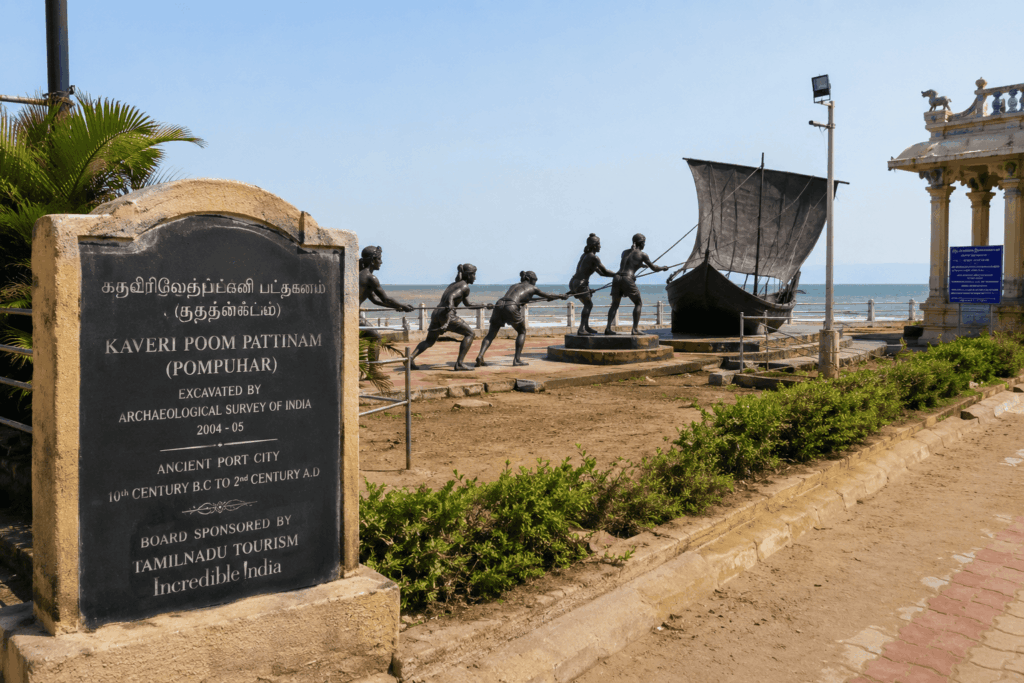
Tamil Nadu has a rich maritime history that stretches back more than two thousand years, and few places represent this legacy better than Kaveripoompattinam, popularly known as Poompuhar. Once one of the busiest port cities in ancient India, Poompuhar served as the principal seaport of the early Chola dynasty and became a thriving center of trade, culture, literature, and international commerce. Located at the point where the mighty River Kaveri meets the Bay of Bengal, the city connected South India with civilizations across Asia, the Middle East, and the Mediterranean.
During the Sangam Age, Poompuhar flourished as a cosmopolitan city where merchants from Rome, Greece, Arabia, Sri Lanka, and Southeast Asia exchanged goods, ideas, and cultures. Ships loaded with spices, pearls, fine textiles, ivory, precious stones, and sandalwood departed from its harbor, while imported goods such as gold coins, wine, horses, coral, and glassware arrived from distant lands.
The city is celebrated not only for its commercial success but also for its literary importance. Classical Tamil epics such as Silappadikaram and Manimekalai vividly describe the grandeur of Poompuhar, portraying its bustling markets, magnificent streets, royal palaces, and vibrant festivals. These literary works, along with archaeological discoveries and underwater explorations, provide valuable evidence of the city’s historical significance.
Today, although much of the ancient city is believed to have been submerged beneath the sea, Poompuhar continues to attract historians, archaeologists, tourists, students, and researchers interested in India’s maritime heritage. The remains of this once-great port stand as a reminder of the remarkable achievements of the early Cholas.
This article explores the fascinating history of Kaveripoompattinam (Poompuhar), its rise as a global trading center, its cultural importance, archaeological discoveries, and its enduring legacy in Tamil Nadu’s history.
Where Is Kaveripoompattinam (Poompuhar)?
Kaveripoompattinam is located in the Mayiladuthurai district of Tamil Nadu, approximately 40 kilometers from Mayiladuthurai town.
The city lies at the mouth of the River Kaveri, where it flows into the Bay of Bengal.
Its strategic coastal location offered several advantages:
- Easy access to sea routes.
- Fertile agricultural hinterland.
- Abundant freshwater supply.
- Natural harbor for merchant ships.
- Direct connection between inland and overseas trade.
These geographical features helped Poompuhar emerge as one of South India’s most important ancient ports.
Origin of the Name Kaveripoompattinam
The name Kaveripoompattinam reflects both geography and prosperity.
- Kaveri refers to the sacred River Kaveri.
- Poom means “flowering” or “prosperous.”
- Pattinam means “port town” or “coastal city.”
Together, the name means “The prosperous port city on the River Kaveri.”
Over time, people began referring to it simply as Poompuhar, a name that remains widely used today.
Poompuhar During the Sangam Age
The Sangam Age (approximately 300 BCE–300 CE) marked the golden period of Poompuhar.
Ancient Tamil literature describes it as one of the largest and wealthiest cities in South India.
Sangam poems portray Poompuhar as a bustling urban center featuring:
- Busy docks filled with merchant ships.
- Spacious marketplaces.
- Well-planned streets.
- Luxurious mansions.
- Warehouses.
- Public squares.
- Religious shrines.
- Entertainment venues.
The city’s prosperity attracted merchants, sailors, scholars, artists, and travelers from many parts of the world.
Poompuhar: The Great Port of the Cholas
Poompuhar became the principal seaport of the early Chola dynasty.
From this strategic port, Chola rulers developed extensive trade networks that connected Tamil Nadu with foreign kingdoms.
Several famous Chola rulers are associated with the city, including the legendary Karikala Chola, who is credited with strengthening the kingdom’s economy through improved irrigation, trade, and administration.
The wealth generated through maritime commerce helped finance:
- Military campaigns.
- Temple construction.
- Public works.
- Urban development.
- Agricultural improvements.
Poompuhar became the economic engine that supported the rise of the Chola kingdom.
International Maritime Trade
One of Poompuhar’s greatest achievements was its extensive overseas trade.
Merchant ships regularly sailed between Poompuhar and:
- Rome
- Egypt
- Greece
- Arabia
- Sri Lanka
- Myanmar
- Thailand
- Indonesia
- Malaysia
- China
These international trade routes transformed the city into one of Asia’s busiest commercial ports.
Major Exports from Poompuhar
Ancient Tamil merchants exported numerous valuable products.
These included:
Pepper
Often called “Black Gold,” pepper was one of the most valuable exports to the Roman Empire.
Pearls
Pearls harvested from the Gulf of Mannar were highly prized in international markets.
Cotton Textiles
Fine woven fabrics produced in Tamil Nadu were exported across Asia and Europe.
Ivory
Elephant ivory was crafted into decorative items and exported overseas.
Precious Stones
Gemstones from South India found eager buyers abroad.
Sandalwood
Tamil sandalwood was valued for perfumes, religious ceremonies, and luxury products.
Major Imports
Merchant ships arriving at Poompuhar brought:
- Roman gold coins.
- Wine.
- Glassware.
- Coral.
- Horses.
- Luxury pottery.
- Precious metals.
These imported goods reflected the city’s global commercial connections.
Poompuhar in Silappadikaram
One of the richest descriptions of ancient Poompuhar appears in the Tamil epic Silappadikaram, written by Ilango Adigal.
The story begins in Poompuhar, where the merchant Kovalan and his wife Kannagi lived.
The epic describes:
- Magnificent royal palaces.
- Colorful marketplaces.
- Prosperous merchant communities.
- Festivals.
- Dance and music performances.
- Busy harbor activities.
- Beautiful residential areas.
These literary descriptions provide historians with valuable insights into urban planning and daily life during the Sangam Age.
Poompuhar in Manimekalai
The Buddhist Tamil epic Manimekalai, written by Seethalai Sathanar, also portrays Poompuhar as a vibrant and cosmopolitan city.
The work highlights:
- Buddhist influences.
- Religious diversity.
- Merchant communities.
- International trade.
- Social life.
- Education and philosophy.
Together, Silappadikaram and Manimekalai preserve the memory of Poompuhar’s golden age.
Archaeological Discoveries
Archaeological excavations have confirmed many literary descriptions of Poompuhar.
Researchers have discovered:
- Brick structures.
- Wharf-like constructions.
- Ring wells.
- Pottery.
- Terracotta figurines.
- Beads.
- Roman coins.
- Storage jars.
- Industrial remains.
These discoveries indicate that Poompuhar was a well-developed urban settlement with sophisticated infrastructure.
Underwater Archaeology
Marine archaeological surveys carried out off the coast of Poompuhar have revealed submerged structures beneath the Bay of Bengal.
Divers and researchers have reported findings such as:
- Stone blocks.
- Brick foundations.
- Wharf remains.
- Structural alignments.
- Ancient habitation sites.
Many historians believe these remains belonged to parts of the original city that were lost to the sea due to coastal erosion or natural disasters.
Although research continues, these underwater discoveries have generated considerable interest among archaeologists worldwide.
Why Poompuhar Is Still Important
Even today, Kaveripoompattinam remains one of Tamil Nadu’s most historically significant heritage sites.
Its importance lies in:
- Being the principal port of the early Cholas.
- Connecting India with international maritime trade.
- Preserving the legacy of Sangam literature.
- Demonstrating advanced urban planning.
- Providing archaeological evidence of ancient Tamil civilization.
- Showcasing India’s long history of overseas commerce.
For students, researchers, history enthusiasts, and tourists, Poompuhar offers a fascinating glimpse into the maritime achievements of ancient South India.