
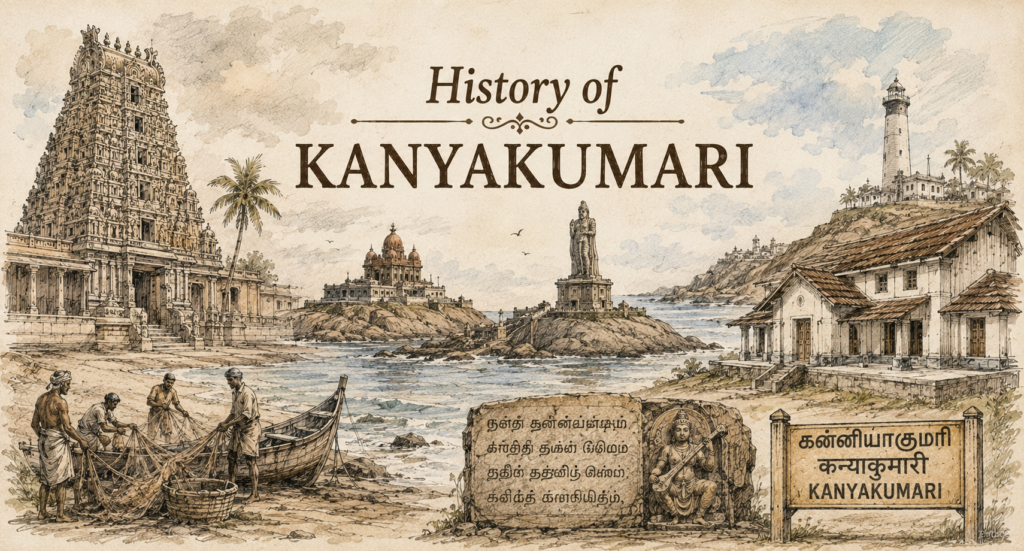
Kanyakumari, located at the southernmost tip of mainland India, is one of the country’s most iconic historical and geographical destinations. Known for its spectacular sunrise and sunset views, the confluence of the Bay of Bengal, Arabian Sea, and Indian Ocean, and its deep spiritual significance, Kanyakumari has been a center of civilization, maritime trade, religion, and cultural exchange for over two thousand years.
Today, millions of travelers visit Kanyakumari to experience landmarks such as the Vivekananda Rock Memorial, the Thiruvalluvar Statue, and the Bhagavathy Amman Temple. However, beyond its breathtaking scenery lies an extraordinary history shaped by ancient Tamil kingdoms, international trade, European exploration, and India’s freedom movement.
For readers in the United States and around the world, Kanyakumari offers a unique perspective on India’s maritime heritage. Long before the arrival of European explorers, this coastal region connected South India with Rome, Egypt, Arabia, Sri Lanka, and Southeast Asia through thriving sea trade. Ancient Greek and Roman geographers described this region as an important landmark for sailors navigating the Indian Ocean.
Throughout history, Kanyakumari came under the influence of the Early Pandyas, Cheras, Cholas, Venad Kingdom, Travancore Kingdom, Portuguese, Dutch, British Empire, and finally the Republic of India. Each era contributed to the district’s remarkable blend of history, culture, architecture, and religious traditions.
This article explores the early history of Kanyakumari—from prehistoric settlements and Sangam literature to maritime commerce and the rise of one of India’s most celebrated pilgrimage destinations.
Where is Kanyakumari?
Kanyakumari is located in the southernmost part of the Indian state of Tamil Nadu, approximately 705 kilometers south of Chennai.
The district is bordered by:
- Arabian Sea (west)
- Bay of Bengal (east)
- Indian Ocean (south)
- Kerala (northwest)
- Tirunelveli District (north)
Its unique geographical position has made Kanyakumari an important meeting point for civilizations, religions, traders, and travelers for centuries.
Origin of the Name “Kanyakumari”
The name Kanyakumari comes from Goddess Kanya Kumari, a youthful form of Goddess Parvati.
According to Hindu tradition, the goddess performed penance here while awaiting her marriage to Lord Shiva. When the marriage did not take place, she remained an eternal virgin (Kanya), and the town became known as Kanyakumari, meaning “The Virgin Goddess.”
The Bhagavathy Amman Temple, dedicated to the goddess, continues to be one of India’s most revered pilgrimage centers.
Ancient Human Settlement
Archaeological discoveries indicate that the Kanyakumari region has been inhabited since prehistoric times.
Excavations have uncovered:
- Megalithic burial sites
- Iron Age tools
- Black-and-red ware pottery
- Stone implements
- Ancient agricultural settlements
These discoveries demonstrate that early communities settled here because of:
- Fertile land
- Freshwater resources
- Rich fishing grounds
- Favorable climate
- Easy access to maritime trade
Kanyakumari During the Sangam Age
The Sangam Age (approximately 300 BCE–300 CE) represents one of the earliest documented periods of Tamil civilization.
During this era, Kanyakumari formed part of the Pandya Kingdom, one of the three great Tamil dynasties alongside the Cheras and Cholas.
Classical Tamil literature frequently mentions the southern coastline, praising its:
- Pearl fisheries
- Maritime trade
- Coastal settlements
- Religious importance
- Agricultural prosperity
The district’s strategic location at the meeting point of major sea routes helped establish it as an important commercial center.
Maritime Trade Across the Indian Ocean
Kanyakumari’s greatest historical strength was its location.
For centuries, merchant ships traveling between East and West used India’s southern tip as an important navigational landmark.
Ancient traders sailed from this region to:
- Rome
- Egypt
- Greece
- Arabia
- Sri Lanka
- Southeast Asia
Exports included:
- Pearls
- Pepper
- Cardamom
- Cinnamon
- Cotton textiles
- Precious stones
- Ivory
Imports included:
- Gold
- Glassware
- Wine
- Horses
- Silk
- Luxury goods
Roman coins discovered throughout southern Tamil Nadu provide strong archaeological evidence of these international trade networks.
The Pandya Kingdom
Among the ancient Tamil kingdoms, the Pandyas maintained the closest historical relationship with Kanyakumari.
The Pandya rulers encouraged:
- Maritime commerce
- Agriculture
- Temple construction
- Pearl fishing
- Tamil literature
Their control over the southern coastline generated enormous wealth through overseas trade.
Nearby ports became gateways connecting South India with the wider Indian Ocean world.
Chera Influence
The western part of present-day Kanyakumari District also experienced the influence of the Chera Kingdom, whose territory extended into present-day Kerala.
Because Kanyakumari lies at the crossroads between Tamil and Malayalam-speaking regions, it developed a unique cultural identity influenced by both traditions.
This blend remains visible today in:
- Language
- Cuisine
- Architecture
- Festivals
- Religious customs
Agriculture and Natural Resources
Although famous for tourism, Kanyakumari has long been an agricultural region.
Farmers cultivated:
- Rice
- Coconut
- Banana
- Tapioca
- Rubber
- Spices
- Cashew
The district’s relatively high rainfall and fertile soil supported prosperous farming communities.
Fishing also became a major source of livelihood because of the extensive coastline.
Religious Importance
Kanyakumari has been an important pilgrimage destination for centuries.
The district contains sacred sites representing multiple religions.
Major religious traditions include:
- Hinduism
- Christianity
- Islam
- Jainism (historically)
Pilgrims have visited the area for generations because of its association with the Goddess Kanya Kumari and its unique geographical setting.
Bhagavathy Amman Temple
One of the oldest and most important landmarks in the district is the Bhagavathy Amman Temple.
Dedicated to Goddess Kanya Kumari, the temple has served as one of South India’s major pilgrimage centers for centuries.
The temple is renowned for:
- Ancient Dravidian architecture
- Religious festivals
- Spiritual significance
- Coastal location
Millions of devotees visit every year.
Chola Rule
During the 9th to 13th centuries, the powerful Chola Empire expanded into southern Tamil Nadu.
The Cholas strengthened:
- Administration
- Maritime security
- Irrigation
- Trade
- Temple patronage
Their naval dominance helped maintain commercial routes passing around India’s southern coastline.
Venad and Travancore Kingdom
Following the decline of the Cholas and Pandyas, the region gradually became part of the Venad Kingdom, which later evolved into the Kingdom of Travancore.
Travancore rulers promoted:
- Agriculture
- Education
- Temple administration
- Public works
- Coastal security
This period significantly influenced the district’s later political and cultural identity.
Arrival of European Powers
The arrival of the Portuguese during the late 15th and early 16th centuries transformed Kanyakumari’s maritime history.
European traders were attracted by:
- Spice trade
- Pearl fisheries
- Strategic sea routes
Later, the Dutch and British also established influence across the southern coastline.
Christian missionaries introduced educational institutions and churches that continue to serve local communities today.
Famous Historical Landmarks
Some of Kanyakumari’s most famous historical attractions include:
- Vivekananda Rock Memorial, commemorating Swami Vivekananda’s meditation in 1892.
- Thiruvalluvar Statue, honoring the legendary Tamil poet and philosopher.
- Gandhi Memorial Mandapam, where Mahatma Gandhi’s ashes were kept before immersion.
- The scenic meeting point of the Arabian Sea, Bay of Bengal, and Indian Ocean, one of the district’s defining natural landmarks.
These sites symbolize Kanyakumari’s enduring importance as a place of spirituality, history, and national heritage.
Legacy of Ancient Kanyakumari
By the close of the medieval period, Kanyakumari had become:
- A major pilgrimage destination
- A thriving maritime trade center
- An important agricultural region
- A cultural bridge between Tamil Nadu and Kerala
- A symbol of India’s southern coastline
Its strategic location ensured that it remained significant through every major period of South Indian history.