
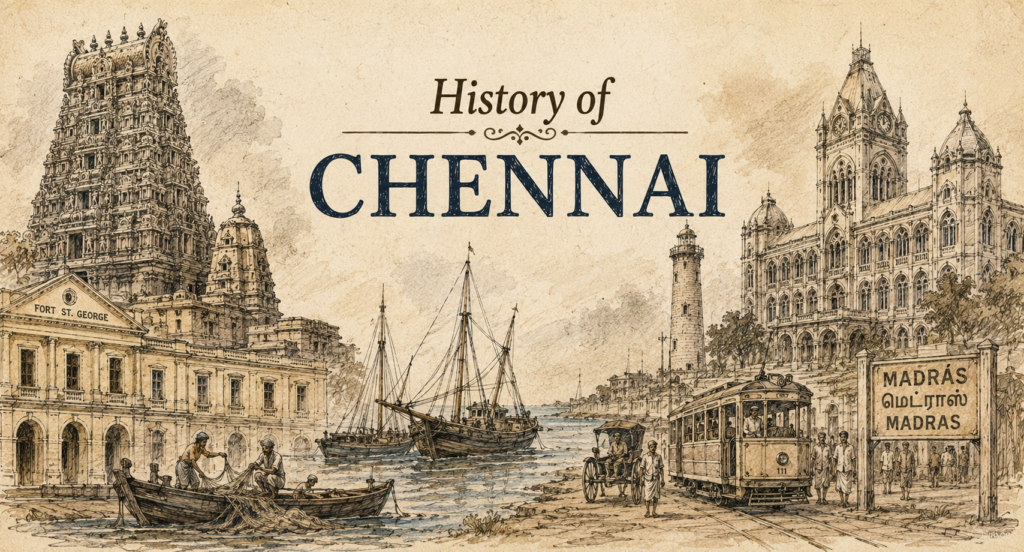
Chennai, the capital of Tamil Nadu, is one of India’s largest metropolitan cities and an important center for commerce, technology, education, healthcare, culture, and maritime trade. Known as the “Gateway to South India,” Chennai blends centuries of history with modern urban development, making it one of the country’s most influential cities.
For many readers in the United States and around the world, Chennai is often recognized as India’s automotive manufacturing hub, a major information technology center, and home to prestigious educational and medical institutions. However, long before becoming a modern metropolis, Chennai’s coastline was occupied by thriving fishing communities, ancient temples, bustling ports, and prosperous trade settlements connected to kingdoms that ruled southern India for over two thousand years.
The city’s history is unique because it combines ancient Tamil civilization with European colonial history. Unlike cities such as Delhi or Agra that grew around royal capitals, modern Chennai developed from a collection of villages that later became the headquarters of the British East India Company in southern India.
Throughout its long history, the Chennai region witnessed the rule of the Sangam-era Tamil kingdoms, Pallavas, Cholas, Pandyas, Vijayanagara Empire, Portuguese, Dutch, British East India Company, and finally independent India. Each period contributed to the city’s architecture, economy, culture, and identity.
This article explores the fascinating early history of Chennai, from prehistoric settlements to the founding of Fort St. George, laying the foundation for one of Asia’s greatest modern cities.
Where is Chennai?
Chennai is located on the Coromandel Coast along the Bay of Bengal in southeastern India.
It lies approximately:
- 350 kilometers northeast of Tiruchirappalli
- 140 kilometers east of Vellore
- 180 kilometers north of Puducherry
Its long coastline stretches for nearly 19 kilometers within the city, making Chennai one of India’s major maritime centers.
Its location has historically made it an important hub for:
- International trade
- Shipping
- Fishing
- Commerce
- Military strategy
- Cultural exchange
Origin of the Name “Chennai”
The city’s official name changed from Madras to Chennai in 1996.
Several theories explain the origin of “Chennai.”
The most widely accepted explanation links the name to Chennappa Nayak, a local ruler under the Vijayanagara Empire. The British East India Company acquired land from the Nayak rulers in the 17th century, and the settlement became associated with Chennappa’s name.
The older name Madras also has uncertain origins. Historians have proposed several possibilities:
- A Portuguese family named “Madeiros”
- The fishing village of “Madraspatnam”
- A local administrative designation
Although scholars continue to debate these origins, both names remain closely connected with the city’s colonial history.
Ancient Human Settlement
Long before modern Chennai existed, the surrounding region was inhabited by farming communities and coastal fishing villages.
Archaeological discoveries around Chennai and northern Tamil Nadu have uncovered:
- Megalithic burial sites
- Iron Age artifacts
- Ancient pottery
- Stone tools
- Early settlements
These findings indicate that human habitation in the region dates back thousands of years.
The coastline provided abundant fish, while nearby rivers and fertile plains supported agriculture.
Chennai During the Sangam Age
During the Sangam Age (approximately 300 BCE–300 CE), the Chennai region formed part of the northern Tamil country.
Although the city itself did not yet exist, nearby settlements participated in expanding trade across the Bay of Bengal.
Merchants exchanged:
- Cotton textiles
- Pepper
- Rice
- Pearls
- Precious stones
- Spices
Ships connected the eastern coast of India with:
- Sri Lanka
- Southeast Asia
- Arabia
- The Roman world
Roman coins discovered throughout Tamil Nadu demonstrate the extensive overseas trade networks of this period.
Pallava Dynasty: The First Great Builders
One of the earliest major dynasties to influence the Chennai region was the Pallava Empire.
Between the 4th and 9th centuries CE, the Pallavas ruled much of northern Tamil Nadu from their capital at Kanchipuram, located about 75 kilometers from present-day Chennai.
Under Pallava rule:
- Agriculture expanded.
- Ports developed.
- Temple architecture flourished.
- Sanskrit and Tamil scholarship advanced.
- Trade increased.
The famous rock-cut monuments at nearby Mahabalipuram (Mamallapuram) were built during this period and demonstrate the remarkable artistic achievements of the Pallavas.
These monuments later became a UNESCO World Heritage Site.
Coastal Trade and Maritime Commerce
The eastern coastline around Chennai became increasingly important because of maritime trade.
Merchants transported goods such as:
- Cotton cloth
- Pepper
- Silk
- Ivory
- Precious stones
- Sandalwood
- Aromatic spices
Ships arriving from Southeast Asia and the Middle East introduced new products, ideas, and cultural influences.
The coast gradually evolved into one of South India’s busiest commercial regions.
The Chola Empire
Between the 9th and 13th centuries, the Imperial Cholas transformed South India into one of the world’s leading maritime powers.
The Chennai region benefited from:
- Efficient administration
- Improved irrigation
- Agricultural expansion
- Growing trade
- Naval protection
Although major Chola ports included Nagapattinam and Kaveripoompattinam, settlements along the northern coast also supported commercial activities.
The Cholas strengthened links with:
- Sri Lanka
- Indonesia
- Malaysia
- Thailand
- China
These overseas relationships increased prosperity throughout coastal Tamil Nadu.
Vijayanagara Empire
Following the decline of the Cholas and Pandyas, the Vijayanagara Empire gained control over northern Tamil Nadu during the 14th century.
The empire governed the Chennai region through Nayak administrators, who encouraged:
- Agriculture
- Temple construction
- Trade
- Local administration
- Security
Several fishing villages existed along the coast during this period, including:
- Madraspatnam
- Chennapatnam
- Mylapore
- Triplicane
These villages later formed the foundation of modern Chennai.
Mylapore: An Ancient Port
One of Chennai’s oldest neighborhoods is Mylapore, whose history predates the founding of the modern city
Ancient Mylapore was famous for:
- Pearl trade
- Religious learning
- Maritime commerce
- Temple culture
Historical records suggest that merchants from Rome, Arabia, and Southeast Asia visited the area.
Today, Mylapore remains one of Chennai’s most culturally significant districts.
Arrival of the Portuguese
The Portuguese arrived on the Coromandel Coast during the early 16th century.
They established trading settlements and constructed churches, including the famous San Thome Basilica, traditionally associated with St. Thomas the Apostle.
Portuguese influence introduced:
- European architecture
- Christianity
- New trading relationships
- Maritime commerce
Although their political influence remained limited, they contributed significantly to the region’s cultural diversity.
Foundation of Modern Chennai
The defining moment in Chennai’s history occurred in 1639.
The British East India Company obtained a small strip of land from Damarla Venkatadri Nayak, a local governor under the Vijayanagara Empire.
The British selected this location because it offered:
- Access to the sea
- Favorable trading opportunities
- Strategic defense
- Room for expansion
This agreement marked the beginning of modern Chennai.
Construction of Fort St. George
In 1640, the British began constructing Fort St. George, the first major English fortress in India.
The fort became:
- The headquarters of the British East India Company in South India
- A military center
- A commercial hub
- An administrative capital
Around the fort, merchants, craftsmen, laborers, and traders established settlements that gradually expanded into the city known as Madras.
Fort St. George remains one of Chennai’s most important historical landmarks and continues to house government offices and a museum.
Growth of Colonial Madras
The success of Fort St. George attracted merchants from across India and abroad.
Communities that settled around the fort included:
- Tamil merchants
- Telugu traders
- Armenian merchants
- Portuguese Christians
- Jewish traders
- British officials
- Indian craftsmen
This multicultural environment helped shape Chennai into one of India’s most diverse cities.
Legacy of Early Chennai
By the end of the 17th century, Chennai had evolved from a collection of coastal villages into one of the British Empire’s most important trading centers in Asia.
Its early development established:
- Strong maritime commerce
- International trade networks
- Cultural diversity
- Colonial administration
- Urban planning
These foundations transformed Chennai into one of modern India’s leading metropolitan cities.