
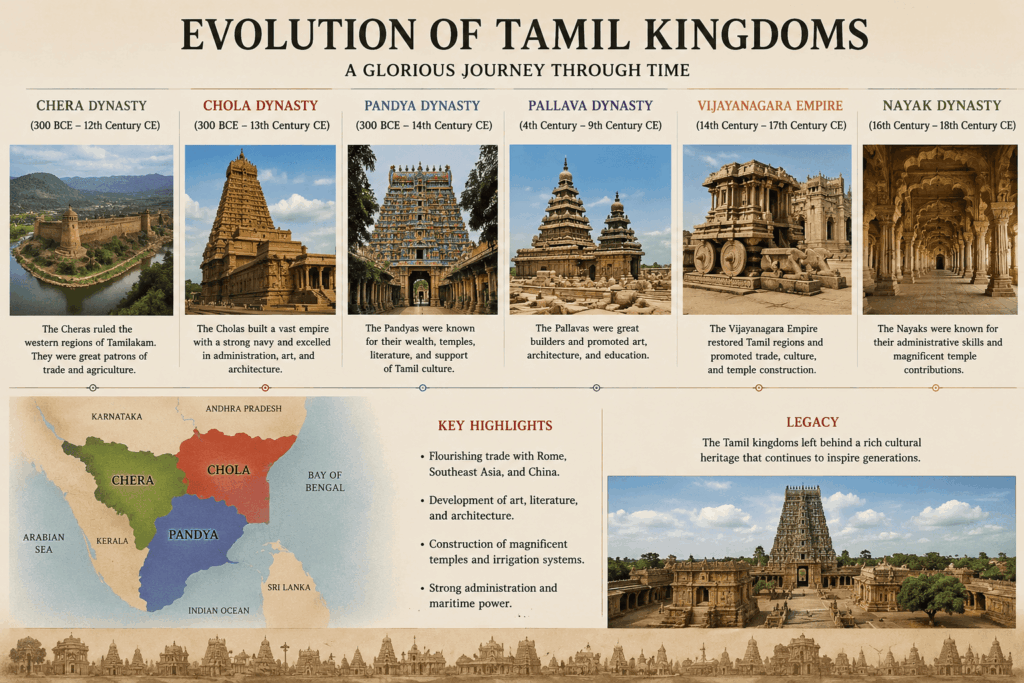
Tamil Nadu has one of the oldest continuously surviving civilizations in the world. Long before many modern nations came into existence, Tamil kingdoms had already established powerful governments, flourishing trade networks, advanced irrigation systems, magnificent temples, and a rich literary tradition. The story of the Tamil kingdoms is not just the history of rulers and battles—it is the story of a civilization that shaped South India’s culture, economy, language, architecture, and identity.
From the legendary Cheras, Cholas, and Pandyas to the Pallavas, Vijayanagara Empire, Nayaks, and eventually the British, Tamil Nadu witnessed centuries of political transformation. Each dynasty left behind remarkable achievements that continue to influence modern Tamil society.
The evolution of Tamil kingdoms reflects resilience, innovation, diplomacy, maritime excellence, and cultural brilliance. Even today, the temples, inscriptions, sculptures, literature, and traditions created during these kingdoms attract historians, researchers, tourists, and students from around the world.
Whether you are preparing for UPSC, TNPSC, SSC, or simply interested in Indian history, understanding the evolution of Tamil kingdoms provides valuable insights into one of India’s most fascinating historical journeys.
The Origins of Tamil Civilization
The roots of Tamil civilization stretch back thousands of years. Archaeological discoveries suggest that organized settlements existed in Tamil Nadu during prehistoric times. Excavations at places like Keeladi, Adichanallur, Kodumanal, and Porunthal have revealed evidence of urban planning, craftsmanship, agriculture, literacy, and trade.
Many historians believe that these discoveries prove that Tamil society had developed sophisticated settlements much earlier than previously assumed.
Agriculture became the backbone of early Tamil society. Rivers such as the Kaveri, Vaigai, Tamiraparani, and Palar supported farming communities. Fertile river valleys enabled the cultivation of rice, sugarcane, cotton, pulses, and spices.
Villages gradually evolved into towns, and local chieftains eventually established kingdoms that governed larger territories.
The Sangam Age
The Sangam Age marks one of the most celebrated periods in Tamil history. It is named after the literary academies known as Sangams, where Tamil scholars and poets gathered to compose classical literature.
Hundreds of poems written during this period survive today, providing valuable information about society, politics, warfare, trade, economy, romance, ethics, and everyday life.
Unlike many ancient civilizations that depended solely on inscriptions, Tamil history is enriched by literary sources that vividly describe people’s lives.
The Sangam Age introduced three major ruling dynasties:
Cheras
Cholas
Pandyas
Together, these kingdoms became known as the **Muvendhar** or the “Three Crowned Kings.”
Although they often fought one another, they also contributed significantly to Tamil culture and prosperity.
The Chera Kingdom
The Cheras ruled the western parts of ancient Tamilakam, covering present-day Kerala and parts of western Tamil Nadu.
Their strategic location along the Arabian Sea enabled them to dominate maritime trade.
The Cheras became famous exporters of:
Black pepper
Cardamom
Cinnamon
Sandalwood
Ivory
Pearls
Precious stones
Roman merchants frequently visited Chera ports to purchase spices, making the kingdom one of the wealthiest regions in ancient India.
Capital
The early Chera capital is believed to have been Vanchi (Karur is widely associated with it).
Famous Rulers
Among the notable Chera kings was Senguttuvan Chera, remembered for his military strength and patronage of Tamil literature.
He is closely associated with the epic Silappadikaram , one of Tamil literature’s greatest works.
Contributions of the Cheras
The Cheras made lasting contributions in several fields.
Maritime Trade
Ships from Egypt, Greece, Rome, Arabia, and Southeast Asia regularly visited Chera ports.
Trade generated enormous wealth and introduced foreign influences into Tamil society.
Literature
The Chera rulers generously supported Tamil poets.
Several Sangam poems praise their bravery, generosity, and justice.
Agriculture
The kingdom invested in irrigation and agricultural expansion, helping farmers produce surplus crops.
Culture
The Cheras encouraged music, dance, festivals, and temple traditions that remain influential today.
The Chola Kingdom
The Cholas emerged as one of the world’s greatest maritime powers.
Initially ruling from the fertile Kaveri delta, they gradually expanded across South India and overseas.
The Sangam Cholas laid the foundation for what would later become the mighty Imperial Chola Empire.
Capital
Their early capitals included Uraiyur and later Puhar (Kaveripoompattinam).
Puhar became one of India’s busiest international ports.
Merchants from Rome, Southeast Asia, China, and Arabia traded here regularly.
Karikala Chola – The Visionary King
Among the early Chola rulers, Karikala Chola occupies a special place.
He is celebrated not only as a successful warrior but also as an exceptional administrator.
His greatest engineering achievement was constructing the **Kallanai (Grand Anicut)** across the Kaveri River.
Built nearly 2,000 years ago, this remarkable dam still serves irrigation needs today, making it one of the oldest functioning water-regulation structures in the world.
Karikala’s irrigation projects transformed agriculture across the fertile delta.
Rice production increased significantly, contributing to the kingdom’s prosperity.
Achievements of the Early Cholas
The Cholas excelled in multiple fields.
Agriculture
Efficient irrigation ensured stable food production.
Trade
International trade connected Tamil Nadu with:
Rome
Sri Lanka
Southeast Asia
Arabia
China
Military
The Cholas maintained disciplined armies and a capable naval force.
Urban Development
Cities such as Puhar became thriving commercial centers filled with warehouses, marketplaces, and foreign merchants.
The Pandya Kingdom
The Pandya kingdom occupied southern Tamil Nadu.
It was among the oldest continuously ruling dynasties in India.
The Pandyas gained worldwide fame for their pearl fisheries located along the Gulf of Mannar.
Pearls harvested from these waters were exported across the ancient world.
Roman writers frequently mentioned the wealth generated by Pandya pearls.
Capital of the Pandyas
Madurai served as the magnificent capital of the Pandya kingdom.
Even today, Madurai remains one of India’s oldest continuously inhabited cities.
It emerged as a major center of:
Literature
Education
Religion
Trade
Fine arts
The city attracted scholars, merchants, travelers, and pilgrims from across Asia.
Contributions of the Pandyas
The Pandya rulers played a major role in preserving Tamil culture.
Literature
Many Sangam poets received royal patronage.
Tamil grammar, poetry, and literary criticism flourished.
Religion
Temples dedicated to Shiva, Vishnu, and Murugan expanded during different periods.
Trade
Ports like Korkai connected Tamil Nadu to international markets.
Economy
Pearls, spices, cotton textiles, elephants, and gemstones generated considerable revenue.
Society During the Sangam Period
The Sangam Age was socially vibrant and economically prosperous.
People belonged to diverse occupations, including:
Farmers
Fishermen
Merchants
Blacksmiths
Goldsmiths
Weavers
Potters
Soldiers
Poets
Priests
Women actively participated in literature, trade, agriculture, and administration.
Several renowned female poets, including Avvaiyar, made lasting contributions to Tamil literature.
Education was valued, and poetry was highly respected.
Hospitality was considered an important virtue.
Economy and Trade
Trade formed the backbone of the Tamil kingdoms.
Merchants exported:
Pepper
Cardamom
Cinnamon
Cotton textiles
Silk
Pearls
Ivory
Sandalwood
Precious stones
In return, foreign traders brought:
Gold coins
Wine
Glassware
Coral
Luxury goods
Horses
Roman coins discovered across Tamil Nadu demonstrate the strength of these commercial ties.
Ancient ports bustled with activity, where ships from distant lands exchanged goods, ideas, languages, and cultures.
Religion and Cultural Life
Early Tamil society practiced nature worship alongside the worship of Murugan, Shiva, Vishnu, Korravai, and other regional deities.
Festivals celebrated agriculture, harvests, victories, and seasonal changes.
Music, dance, storytelling, and folk traditions flourished in villages and royal courts alike.
These cultural foundations would later influence Bhakti movements, temple architecture, and classical arts throughout South India.