
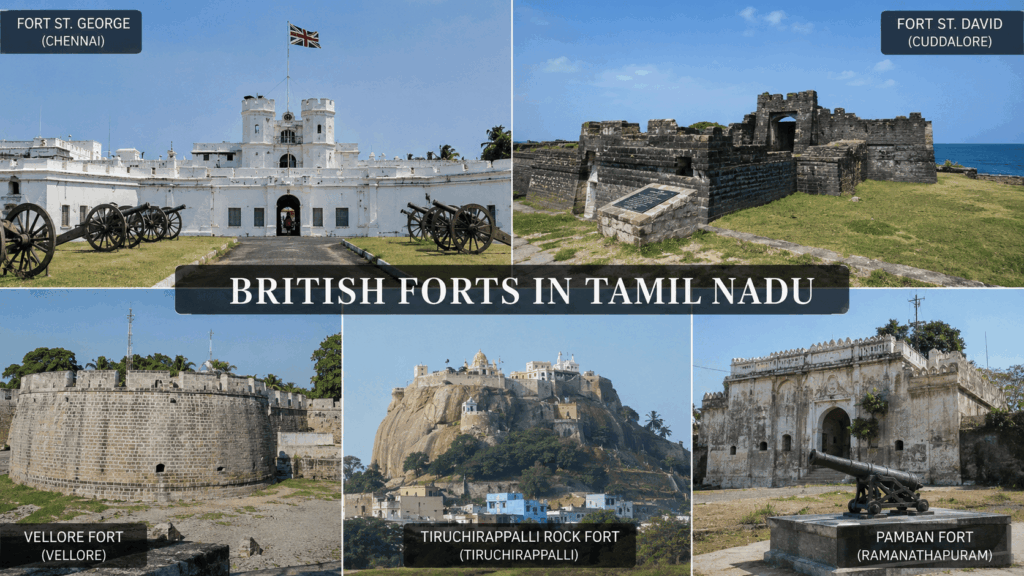
Tamil Nadu is home to some of India’s most remarkable forts, each reflecting centuries of political change, military strategy, and architectural excellence. While many forts were originally built by South Indian dynasties such as the Cholas, Pandyas, Vijayanagara rulers, Nayaks, and Marathas, the arrival of European colonial powers transformed several of these strongholds into major military and administrative centres. Among them, the British played a significant role in strengthening, expanding, and governing many forts across the region.
From the iconic Fort St. George** in Chennai to the strategically important Fort St. David in Cuddalore and the historic Vellore Fort , British forts in Tamil Nadu narrate the story of colonial expansion, trade, military campaigns, and the eventual rise of the British Empire in South India.
These forts were more than defensive structures. They served as trading centres, administrative headquarters, military barracks, prisons, warehouses, and symbols of British authority. They also became the backdrop for key historical events, including the Carnatic Wars, the Anglo-Mysore Wars, and the famous **Vellore Mutiny of 1806**, regarded as one of the earliest major uprisings against British rule.
Today, many of these forts are protected heritage monuments that attract history enthusiasts, tourists, architecture lovers, students, researchers, and competitive exam aspirants. Their massive walls, ancient cannons, museums, churches, temples, and colonial buildings continue to preserve the fascinating story of British India.
This article explores the history, architecture, military importance, and tourism value of the most significant British forts in Tamil Nadu.
The Arrival of the British in Tamil Nadu
The history of British forts in Tamil Nadu began with the arrival of the British East India Company during the early 17th century. Initially focused on trade, the Company sought secure locations along the Coromandel Coast to establish warehouses and commercial settlements.
Tamil Nadu’s coastline was ideal because of its:
Excellent natural harbours
Flourishing textile trade
Access to inland kingdoms
Maritime links with Southeast Asia and Europe
Rich agricultural hinterland
As trade expanded, the British realized that protecting their settlements required strong fortifications. Rival European powers such as the Portuguese, Dutch, French, and Danes were also competing for influence, while regional Indian kingdoms often fought for territorial control.
These circumstances led to the construction and strengthening of several forts across Tamil Nadu.
Why Did the British Build Forts?
British forts were designed to serve multiple purposes beyond military defence.
Their main objectives included:
Protection of Trade
The British East India Company transported valuable goods such as cotton textiles, spices, indigo, silk, saltpetre, and precious stones. Fortified settlements protected warehouses and merchants from attacks.
Defence Against European Rivals
The British frequently clashed with French, Dutch, and Portuguese forces during the colonial era. Forts acted as defensive strongholds during these conflicts.
Administrative Centres
Many forts became headquarters for British officials responsible for taxation, law enforcement, and governance.
Military Bases
Large barracks accommodated soldiers, artillery units, cavalry, and military supplies.
Political Control
Strategically located forts allowed the British to monitor local rulers, maintain order, and expand their influence across South India.
Characteristics of British Military Architecture
British forts in Tamil Nadu combined European engineering principles with local construction materials and climatic adaptations.
Common architectural features included:
Thick granite or brick walls
Bastions for artillery
Watchtowers
Moats surrounding the fort
Cannon emplacements
Large gateways
Parade grounds
Barracks
Churches
Administrative offices
Warehouses
Underground storage rooms
Unlike medieval Indian hill forts, British forts generally emphasized artillery-based defence rather than elevated positions.
Major British Forts in Tamil Nadu
Several forts became closely associated with British military and political history.
Among the most important are:
1. Fort St. George – Chennai
Built in 1644, Fort St. George was the first major English fortification in India.
It became the headquarters of the British East India Company on the Coromandel Coast and later served as the administrative centre of the Madras Presidency.
Today, the fort houses government offices, museums, and **St. Mary’s Church**, one of the oldest Anglican churches in Asia.
2. Fort St. David – Cuddalore
Located near Cuddalore, Fort St. David played a major role during the Carnatic Wars.
Originally established by the British in the late 17th century, the fort became an important military base during conflicts with the French.
Although much of the structure now lies in ruins, it remains an important heritage site reflecting colonial military history.
3. Vellore Fort
Although originally constructed by the Vijayanagara rulers in the 16th century, Vellore Fort became one of the British Empire’s most important military strongholds after coming under British control.
The fort gained national significance because of the **Vellore Mutiny of 1806**, when Indian soldiers rebelled against British authority—an event often regarded as a precursor to the Revolt of 1857.
4. Tiruchirappalli Rock Fort
The ancient Rock Fort was originally developed by earlier South Indian rulers, but the British recognized its strategic importance during the Carnatic Wars.
Control of the fort frequently shifted between the British, the French, the Nawabs of Arcot, and other regional powers before the British established dominance.
The Carnatic Wars and the Rise of British Power
One of the most significant periods in the history of British forts in Tamil Nadu was the **Carnatic Wars** (1746–1763).
These wars were fought primarily between the British East India Company and the French East India Company, with local Indian rulers supporting different sides.
The British successfully defended and captured several strategic forts during these conflicts.
The outcome of the Carnatic Wars marked the beginning of British political supremacy in South India.
Importance of Coastal Forts
The Coromandel Coast became one of the busiest trading regions in Asia during the colonial period.
Coastal forts allowed the British to:
Protect merchant ships
Monitor maritime trade
Collect customs duties
Defend ports against naval attacks
Store imported and exported goods
Maintain communication with Europe
These forts formed an interconnected network that strengthened British commercial dominance.
Life Inside a British Fort
British forts functioned as self-contained communities.
Within their walls lived:
Soldiers
British officials
Merchants
Clerks
Artisans
Indian workers
Translators
Religious leaders
Facilities commonly included:
Barracks
Hospitals
Kitchens
Churches
Warehouses
Offices
Armouries
Wells
Stables
Daily life revolved around military drills, trade administration, governance, and commercial activities.
Relationship with Local Kingdoms
The British frequently negotiated with Indian rulers to secure trading rights and territorial control.
Major interactions occurred with:
The Nawabs of Arcot
The Kingdom of Mysore
The Marathas
The rulers of Thanjavur
The Carnatic administration
These relationships often shifted between cooperation, diplomacy, and warfare depending on changing political circumstances.
Why British Forts Matter Today
Today, British forts are more than reminders of colonial rule. They serve as valuable educational resources that help us understand India’s complex past.
These monuments preserve evidence of:
Colonial administration
Military engineering
Maritime trade
Cultural exchange
Political conflicts
Early resistance movements
Many forts now house museums displaying weapons, coins, uniforms, manuscripts, maps, and archaeological artefacts that bring history to life.