
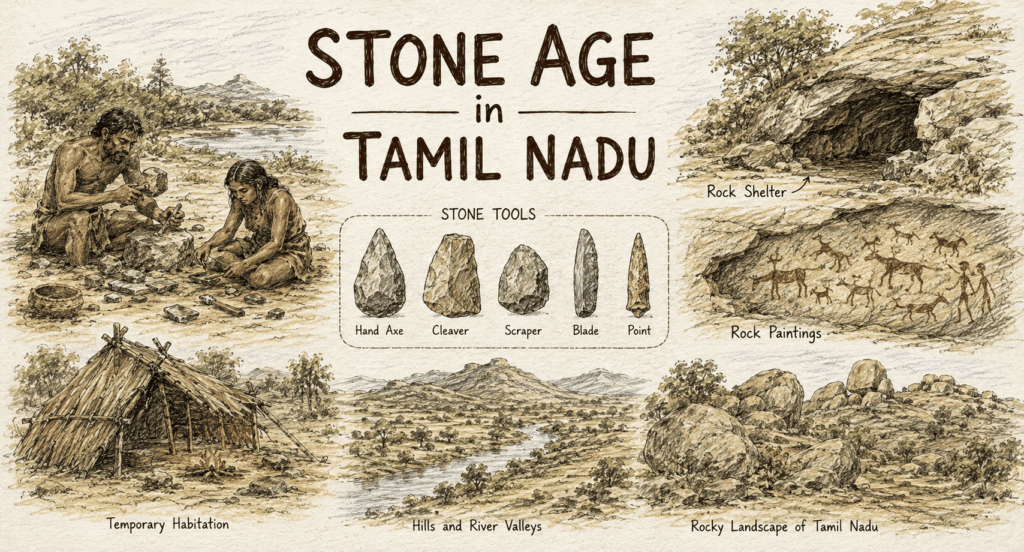
Long before the rise of cities, kingdoms, and written history, early humans lived, hunted, and adapted to the diverse landscapes of what is now Tamil Nadu. Today, the state is recognized as one of India’s most significant archaeological regions, preserving evidence of human life that stretches back hundreds of thousands of years. From ancient stone tools found along river valleys to prehistoric rock shelters and Neolithic settlements, Tamil Nadu offers an extraordinary record of human evolution and technological progress.
For readers in the United States who are interested in archaeology, anthropology, and ancient civilizations, the Stone Age in Tamil Nadu provides a fascinating perspective on humanity’s shared origins. While places like Olduvai Gorge in Tanzania or the caves of France often dominate discussions of prehistoric history, southern India holds equally valuable evidence that helps scientists understand how early humans adapted, innovated, and eventually laid the foundations for later civilizations.
What Was the Stone Age?
The Stone Age is the earliest and longest period of human history, beginning with the first known use of stone tools and ending when metal tools became widespread. During this era, people relied primarily on stone implements for hunting, food preparation, woodworking, and survival.
Archaeologists generally divide the Stone Age into three major periods:
- Paleolithic (Old Stone Age): Approximately 2.6 million years ago to around 10,000 BCE
- Mesolithic (Middle Stone Age): Around 10,000 BCE to 4,000 BCE
- Neolithic (New Stone Age): Around 4,000 BCE to 1,500 BCE in parts of South India
Tamil Nadu contains archaeological evidence from all three periods, making it one of the most important prehistoric regions in South Asia. Studies by the Archaeological Survey of India and the Tamil Nadu State Department of Archaeology continue to expand our understanding of these early communities.
Why Tamil Nadu Is Important in Stone Age Research
Tamil Nadu’s geography made it an ideal environment for prehistoric communities. Rivers, rocky hills, forests, and coastal plains provided water, food, and natural shelters.
Over the past century, archaeologists have discovered:
- Stone tool workshops
- River valley settlements
- Rock shelters
- Animal fossils
- Prehistoric habitation sites
- Early farming communities
- Burial monuments dating to later prehistoric periods
These discoveries demonstrate that humans occupied the region continuously over hundreds of thousands of years, adapting to changing climates and environments.
The Paleolithic Period: Tamil Nadu’s Earliest Humans
The Paleolithic, or Old Stone Age, marks the earliest evidence of human activity in Tamil Nadu.
During this period, early humans lived as hunter-gatherers. They depended on wild animals, edible plants, fruits, roots, and seasonal water sources. Communities were mobile, moving from place to place in search of food rather than establishing permanent villages.
Stone tools from this era were crafted by striking rocks such as quartzite and chert to create sharp cutting edges. Archaeologists have recovered:
- Hand axes
- Cleavers
- Choppers
- Scrapers
- Flake tools
These implements were used for butchering animals, cutting wood, preparing hides, and processing plants.
One of the most important Paleolithic sites is Attirampakkam, near Chennai. Excavations there have uncovered stone tools dating back more than one million years, making it one of the oldest known archaeological sites in South Asia. Research published in international scientific journals suggests that the site preserves evidence of remarkably early technological development and challenges previous assumptions about the spread of early human tool-making traditions.
Attirampakkam: A Landmark Discovery
Attirampakkam has transformed our understanding of prehistoric India.
Excavations have revealed thousands of carefully crafted stone tools preserved within ancient sediment layers. Scientific dating indicates that some tools belong to the Lower Paleolithic period, while others demonstrate a gradual transition toward more sophisticated Middle Paleolithic technologies.
These findings suggest that early human populations in South Asia independently adapted their tool-making techniques over long periods rather than simply adopting technologies from elsewhere.
For archaeologists worldwide, Attirampakkam is now considered one of Asia’s most significant prehistoric sites.
The Mesolithic Period: Adapting to a Changing World
As the last Ice Age ended, environmental conditions changed dramatically.
During the Mesolithic period, forests expanded, rivers shifted, and wildlife populations changed. Human communities responded by developing smaller, more specialized stone tools known as microliths.
These tiny blades could be attached to wooden shafts to create:
- Spears
- Hunting arrows
- Fishing equipment
- Cutting tools
Mesolithic communities also became more efficient at exploiting diverse food resources, including fish, shellfish, birds, and small mammals.
Archaeological evidence suggests that seasonal camps became increasingly common, marking a gradual transition toward more settled lifestyles.
The Neolithic Period: Farming Begins
The Neolithic period represents one of humanity’s greatest transformations.
Instead of relying entirely on hunting and gathering, people began cultivating crops and domesticating animals. Permanent settlements gradually emerged, allowing communities to produce food rather than simply collect it.
Evidence from Neolithic sites in Tamil Nadu includes:
- Polished stone axes
- Grinding stones
- Pottery
- Storage pits
- Agricultural tools
- Domesticated animal remains
This shift encouraged population growth, craft specialization, and increasingly complex social organization.
Although farming developed at different times across India, Tamil Nadu’s Neolithic communities played an important role in the region’s long-term cultural development.
Important Stone Age Sites in Tamil Nadu
Attirampakkam (Tiruvallur District)
Perhaps the state’s most famous prehistoric site, Attirampakkam has yielded thousands of stone tools dating back over one million years. It remains central to international research on early human evolution.
Gudiyam Caves
Located near Chennai, the Gudiyam Caves contain evidence of repeated prehistoric occupation.
Stone tools discovered in and around these rock shelters indicate that early humans used the area for temporary habitation and tool production.
Kortallayar River Valley
This river basin has produced numerous Paleolithic artifacts, demonstrating that ancient communities frequently settled near dependable water sources.
Paiyampalli
Paiyampalli is one of Tamil Nadu’s best-known Neolithic sites.
Excavations have uncovered pottery, polished stone tools, evidence of agriculture, and permanent habitation, illustrating the transition from hunting and gathering to settled village life.
Stone Tools: The Technology of Early Humans
Although simple by modern standards, Stone Age tools required considerable planning and skill.
Archaeologists have identified numerous tool types across Tamil Nadu, including:
- Hand axes for heavy cutting
- Cleavers for processing animal carcasses
- Scrapers for preparing hides
- Microliths for hunting weapons
- Polished axes for clearing vegetation and woodworking
- Grinding stones for processing grains and seeds
The evolution of these tools reflects changing lifestyles, environmental adaptation, and increasing technological sophistication.
Daily Life During the Stone Age
Life in prehistoric Tamil Nadu revolved around survival and cooperation.
People likely lived in small family groups and depended on teamwork for hunting, gathering food, and protecting one another.
Daily activities included:
- Hunting deer and wild cattle
- Collecting edible plants and fruits
- Fishing in rivers and lakes
- Producing stone tools
- Building temporary shelters
- Caring for children
- Sharing food within the community
Over time, these practices became more organized as permanent settlements emerged.
Climate and Environment
Tamil Nadu’s prehistoric environment differed from today’s landscape but still offered abundant natural resources.
Ancient communities benefited from:
- River systems
- Seasonal rainfall
- Grasslands
- Dense forests
- Rocky hills providing natural shelter
- Diverse wildlife
Changes in climate over thousands of years influenced migration patterns and encouraged technological innovation as people adapted to new conditions.
How Archaeologists Study the Stone Age
Modern archaeology combines traditional excavation with advanced scientific techniques to better understand prehistoric life.
Researchers use:
- Radiometric dating to determine the age of artifacts.
- Stratigraphy to analyze soil layers and reconstruct chronological sequences.
- Microscopic wear analysis to identify how tools were used.
- Geographic Information Systems (GIS) to map archaeological landscapes.
- Environmental studies to reconstruct ancient climates and ecosystems.
These methods allow scientists to build increasingly detailed pictures of life during the Stone Age.
Why the Stone Age in Tamil Nadu Matters Today
The Stone Age record of Tamil Nadu is more than a collection of ancient tools—it represents one of the longest continuous chapters in human history. Sites such as Attirampakkam, Gudiyam Caves, and Paiyampalli demonstrate that southern India was home to innovative communities that adapted successfully to changing environments over hundreds of thousands of years.
For American readers interested in archaeology and world history, these discoveries broaden our understanding of early human development beyond the better-known archaeological landscapes of Europe and Africa. They highlight the global nature of human evolution and remind us that significant technological and cultural innovations emerged across many regions of the world.
As new excavations and scientific analyses continue, Tamil Nadu remains one of the most exciting places for prehistoric research. Every newly discovered stone tool, settlement, and fossil adds another piece to the story of humanity’s earliest ancestors and deepens our appreciation for the remarkable journey that led from simple stone implements to the complex civilizations we know today.