
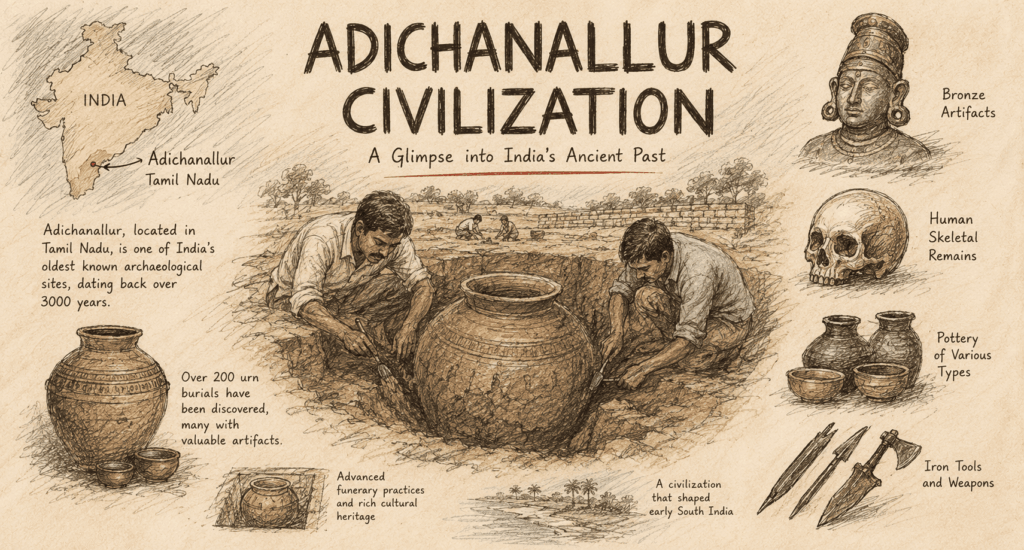
Ancient civilizations have long fascinated people around the world. When discussing early human societies, names such as Egypt, Mesopotamia, Greece, Rome, and the Indus Valley Civilization often dominate the conversation. Yet, tucked away in southern India lies an archaeological site that is steadily gaining international recognition for its remarkable discoveries and its contribution to understanding the origins of civilization in the Indian subcontinent.
The Adichanallur Civilization, located in the southern Indian state of Tamil Nadu, is one of the country’s most significant archaeological sites. Famous for its vast urn burials, sophisticated iron technology, bronze artifacts, and evidence of an organized society, Adichanallur offers a rare glimpse into life more than 2,500 years ago. Scientific studies suggest that the site dates to the Iron Age and Early Historic periods, with some radiocarbon dates indicating occupation beginning well before the Common Era. Researchers continue to refine its chronology through ongoing excavations and laboratory analysis.
For readers in the United States, Adichanallur provides an opportunity to explore a lesser-known chapter of world history. Its discoveries demonstrate that southern India was home to technologically skilled communities with advanced craftsmanship, established cultural traditions, and extensive trade connections long before many later kingdoms rose to prominence.
Today, Adichanallur is regarded as one of the most important archaeological sites in South Asia, helping historians reconstruct the story of ancient Tamil civilization.
Where Is Adichanallur?
Adichanallur is situated in Thoothukudi (Tuticorin) District in the southern Indian state of Tamil Nadu. The site lies close to the Tamirabarani River, one of the oldest continuously flowing rivers in southern India.
The river has sustained human settlements for thousands of years by providing:
- Fresh water
- Fertile agricultural land
- Transportation routes
- Rich fishing resources
- Trade opportunities
Like the Nile in Egypt or the Tigris and Euphrates in Mesopotamia, the Tamirabarani River played a crucial role in supporting early civilization.
The archaeological site covers a large area and forms part of a broader network of ancient settlements found along the Tamirabarani River Valley. Many historians believe this region was among the earliest centers of settled life in southern India.
Why Adichanallur Is Important
Adichanallur is significant because it preserves evidence of an advanced Iron Age community that practiced agriculture, metallurgy, pottery making, long-distance trade, and sophisticated burial customs.
Unlike many archaeological sites that reveal only buildings or isolated artifacts, Adichanallur contains one of the largest known urn burial cemeteries in South Asia. Thousands of burial urns have been identified, making it an invaluable source of information about ancient social structure, beliefs, health, technology, and everyday life.
The site has yielded:
- Large burial urns
- Human skeletons
- Bronze objects
- Iron weapons
- Pottery
- Gold ornaments
- Shell artifacts
- Agricultural tools
- Animal remains
Each discovery helps archaeologists piece together the story of a thriving community that lived centuries before the rise of many later South Indian kingdoms.
Discovery of Adichanallur
Although local residents had long known about ancient burial urns in the area, systematic archaeological investigations began during the late nineteenth century.
European scholars and colonial administrators noticed large numbers of pottery fragments and burial urns emerging from agricultural fields after seasonal rains. These discoveries attracted the attention of archaeologists working under British India.
One of the earliest documented investigations was carried out by German researcher Dr. Jagor during the 1870s. However, the site gained wider recognition through the work of Alexander Rea, an archaeologist with the Archaeological Survey of India (ASI).
Alexander Rea and the First Major Excavations
Between 1899 and 1905, Alexander Rea conducted extensive excavations at Adichanallur.
His team unearthed hundreds of burial urns along with thousands of artifacts.
Among the discoveries were:
- Complete human skeletons
- Bronze bowls
- Decorative ornaments
- Iron swords
- Spears
- Pottery vessels
- Gold ornaments
- Copper objects
These excavations were groundbreaking because they revealed that southern India possessed a highly developed Iron Age culture comparable in sophistication to many other ancient civilizations.
Many artifacts recovered during Rea’s excavations are preserved today in museums, where they continue to be studied by archaeologists.
Modern Excavations
Interest in Adichanallur was renewed during the twenty-first century.
The Archaeological Survey of India resumed excavations in 2004, employing modern archaeological techniques unavailable during the colonial period.
These investigations included:
- Scientific excavation methods
- Carbon dating
- Soil analysis
- Botanical studies
- Osteological examination of skeletons
- Metallurgical analysis
- Digital documentation
Modern archaeology allows researchers to answer questions that earlier excavations could not address.
Rather than simply collecting artifacts, today’s archaeologists seek to understand how ancient communities lived, worked, farmed, traded, and interacted with their environment.
Dating the Civilization
Determining the age of Adichanallur has been one of the most important goals of archaeological research.
Radiocarbon dating and associated scientific studies indicate that different parts of the site were occupied during the Iron Age, with evidence extending into the Early Historic period. Some tested samples suggest activity dating back to around the first millennium BCE, although researchers continue to debate the exact beginning of occupation and the duration of settlement.
The site’s significance lies not only in its age but also in the sophistication of its material culture, including advanced ironworking and elaborate burial traditions.
The Famous Burial Urns
The feature that has made Adichanallur famous around the world is its extraordinary urn burial cemetery.
Thousands of large ceramic urns have been discovered beneath the ground.
Many of these urns contained:
- Human skeletons
- Ashes
- Iron tools
- Bronze ornaments
- Pottery vessels
- Food offerings
- Animal bones
- Beads
Some urns were large enough to contain complete skeletons, while others held cremated remains.
The burial practice suggests that ancient communities followed carefully developed funerary rituals, reflecting beliefs about death, remembrance, and the afterlife.
What the Burials Reveal
The burial urns provide valuable clues about the people who lived here.
Archaeologists have learned that many individuals were buried with personal possessions, indicating that certain objects held cultural or symbolic importance beyond daily use.
Researchers have also observed differences in the size of burial urns and the quantity of grave goods, which may reflect variations in age, occupation, social standing, or family traditions. While interpretations remain under study, these patterns suggest a society with established customs and organized community life.
The presence of children, adults, men, and women among the burials also indicates that Adichanallur was a permanent settlement rather than a temporary camp.
Bronze Technology
One of the most remarkable aspects of Adichanallur is the quality of its bronze craftsmanship.
Archaeologists recovered:
- Bronze bowls
- Decorative vessels
- Animal figurines
- Ornaments
- Ritual objects
These items demonstrate considerable expertise in metal casting and finishing.
Bronze production required specialized knowledge of metallurgy, controlled heating techniques, and access to raw materials, indicating the presence of skilled artisans within the community.