
When most Americans think about ancient civilizations, names like Egypt, Mesopotamia, Greece, Rome, or the Indus Valley Civilization usually come to mind. However, in southern India, archaeologists have uncovered evidence of another remarkable urban settlement that is changing historians’ understanding of early civilization in South Asia.
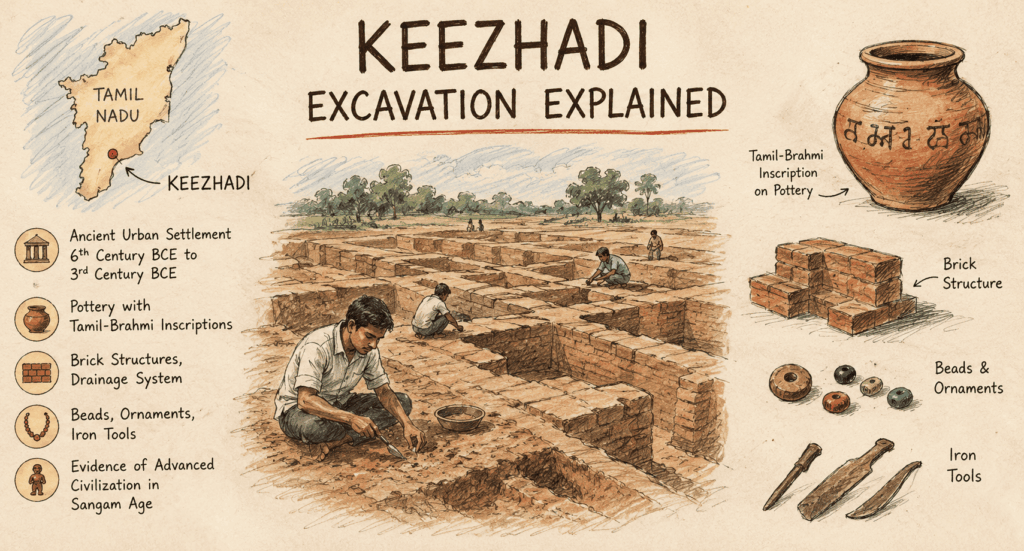
The Keezhadi (also spelled Keeladi) Excavation is one of India’s most significant archaeological discoveries of the 21st century. Located in the state of Tamil Nadu, about 12 kilometers (7.5 miles) southeast of Madurai, the excavation has revealed an advanced urban settlement that flourished more than 2,000 years ago along the Vaigai River. Excavations have uncovered brick buildings, drainage systems, industrial workshops, pottery with Tamil-Brahmi inscriptions, jewelry, and thousands of artifacts, providing valuable insights into early Tamil society.
For an international audience, Keezhadi offers something fascinating: evidence that sophisticated urban life developed in southern India during the Early Historic (Sangam) period, expanding our understanding of how ancient civilizations evolved across the Indian subcontinent.
Where Is Keezhadi?
Keezhadi is situated in Sivaganga District, Tamil Nadu, near the historic city of Madurai. The settlement lies within the fertile Vaigai River Valley, an area that supported agriculture, trade, and urban growth for centuries.
The Vaigai River played a role similar to that of:
- The Nile in Egypt
- The Tigris and Euphrates in Mesopotamia
- The Yellow River in China
Reliable water sources encouraged farming, transportation, and the emergence of permanent settlements.
Discovery of the Site
Although archaeological surveys had long suggested ancient habitation in the Vaigai Valley, systematic exploration began in 2013–2014 when the Archaeological Survey of India (ASI) surveyed hundreds of sites across the river basin. Keezhadi was selected for excavation because of the density of surface artifacts. Excavations officially began in 2015 under archaeologist K. Amarnath Ramakrishna, with later excavation phases conducted by the Tamil Nadu State Department of Archaeology.
Each excavation season revealed increasingly compelling evidence of a well-planned settlement.
Why Keezhadi Matters
Keezhadi is significant because it demonstrates that urbanization, literacy, and specialized industries were well established in ancient Tamilakam (the Tamil-speaking region of South India) during the Early Historic/Sangam period. Archaeological evidence points to organized neighborhoods, craft production, trade, and writing, challenging earlier assumptions that early South India was primarily rural during this era.
Rather than rewriting all of Indian history, Keezhadi adds an important southern chapter by showing that complex urban societies flourished outside the better-known northern centers.
Timeline of the Excavations
| Year | Milestone |
|---|---|
| 2013–2014 | Vaigai Valley archaeological survey |
| 2015 | First major excavation at Keezhadi |
| 2016 | Discovery of brick structures and inscriptions |
| 2017 | Radiocarbon dating expanded chronological understanding |
| 2018 onward | Tamil Nadu Archaeology Department continued excavation |
| 2025 | ASI published its excavation report following scientific review and court-directed release. |
Major Discoveries
1. Planned Urban Settlement
Archaeologists uncovered:
- Brick-built houses
- Streets
- Drainage systems
- Water storage structures
- Industrial workspaces
These discoveries indicate an organized settlement rather than a temporary village.
2. Thousands of Artifacts
More than 13,000 artifacts have been documented across excavation phases, including:
- Pottery
- Terracotta figurines
- Iron tools
- Gold ornaments
- Glass beads
- Shell bangles
- Bone tools
- Weights
- Gaming pieces
Together, these objects illustrate everyday life, craftsmanship, and trade.
3. Tamil-Brahmi Inscriptions
One of Keezhadi’s most important contributions is the discovery of pottery bearing Tamil-Brahmi inscriptions, indicating that writing was in practical use for marking objects and perhaps ownership or commerce.
These inscriptions reinforce literary evidence that literacy existed in early Tamil society during the Sangam period.
4. Advanced Water Management
Excavations have revealed:
- Ring wells
- Drainage channels
- Storage facilities
These features reflect careful planning and public infrastructure, characteristics commonly associated with urban settlements.
5. Craft Production
Evidence has been found for industries such as:
- Bead making
- Pottery production
- Textile-related activities
- Metalworking
This suggests occupational specialization rather than a purely agricultural community.
Dating the Settlement
Radiocarbon dating has been central to understanding Keezhadi’s chronology. Different excavation phases and analyses have produced dates broadly spanning the Early Historic period, with several findings indicating occupation beginning around the 6th century BCE and continuing into the early centuries CE. Archaeological interpretation and precise dating remain subjects of ongoing scholarly discussion, but there is broad agreement that Keezhadi represents an important ancient urban settlement in southern India.
Daily Life in Ancient Keezhadi
Evidence suggests residents likely lived in a prosperous settlement characterized by:
Agriculture
Farmers cultivated crops supported by the Vaigai River.
Trade
Beads, ornaments, ceramics, and imported materials indicate commercial networks extending beyond the local region.
Skilled Crafts
Artisans produced high-quality ceramics, jewelry, and textiles.
Literacy
Inscribed pottery indicates writing formed part of daily economic or social activity.
Community Life
Brick houses and public infrastructure point to stable neighborhoods and organized civic planning.
Sangam Civilization
Keezhadi is closely associated with the Sangam Age, a period celebrated in classical Tamil literature for its poetry, trade, governance, and cultural achievements.
The archaeological discoveries provide physical evidence that complements descriptions found in Sangam texts, helping historians better understand how people lived during this era.
Trade Connections
Artifacts suggest the inhabitants participated in regional and long-distance trade.
Likely trade items included:
- Pearls
- Textiles
- Iron products
- Beads
- Pottery
Historical sources also indicate that the wider Tamil region traded extensively with the Mediterranean world during the Early Historic period.
How Keezhadi Compares with Other Ancient Civilizations
| Civilization | Approximate Period | Key Features |
|---|---|---|
| Egypt | 3100 BCE onward | Monumental architecture, writing |
| Mesopotamia | 3500 BCE onward | Cities, irrigation, cuneiform |
| Indus Valley | 2600–1900 BCE | Planned cities, drainage |
| Keezhadi (Early Historic Tamil) | c. 6th century BCE–early centuries CE | Urban planning, literacy, craft industries, water management |
Keezhadi is not contemporary with the Mature Indus Valley Civilization, which is much older, but it demonstrates that complex urban traditions also developed in peninsular India during the Early Historic period.
Continuing Research
Excavations are ongoing, and archaeologists continue to study:
- Settlement layout
- Industries
- Environmental history
- Agricultural practices
- Trade networks
- Ancient technologies
As additional excavation areas are explored, researchers expect new discoveries to deepen our understanding of early Tamil society.
Visiting Keezhadi
Today, visitors can explore:
- The excavation site (subject to public access and excavation schedules)
- The nearby site museum
- Madurai’s historic temples and cultural landmarks
The museum displays pottery, ornaments, tools, inscriptions, and reconstructions that help visitors visualize life in ancient Keezhadi.
Frequently Asked Questions
What is Keezhadi?
Keezhadi is an archaeological site in Tamil Nadu that has revealed an ancient urban settlement associated with the Early Historic (Sangam) period.
Why is Keezhadi famous?
It provides strong archaeological evidence for organized urban life, literacy, craft production, and civic infrastructure in ancient Tamil society.
How old is Keezhadi?
Radiocarbon dating indicates occupation beginning around the 6th century BCE, with continued habitation into the early centuries CE, although researchers continue refining the chronology.
Who discovered Keezhadi?
The Archaeological Survey of India initiated excavations after extensive surveys, and later excavation phases have been led by the Tamil Nadu State Department of Archaeology.
Is Keezhadi linked to the Indus Valley Civilization?
There is no established archaeological consensus that Keezhadi was part of the Indus Valley Civilization. Instead, it represents an important urban settlement of ancient Tamilakam. Some researchers explore possible cultural connections, but these remain subjects of scholarly investigation rather than established