
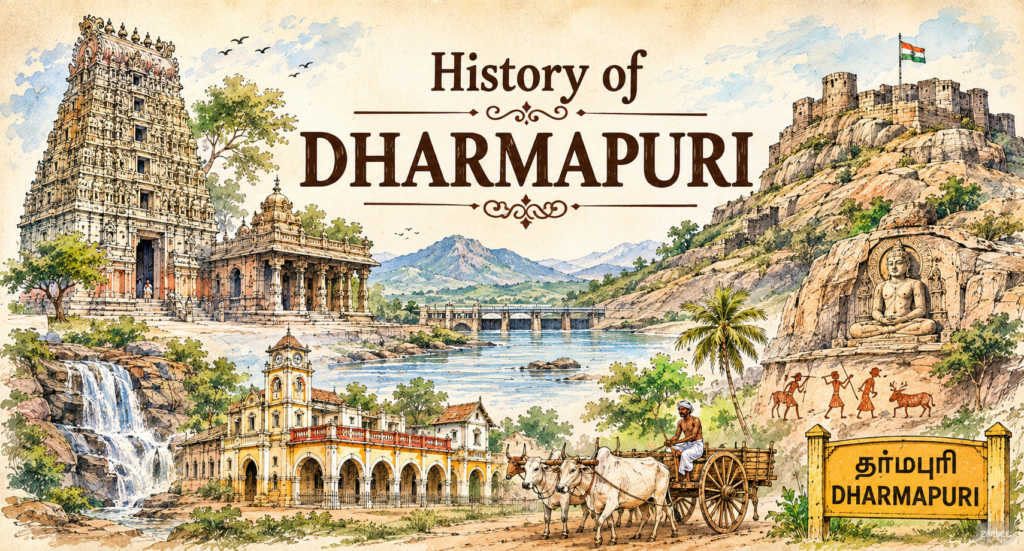
Dharmapuri, located in the northwestern part of Tamil Nadu, is one of South India’s oldest historically significant regions. Famous today for the spectacular Hogenakkal Falls, ancient temples, mango orchards, and scenic landscapes, Dharmapuri has a history that stretches back more than two thousand years.
While international visitors often associate Tamil Nadu with cities like Chennai, Madurai, or Thanjavur, Dharmapuri tells a different story. Rather than being shaped primarily by coastal trade, its history developed around fertile river valleys, hill passes, agriculture, and military routes connecting Tamil Nadu with Karnataka. Over centuries, the region witnessed the rise and fall of several powerful dynasties, including the Sangam-era Tamil kingdoms, the Western Gangas, Nolambas, Cholas, Hoysalas, Vijayanagara Empire, Mysore Kingdom, and the British East India Company.
For readers in the United States and around the world, Dharmapuri offers an opportunity to explore a lesser-known but fascinating chapter of Indian history. Ancient inscriptions, archaeological discoveries, medieval temples, and historic trade routes reveal how this inland district became an important political, agricultural, and cultural center in southern India.
Today, Dharmapuri is recognized not only for its historical importance but also for its thriving mango industry, eco-tourism, and the breathtaking Hogenakkal Falls—often called the “Niagara of India.”
This article explores the early history of Dharmapuri, tracing its journey from prehistoric settlements to one of Tamil Nadu’s most historically rich inland districts.
Where is Dharmapuri?
Dharmapuri is situated in northwestern Tamil Nadu, approximately 300 kilometers west of Chennai and about 130 kilometers southeast of Bengaluru.
The district is bordered by:
- Krishnagiri District
- Salem District
- Karnataka State
The mighty Cauvery River flows through parts of the district before forming the famous Hogenakkal Falls.
Its strategic inland location historically connected:
- Tamil Nadu
- Karnataka
- Andhra Pradesh
This geographical position made Dharmapuri an important military and commercial corridor for many centuries.
Origin of the Name “Dharmapuri”
The name Dharmapuri combines two Sanskrit-derived words:
- Dharma – meaning righteousness, justice, or virtue.
- Puri – meaning town or city.
Thus, Dharmapuri can be interpreted as “The City of Righteousness.”
Historical inscriptions suggest the region was once known by other names under different dynasties, but the present name became widely accepted during the medieval period.
Prehistoric and Ancient Human Settlement
Archaeological discoveries indicate that humans lived in the Dharmapuri region long before recorded history.
Researchers have uncovered:
- Megalithic burial sites
- Stone circles
- Dolmens
- Iron Age tools
- Pottery fragments
- Ancient habitation sites
These findings demonstrate that prehistoric communities settled here because of:
- Fertile agricultural land
- Forest resources
- Freshwater availability
- Natural trade routes
The region’s hills and valleys provided favorable conditions for early farming and livestock rearing.
Dharmapuri During the Sangam Age
During the Sangam Age (approximately 300 BCE–300 CE), Dharmapuri formed part of the territories influenced by early Tamil kingdoms.
Ancient Tamil literature describes the region as:
- Rich in forests
- Abundant in wildlife
- Suitable for cattle grazing
- Fertile for agriculture
Trade routes passing through the district connected inland Tamil settlements with western and northern India.
Merchants transported:
- Pepper
- Honey
- Forest products
- Cotton
- Iron tools
- Agricultural goods
These routes contributed to the economic growth of early settlements.
The Western Ganga Dynasty
One of the earliest major dynasties to leave a lasting influence on Dharmapuri was the Western Ganga Dynasty, which ruled parts of present-day Karnataka and northwestern Tamil Nadu between the 4th and 10th centuries CE.
The Gangas encouraged:
- Agriculture
- Irrigation
- Temple construction
- Village administration
Several inscriptions discovered in the district provide valuable information about land grants, taxation, and local governance during their rule.
Nolamba Rule
Following the Gangas, the Nolamba Dynasty exercised control over the region.
The Nolambas were known for:
- Building temples
- Supporting local administration
- Developing agriculture
- Strengthening defensive settlements
Many historians consider Dharmapuri an important frontier zone during this period because it lay between larger competing kingdoms.
Chola Empire and Regional Prosperity
Between the 10th and 13th centuries, the powerful Chola Empire incorporated Dharmapuri into its expanding kingdom.
Under Chola administration:
- Irrigation systems improved.
- Agriculture expanded.
- Village self-governance flourished.
- Temples became centers of education and culture.
Farmers cultivated:
- Rice
- Millets
- Sugarcane
- Pulses
- Oilseeds
The Cholas also maintained roads connecting inland districts with major trading centers.
Ancient Temples of Dharmapuri
Dharmapuri is home to several historically significant temples that showcase centuries of South Indian architecture.
Among the most notable are:
Mallikarjuna Swamy Temple
This ancient Shiva temple contains inscriptions from the Chola period and reflects early Dravidian architectural traditions.
Kottai Kovil (Fort Temple)
Located within the historic fort area, this temple illustrates the region’s military and religious importance during medieval times.
Theerthamalai Temple
Situated atop a scenic hill, Theerthamalai Temple is one of Tamil Nadu’s oldest pilgrimage destinations. Dedicated to Lord Shiva, it has attracted devotees for centuries and offers panoramic views of the surrounding countryside.
Hoysala Influence
During the 12th and 13th centuries, the Hoysala Empire expanded into parts of northwestern Tamil Nadu.
Although their control over Dharmapuri was relatively brief, they contributed to:
- Administrative reforms
- Military fortifications
- Temple patronage
Their influence reflected the district’s importance as a border region connecting Karnataka and Tamil Nadu.
Vijayanagara Empire
Following the decline of earlier kingdoms, Dharmapuri became part of the Vijayanagara Empire during the 14th century.
The empire strengthened the region by:
- Improving revenue administration
- Building defensive forts
- Supporting agriculture
- Encouraging trade
Local governors known as Nayaks managed the district on behalf of the empire.
This period brought political stability and economic growth.
Agriculture and Mango Cultivation
Agriculture has always been central to Dharmapuri’s history.
The district’s fertile soil and favorable climate supported cultivation of:
- Rice
- Millets
- Groundnuts
- Coconut
- Pulses
- Mangoes
Over time, Dharmapuri became one of India’s leading mango-producing districts, earning recognition for varieties exported across the country and abroad.
Hogenakkal Falls: Nature and History
One of Dharmapuri’s greatest natural landmarks is Hogenakkal Falls, where the Cauvery River cascades through rocky gorges before entering Tamil Nadu.
The name Hogenakkal comes from Kannada words meaning “Smoky Rocks,” referring to the mist created by the waterfalls.
For centuries, travelers, traders, and pilgrims crossing the Cauvery viewed Hogenakkal as both a natural wonder and an important crossing point.
Today it is among Tamil Nadu’s most visited tourist destinations.
Mysore Kingdom and Hyder Ali
During the 18th century, the region came under the influence of the Kingdom of Mysore, ruled by Hyder Ali and later Tipu Sultan.
Because Dharmapuri occupied an important frontier position, it became strategically valuable during the Anglo-Mysore Wars.
Several military campaigns passed through the surrounding region before British forces eventually established control.
British East India Company
Following the defeat of Tipu Sultan in 1799, the British East India Company assumed control over Dharmapuri.
Under British administration:
- Revenue systems were reorganized.
- Roads improved.
- Agriculture expanded.
- Administrative districts were restructured.
The British also documented many of the district’s historical monuments and inscriptions, preserving valuable records for future historians.
Legacy of Ancient and Medieval Dharmapuri
By the end of the medieval period, Dharmapuri had established itself as:
- An important agricultural region
- A strategic military corridor
- A center of temple culture
- A prosperous inland trading district
- A gateway between Tamil Nadu and Karnataka
Its rich history continues to be reflected in its monuments, traditions, and cultural landscape.