
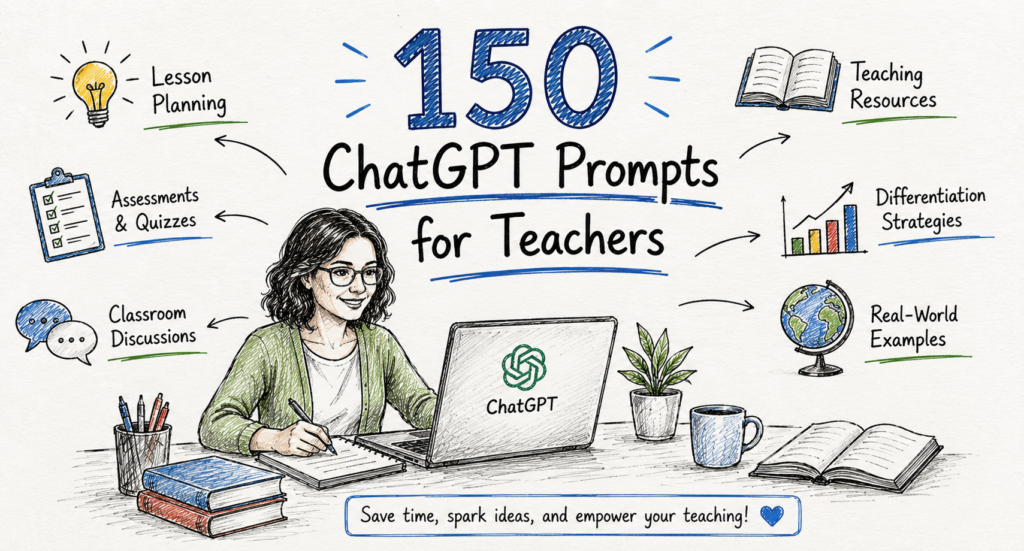
Teaching is one of the most rewarding professions, but it’s also one of the most demanding. Between lesson planning, grading, classroom management, parent communication, curriculum alignment, and professional development, educators often juggle multiple responsibilities every day. Across the United States, many teachers are turning to artificial intelligence tools like ChatGPT to reduce repetitive administrative work and spend more time focusing on what matters most—helping students learn.
When used responsibly, ChatGPT can assist teachers with creating lesson plans, generating classroom activities, designing assessments, writing newsletters, differentiating instruction, and providing fresh ideas for student engagement. It is not a replacement for professional judgment or classroom experience, but it can be a valuable teaching assistant that improves efficiency and sparks creativity.
The quality of ChatGPT’s output depends on the quality of the prompt you provide. Detailed prompts that include grade level, subject, learning objectives, classroom context, and desired outcomes consistently produce more useful and classroom-ready responses.
This guide contains 150 practical ChatGPT prompts for teachers, beginning with 25 prompts focused on lesson planning, classroom preparation, and instructional design.
Important: Always review AI-generated educational materials for accuracy, age appropriateness, curriculum alignment, and compliance with your school’s policies. AI should support—not replace—professional teaching expertise.
Why Teachers Use ChatGPT
Educators use ChatGPT to:
- Create lesson plans
- Develop classroom activities
- Generate quizzes and assessments
- Write parent communications
- Differentiate instruction
- Design project-based learning
- Produce discussion questions
- Create study guides
- Build rubrics
- Save preparation time
By automating repetitive tasks, teachers can devote more attention to personalized instruction, student support, and classroom engagement.
Best Practices for Writing ChatGPT Prompts
To get the best results:
- Specify the grade level.
- Mention the subject.
- Include the learning objectives.
- Reference relevant academic standards when applicable.
- Describe your classroom environment.
- Request structured outputs such as lesson plans, worksheets, or rubrics.
- Ask for differentiated activities to meet diverse learning needs.
- Review all AI-generated materials before sharing them with students.
Lesson Planning & Classroom Preparation Prompts (1–25)
1. Create a Complete Lesson Plan
Prompt
Act as an experienced U.S. educator. Create a 60-minute lesson plan for [subject] at the [grade level] level. Include learning objectives, required materials, instructional activities, guided practice, independent work, assessment methods, and homework.
Best For: Daily lesson planning
2. Write Learning Objectives
Prompt
Generate clear, measurable learning objectives for a lesson on [topic] using action verbs aligned with Bloom’s Taxonomy. Include success criteria students can easily understand.
Best For: Standards-based instruction
3. Design a Weekly Lesson Plan
Prompt
Create a five-day lesson plan for [subject] that builds progressively from foundational concepts to mastery. Include daily objectives, classroom activities, formative assessments, and extension opportunities.
Best For: Weekly planning
4. Create an Engaging Lesson Hook
Prompt
Suggest ten creative lesson hooks that will capture students’ attention within the first five minutes of a lesson about [topic]. Include questions, demonstrations, or real-world examples.
Best For: Student engagement
5. Generate Bell Ringer Activities
Prompt
Create ten bell ringer activities for [subject] that reinforce prior learning, encourage critical thinking, and can be completed within five minutes.
Best For: Class warm-ups
6. Build a Classroom Discussion
Prompt
Develop thought-provoking discussion questions about [topic] that encourage analysis, collaboration, respectful debate, and evidence-based reasoning.
Best For: Classroom discussions
7. Differentiate a Lesson
Prompt
Adapt my lesson on [topic] for advanced learners, students who need additional support, English language learners (ELLs), and students with diverse learning needs.
Best For: Differentiated instruction
8. Create Hands-On Activities
Prompt
Suggest five interactive classroom activities for teaching [topic] using collaborative learning, movement, creativity, and real-world problem solving.
Best For: Active learning
9. Align Lessons to Standards
Prompt
Review this lesson plan and recommend ways to align it with relevant U.S. academic standards while maintaining student engagement and measurable learning outcomes.
Best For: Curriculum alignment
10. Plan a Project-Based Learning Unit
Prompt
Design a project-based learning unit for [subject]. Include the driving question, project milestones, assessment rubric, collaboration opportunities, and presentation ideas.
Best For: PBL instruction
11. Create Cross-Curricular Lessons
Prompt
Develop a lesson that integrates [subject] with [second subject] while promoting interdisciplinary learning and real-world applications.
Best For: Integrated teaching
12. Build Vocabulary Activities
Prompt
Generate engaging vocabulary-building activities for [topic], including word maps, matching exercises, sentence-writing tasks, and collaborative games.
Best For: Literacy development
13. Design Critical Thinking Exercises
Prompt
Create activities that encourage students to analyse, evaluate, and apply concepts related to [topic] instead of simply memorising facts.
Best For: Higher-order thinking
14. Generate Classroom Examples
Prompt
Provide ten age-appropriate, real-world examples that explain [concept] in a way students can easily relate to and remember.
Best For: Concept clarification
15. Create Exit Tickets
Prompt
Develop five exit ticket questions that assess students’ understanding of today’s lesson on [topic] and identify areas needing further review.
Best For: Formative assessment
16. Design Independent Practice
Prompt
Create independent practice activities that reinforce today’s lesson while allowing students to demonstrate understanding at different ability levels.
Best For: Reinforcement
17. Plan Collaborative Learning
Prompt
Design a cooperative learning activity where students work in small groups to solve a problem related to [topic]. Include clear roles, discussion prompts, and success criteria.
Best For: Group work
18. Create Homework Assignments
Prompt
Generate meaningful homework assignments for [grade level] students that reinforce classroom learning without becoming overly repetitive or time-consuming.
Best For: Homework planning
19. Build Review Sessions
Prompt
Create an engaging review lesson for [unit] using games, collaborative activities, practice questions, and formative assessments.
Best For: Exam preparation
20. Adapt Lessons for Online Learning
Prompt
Modify this classroom lesson so it works effectively in an online or hybrid learning environment. Recommend digital tools, interaction strategies, and methods to keep students engaged.
Best For: Remote teaching
21. Create a Semester Curriculum Map
Prompt
Develop a semester-long curriculum map for [subject] at the [grade level] level. Organise major units, learning objectives, assessments, and estimated instructional timelines.
Best For: Long-term planning
22. Generate Enrichment Activities
Prompt
Suggest enrichment activities for students who finish early. Ensure the tasks extend learning, encourage creativity, and connect to the current unit.
Best For: Advanced learners
23. Build Inquiry-Based Lessons
Prompt
Design an inquiry-based lesson where students investigate [topic] through questioning, research, experimentation, and collaborative discussion.
Best For: Student-led learning
24. Plan a STEM Challenge
Prompt
Create a classroom STEM challenge related to [topic]. Include materials, constraints, evaluation criteria, teamwork expectations, and reflection questions.
Best For: STEM education
25. Develop a Complete Weekly Teaching Workflow
Prompt
Act as a veteran instructional coach. Create a complete weekly teaching workflow for a [grade level] [subject] teacher, including lesson preparation, classroom instruction, formative assessment, grading, parent communication, reflection, and planning for the following week.
Best For: Teacher productivity and classroom organisation
Why These Prompts Produce Better Teaching Materials
These prompts consistently deliver more useful results because they:
- Clearly define ChatGPT’s role (such as instructional coach or experienced teacher).
- Specify the grade level, subject, and learning objectives.
- Request structured outputs that are ready to adapt for classroom use.
- Encourage active learning, differentiation, and measurable outcomes.
- Focus on supporting teachers while keeping students at the centre of the learning process.
By replacing placeholders such as [subject], [grade level], and [topic] with your own classroom context, you can generate tailored teaching resources that save time without sacrificing educational quality.