
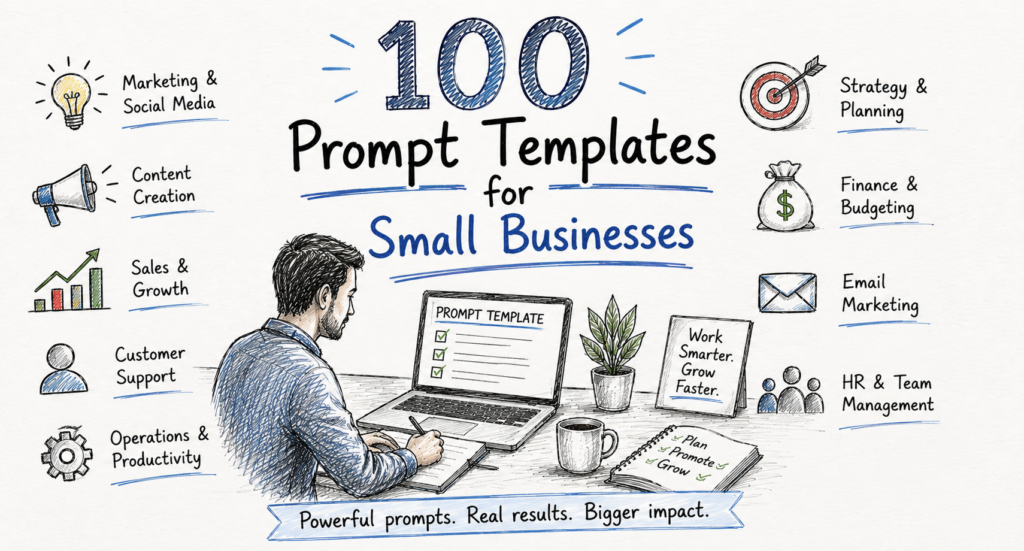
Running a small business means wearing many hats. On any given day, you might be planning marketing campaigns, answering customer emails, managing finances, creating social media content, hiring employees, negotiating with suppliers, and tracking business performance. With limited time and resources, efficiency becomes one of your biggest competitive advantages.
That’s where artificial intelligence (AI) tools like ChatGPT, Claude, Google Gemini, Microsoft Copilot, and Perplexity AI can make a real difference. Instead of starting every task from scratch, business owners can use well-crafted prompts to generate ideas, draft documents, analyze data, create marketing content, and streamline routine operations in minutes.
However, AI only performs as well as the instructions it receives. Generic prompts often produce generic results, while detailed prompts with clear goals, context, and expectations generate much more useful business outputs.
This guide contains 100 practical AI prompt templates for small businesses, beginning with 20 prompt templates focused on business planning, strategy, and growth.
Important: AI should support business decision-making—not replace it. Always review AI-generated content, verify important information, and use your professional judgment before implementing recommendations.
Why Small Businesses Are Using AI
Across the United States, entrepreneurs are using AI to:
Write marketing content
Conduct market research
Generate business ideas
Create social media posts
Draft emails
Improve customer service
Build business plans
Analyze competitors
Write product descriptions
Increase productivity
Used correctly, AI helps business owners spend less time on repetitive administrative work and more time serving customers and growing their companies.
Best Practices for Writing AI Prompts
To get the best results:
Clearly describe your business.
Mention your industry.
Identify your target audience.
State your business goal.
Request a specific format (table, checklist, report, etc.).
Include any constraints such as budget, timeline, or location.
Ask for practical, actionable recommendations.
Review AI-generated content for accuracy before using it.
Business Planning & Strategy Prompt Templates (1–20)
1. Create a Complete Business Plan
Prompt
Act as an experienced small business consultant in the United States. Create a detailed business plan for a [business type] targeting [target audience]. Include an executive summary, market opportunity, products or services, marketing strategy, operations plan, financial overview, potential risks, and a one-year growth roadmap.
Best For: New businesses and startups
2. Conduct Market Research
Prompt
Help me conduct market research for a [business type] operating in [city/state]. Identify customer needs, industry trends, competitors, pricing expectations, and opportunities for differentiation. Present the findings in a structured report.
Best For: Market validation
3. Create Customer Personas
Prompt
Develop three detailed customer personas for my [business type]. Include demographics, goals, challenges, buying behaviour, preferred communication channels, and purchasing motivations.
Best For: Marketing strategy
4. Perform a SWOT Analysis
Prompt
Conduct a SWOT analysis for my [business type]. Identify strengths, weaknesses, opportunities, and threats, then recommend strategic actions to improve long-term competitiveness.
Best For: Business planning
5. Analyze Competitors
Prompt
Act as a competitive intelligence analyst. Compare my business with the top competitors in [industry]. Highlight strengths, weaknesses, pricing strategies, customer experience, and opportunities to stand out.
Best For: Competitive positioning
6. Develop a Pricing Strategy
Prompt
Recommend a pricing strategy for my [product/service] based on market positioning, customer value, competitor pricing, and profitability goals. Explain the reasoning behind each recommendation.
Best For: Pricing decisions
7. Set SMART Business Goals
Prompt
Create five SMART business goals for my [business type] over the next 12 months. Include measurable objectives, timelines, and suggested key performance indicators (KPIs).
Best For: Strategic planning
8. Build a Growth Roadmap
Prompt
Create a 12-month growth roadmap for my [business type]. Include monthly priorities, marketing initiatives, operational improvements, hiring recommendations, and performance milestones.
Best For: Business growth
9. Validate a Business Idea
Prompt
Evaluate my business idea for [product/service]. Assess market demand, customer pain points, competition, revenue potential, challenges, and practical recommendations before launch.
Best For: Startup planning
10. Create a Unique Value Proposition
Prompt
Write a compelling value proposition for my [business type] that clearly explains what makes my business different, the problems it solves, and why customers should choose us.
Best For: Brand messaging
11. Identify New Revenue Streams
Prompt
Suggest ten realistic revenue opportunities for my [business type]. Rank them by implementation difficulty, expected impact, startup cost, and long-term growth potential.
Best For: Business expansion
12. Conduct a Risk Assessment
Prompt
Identify the biggest operational, financial, legal, and market risks facing my [business type]. Recommend practical mitigation strategies for each identified risk.
Best For: Risk management
13. Create a Marketing Budget
Prompt
Build a practical annual marketing budget for my [business type]. Allocate spending across SEO, social media, paid advertising, email marketing, content creation, events, and customer retention.
Best For: Budget planning
14. Plan a New Product Launch
Prompt
Develop a product launch strategy for [product name]. Include audience research, messaging, marketing channels, launch timeline, promotional ideas, KPIs, and post-launch evaluation.
Best For: Product launches
15. Improve Customer Retention
Prompt
Recommend customer retention strategies for my [business type]. Include loyalty programmes, follow-up communications, customer service improvements, and methods to increase repeat purchases.
Best For: Customer loyalty
16. Build a Quarterly Business Review
Prompt
Create a quarterly business review template that summarises financial performance, marketing results, sales metrics, operational improvements, customer feedback, and priorities for the next quarter.
Best For: Business reporting
17. Improve Operational Efficiency
Prompt
Review the typical operations of a [business type] and identify opportunities to reduce costs, automate repetitive tasks, improve workflows, and increase productivity.
Best For: Operations management
18. Develop a Partnership Strategy
Prompt
Recommend strategic partnerships that could help a [business type] grow. Explain the benefits, partnership structure, outreach strategy, and expected business outcomes.
Best For: Business networking
19. Create a One-Page Strategic Plan
Prompt
Develop a one-page strategic plan for my [business type] that includes mission, vision, annual goals, key initiatives, performance metrics, and success indicators.
Best For: Executive planning
20. Build a Complete Small Business Growth Strategy
Prompt
Act as a senior business growth consultant. Create a comprehensive growth strategy for my [business type] in the U.S. market. Include market positioning, customer acquisition, digital marketing, pricing, sales strategy, operational improvements, AI adoption opportunities, customer retention, performance metrics, and a practical 12-month action plan.
Best For: Long-term business success
Why These Prompt Templates Work
These templates consistently generate stronger AI responses because they:
Assign AI a specific expert role, such as business consultant or market analyst.
Provide context about the business, industry, and audience.
Define a clear objective and expected output.
Request structured, actionable recommendations rather than generic advice.
Focus on practical outcomes that small business owners can adapt to their own operations.
To achieve the best results, replace placeholders like [business type], [target audience], and [product/service] with details about your own business. The more relevant information you provide, the more tailored and useful the AI-generated response will be.