
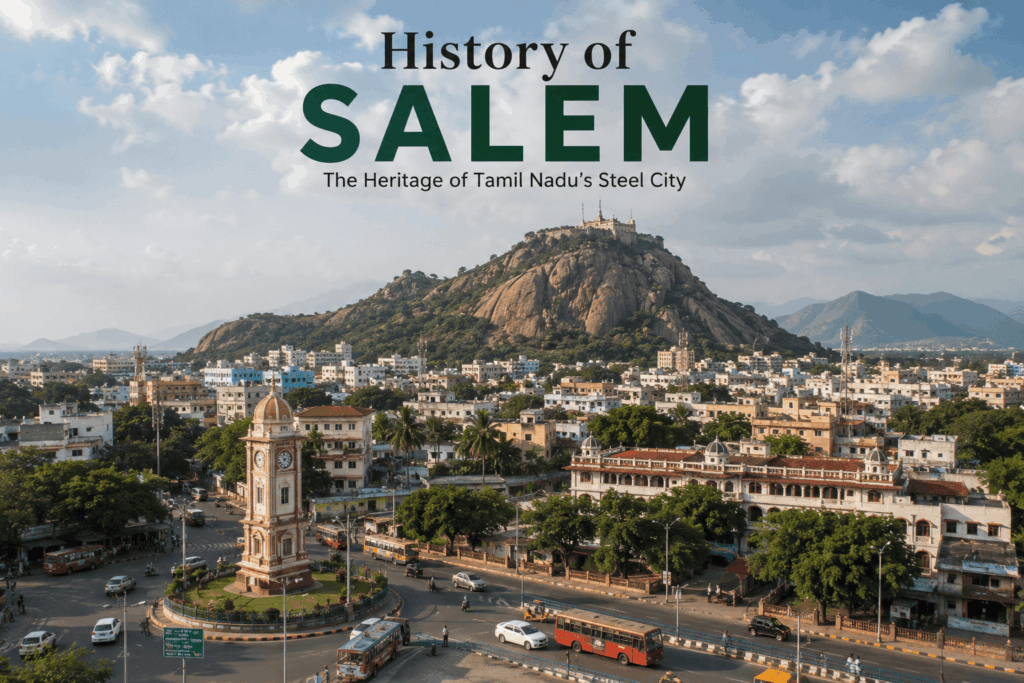
Salem, one of the oldest and most historically significant cities in Tamil Nadu, has played an important role in the cultural, political, and economic development of South India for centuries. Surrounded by picturesque hills such as the Shevaroy, Kanjamalai, Jarugumalai, and Kalrayan Hills, Salem is known today as the Steel City of Tamil Nadu. However, its history extends far beyond modern industries and urban development.
From ancient tribal settlements and Sangam Age trade routes to the rule of the Cheras, Cholas, Pandyas, Vijayanagara Empire, Mysore Kingdom, and the British, Salem has witnessed numerous historical transformations. Its strategic location between western and central Tamil Nadu made it an important centre for agriculture, commerce, military movements, and cultural exchange.
The district is also famous for its temples, forts, ancient inscriptions, mineral wealth, textile industry, and nearby hill station of Yercaud. Over the centuries, Salem evolved into a thriving commercial hub while preserving its rich cultural traditions.
Today, Salem attracts tourists, researchers, students, and history enthusiasts who wish to explore its fascinating past, scenic landscapes, and architectural heritage. For competitive exam aspirants, Salem is an important topic due to its association with major South Indian dynasties, colonial history, and industrial development.
This article explores the remarkable journey of Salem—from its ancient origins to its emergence as one of Tamil Nadu’s leading industrial and cultural centres.
Origin of Salem
The exact origin of the name “Salem” remains a subject of historical discussion.
One popular belief is that the name evolved from the Tamil word **”Sailam”**, meaning a region surrounded by hills. This explanation suits Salem’s geography, as the city is enclosed by several hill ranges.
Another interpretation associates the name with the Chera rulers, who governed parts of the region during ancient times.
Regardless of its linguistic origin, Salem has been an important settlement for many centuries because of its fertile lands, mineral resources, and strategic location.
Early Human Settlements
Archaeological evidence suggests that Salem district has been inhabited since prehistoric times.
Excavations and discoveries have revealed:
Megalithic burial sites
Stone tools
Pottery fragments
Iron implements
Ancient settlements
Hero stones
These findings indicate that early communities practiced agriculture, hunting, iron working, and trade long before organized kingdoms emerged.
The abundance of natural resources made Salem an attractive place for settlement.
Salem During the Sangam Age
During the Sangam Age (approximately 300 BCE–300 CE), Salem formed part of the wider Tamil cultural landscape.
Ancient Tamil literature describes the prosperity of regions surrounding Salem, where agriculture, trade, and craftsmanship flourished.
The area’s fertile plains produced:
Paddy
Millets
Sugarcane
Cotton
Pulses
Merchants transported goods through inland trade routes connecting Salem with important cities such as Karur, Madurai, Kanchipuram, and the western coast.
Its location made it an important commercial link between the Tamil plains and the hill regions.
Rule of the Cheras
The Chera dynasty exercised considerable influence over parts of present-day Salem.
The Cheras encouraged:
Agriculture
Trade
Iron production
Road development
Cultural exchange
The mineral-rich hills surrounding Salem supplied valuable resources for tool making and trade.
The Chera rulers also maintained commercial relations with foreign traders, contributing to the prosperity of the region.
Chola Administration
As the Chola Empire expanded, Salem gradually came under Chola administration.
The Cholas introduced:
Village assemblies
Irrigation projects
Temple construction
Land surveys
Stone inscriptions discovered in and around Salem provide important information about land grants, donations, taxation, and local governance during the Chola period.
Their emphasis on irrigation significantly improved agricultural production.
Pandya Influence
At different periods, the Pandya rulers also controlled parts of Salem.
Competition among the Cheras, Cholas, and Pandyas often resulted in political changes across the region.
Despite these struggles, Salem continued to prosper because of:
Fertile farmland
Trade routes
Skilled artisans
The city remained an important regional centre throughout the medieval period.
Geography and Natural Advantages
One of Salem’s greatest strengths has always been its geography.
The surrounding hills provided:
Natural protection
Iron ore deposits
Forest resources
Water sources
Biodiversity
Meanwhile, fertile plains supported large-scale agriculture.
This combination of natural resources encouraged both economic growth and military importance.
Iron and Mineral Resources
Salem has long been known for its rich deposits of iron ore and minerals.
Historical evidence suggests that iron working existed in the region for centuries.
Ancient blacksmiths produced:
Agricultural tools
Weapons
Household implements
The availability of high-quality iron later contributed to Salem’s emergence as one of India’s important steel-producing regions.
Temples and Religious Heritage
Religion has played a central role in Salem’s cultural history.
Ancient temples became centres of:
Worship
Education
Music
Dance
Community gatherings
Some of the region’s well-known temples include:
Sugavaneswarar Temple
Kottai Mariamman Temple
Kailasanathar Temple
Siddhar temples in surrounding hills
Many temples preserve inscriptions that help historians understand Salem’s political and social history.
Agriculture and Trade
Agriculture formed the backbone of Salem’s economy for centuries.
The region became famous for producing:
Rice
Millets
Cotton
Turmeric
Mangoes
Tapioca
Trade caravans transported these goods to neighbouring kingdoms and coastal ports.
Local markets gradually expanded into thriving commercial centres.
Culture and Traditional Crafts
Salem developed a vibrant cultural identity through centuries of artistic activity.
Traditional occupations included:
Weaving
Pottery
Blacksmithing
Stone carving
Agriculture
Festivals, temple fairs, folk dances, and devotional music strengthened community life across the region.
These traditions continue to thrive in many villages today.
Why Salem Became Important
Several factors contributed to Salem’s historical significance:
Strategic inland location
Rich iron ore deposits
Fertile agricultural land
Active trade routes
Strong dynastic administration
Cultural diversity
Temple heritage
Natural hill fortifications
These advantages allowed Salem to remain prosperous under successive rulers.
Legacy of Ancient Salem
Modern Salem still preserves many reminders of its ancient past.
Visitors can explore:
Historic temples
Hill landscapes
Ancient inscriptions
Archaeological sites
Traditional markets
Cultural festivals
The city’s remarkable blend of history, industry, and natural beauty makes it one of Tamil Nadu’s most fascinating destinations.