
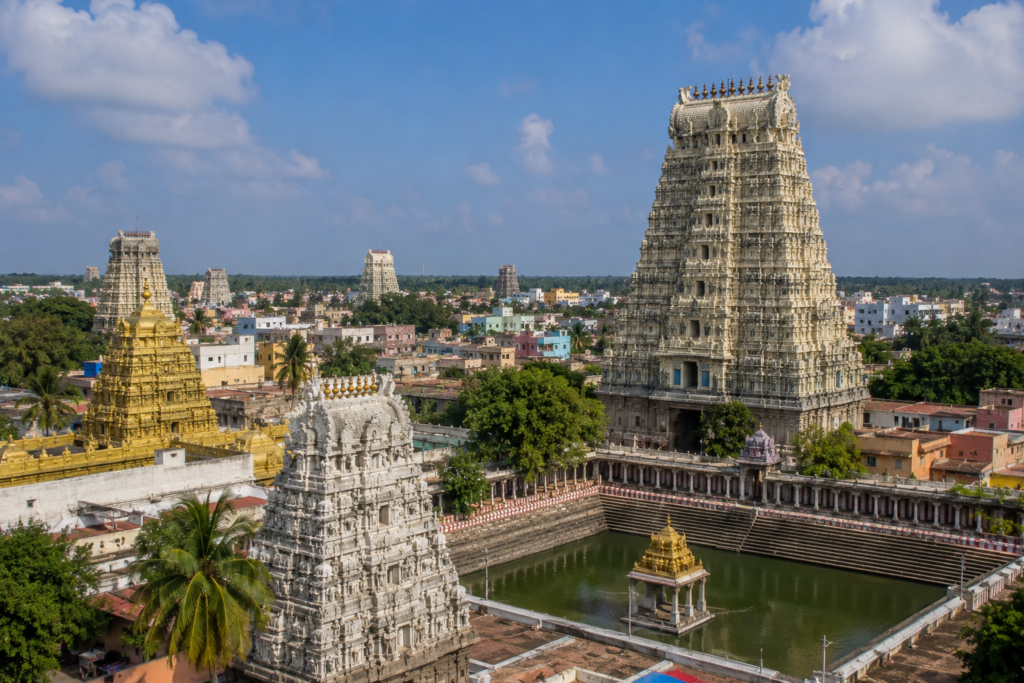
Kanchipuram, often called the **”City of a Thousand Temples”** and the **”Golden City of Temples,”** is one of India’s oldest continuously inhabited cities. Located in the present-day Kanchipuram district of Tamil Nadu, the city has been a renowned centre of religion, education, art, architecture, literature, and trade for more than two thousand years. Revered by Hindus as one of the seven sacred cities (*Sapta Puri*), Kanchipuram occupies a unique place in the cultural and spiritual history of India.
Throughout the centuries, Kanchipuram has served as the capital of powerful dynasties, particularly the Pallavas, whose patronage transformed the city into a magnificent centre of temple architecture and learning. Later, the Cholas, Vijayanagara rulers, Nayaks, and the British contributed to its continued growth and prosperity.
Today, Kanchipuram is famous not only for its ancient temples but also for its world-renowned silk sarees, vibrant festivals, traditional crafts, and rich literary heritage. Pilgrims, tourists, historians, researchers, and students visit the city throughout the year to experience its timeless charm and historical significance.
For competitive exam aspirants, Kanchipuram is an important topic because of its association with the Pallava Empire, Dravidian temple architecture, Tamil culture, and India’s religious history.
This article explores the fascinating journey of Kanchipuram—from its legendary origins and early settlements to its rise as one of South India’s greatest cultural capitals.
The Origin of Kanchipuram
The origins of Kanchipuram are rooted in both mythology and history.
According to Hindu tradition, the city has long been associated with Lord Shiva, Lord Vishnu, and Goddess Kamakshi. Ancient legends describe Kanchipuram as a sacred city where great sages performed penance and where divine blessings were bestowed upon devotees.
One popular belief suggests that the name “Kanchi” refers to a sacred girdle or ornamental belt, symbolizing protection and prosperity. Over centuries, the city became known as Kanchipuram, meaning the prosperous and sacred settlement of Kanchi.
Although mythology adds spiritual significance, archaeological evidence confirms that the region has been inhabited since ancient times.
Early Settlements in Kanchipuram
Archaeological discoveries indicate that human settlements existed around Kanchipuram long before it became an imperial capital.
Excavations have revealed:
Ancient pottery
Iron tools
Coins
Brick structures
Temple foundations
Inscriptions
Its location along important trade routes connecting northern and southern India helped the city grow into an important commercial and cultural centre.
The fertile lands surrounding the Vegavathi River supported agriculture, while merchants contributed to urban development.
Kanchipuram During the Sangam Age
Kanchipuram finds mention in early Tamil literature and is believed to have flourished during the Sangam Age (approximately 300 BCE–300 CE).
During this period, the city developed as:
A centre of trade
A place of learning
A religious settlement
A political centre
Tamil literary works praise the prosperity of Kanchipuram and describe its bustling streets, flourishing markets, and scholarly atmosphere.
Merchants, artisans, poets, and scholars from different regions visited the city, enriching its cultural diversity.
Rise of the Pallava Empire
The greatest chapter in Kanchipuram’s history began with the rise of the Pallava dynasty.
Between the 4th and 9th centuries CE, the Pallavas established Kanchipuram as their imperial capital.
Under rulers such as **Mahendravarman I**, **Narasimhavarman I (Mamalla)**, and **Narasimhavarman II (Rajasimha)**, the city emerged as one of the most important political and cultural centres in South India.
The Pallavas promoted:
Temple construction
Literature
Education
Architecture
Religious tolerance
Their achievements transformed Kanchipuram into a world-renowned centre of art and learning.-
Kanchipuram as a Centre of Learning
Ancient Kanchipuram was often compared with great centres of education like Nalanda.
Students from different parts of India travelled here to study subjects such as:
Sanskrit
Tamil literature
Grammar
Mathematics
Astronomy
Religion
Both Hindu and Jain scholars cotributed to the city’s intellectual life, making Kanchipuram one of the leading educational centres of ancient India.
Religious Importance
Kanchipuram holds a unique position in Indian spirituality because it is sacred to both Shaivites and Vaishnavites.
The city is home to numerous temples dedicated to:
Lord Shiva
Lord Vishnu
Goddess Kamakshi
Pilgrims consider Kanchipuram one of the holiest destinations in India.
Religious festivals celebrated throughout the year continue traditions that have existed for centuries.
Kailasanathar Temple
One of the earliest and finest examples of Dravidian temple architecture is the Kailasanathar Temple.
Constructed during the reign of **Narasimhavarman II (Rajasimha)** in the 8th century CE, the temple is dedicated to Lord Shiva.
Important architectural features include:
Sandstone construction
Beautiful sculptures
Intricate carvings
Miniature shrines
Early Dravidian design
The temple influenced the development of later South Indian temple architecture.
Historians regard it as one of the greatest surviving monuments of the Pallava period.
Vaikuntha Perumal Temple
Another architectural masterpiece built by the Pallavas is the Vaikuntha Perumal Temple.
Dedicated to Lord Vishnu, the temple is famous for:
Multi-storeyed sanctum
Stone sculptures
Historical inscriptions
Detailed carvings
Its inscriptions provide valuable information about Pallava administration and royal history.
Trade and Commerce
Kanchipuram prospered because of active trade.
Merchants dealt in:
Silk textiles
Cotton fabrics
Precious stones
Gold ornaments
Agricultural products
Handicrafts
Trade routes connected Kanchipuram with:
Andhra Pradesh
Karnataka
Sri Lanka
Southeast Asia
Commercial prosperity supported temple construction and urban development.
Art and Architecture
The Pallavas revolutionized South Indian architecture.
Their contributions include:
Rock-cut temples
Structural stone temples
Monumental sculptures
Decorative pillars
Temple inscriptions
These innovations laid the foundation for later Chola, Pandya, and Vijayanagara architectural styles.
The influence of Pallava architecture can still be seen across Tamil Nadu.
Literature and Culture
Royal patronage encouraged the growth of literature in Sanskrit and Tamil.
Poets, philosophers, and scholars flourished in Kanchipuram’s vibrant intellectual environment.
The city became known for:
Classical learning
Temple music
Sculpture
Dance
Religious philosophy
Its cultural achievements continue to inspire scholars and artists today.
Why Kanchipuram Became Famous
Several factors made Kanchipuram one of India’s greatest historical cities:
Capital of the Pallava Empire
Centre of temple architecture
Sacred pilgrimage destination
Educational hub
Prosperous trade
Rich literary traditions
Artistic excellence
Religious harmony
Together, these qualities earned Kanchipuram an enduring place in India’s cultural history.
Legacy of Ancient Kanchipuram
Modern Kanchipuram preserves its ancient heritage through:
Historic temples
Traditional silk weaving
Religious festivals
Temple inscriptions
Classical architecture
Living cultural traditions
Millions of visitors continue to experience the city’s unique blend of history, spirituality, and craftsmanship.